



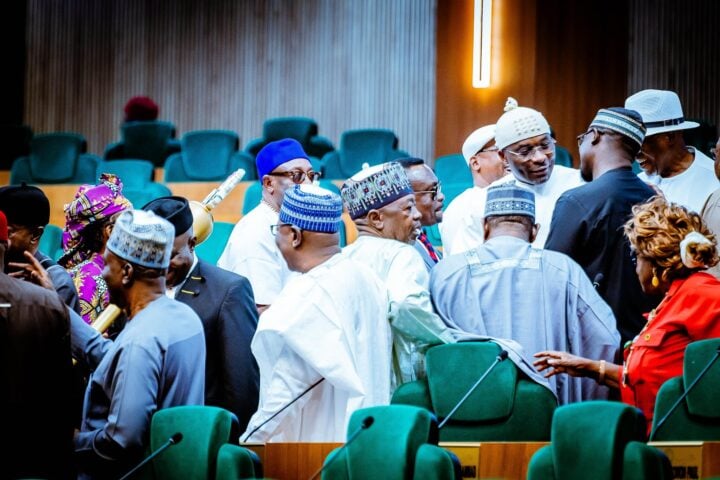
Opposition lawmakers in the house of representatives have staged a walkout from plenary over the Electoral Act amendment bill.
The lawmakers exited the chamber after their attempt to make electronic transmission of election results mandatory without manual collation serving as a fallback where technology fails.
The fresh amendment to section 60(3) provides that: “The Presiding Officer shall electronically transmit the resalts from cach polling unit to REV portal and such tiaasmission shall be done after the prescribed Form ECSA has been signed and stamped by the Presiding officer and/or countersigned by the candidates or Polling agents where available at the Polling Unit. Provided that if the electronic transmission of the result fails as a result of communication failure and it becomes impossible to transmit the result contained in forn: EC&A signed and stamped by the Presiding Officer and countersigned by the candidates or polling agents where available at the polling unit, the form EC&A shall remain the primary source of collation and declaration of the result”.

However, opposition lawmakers insisted that the provision should end after the first paragraph — effectively removing the clause that allows manual collation in the event of electronic transmission failure.
BACKGROUND
In December, the lower legislative chamber amended the Electoral Act and adopted a proposal mandating the real-time transmission of election results to the Independent National Electoral Commission’s result viewing portal (IReV).
The approved clause states that the “presiding officer shall electronically transmit the results from each polling unit to the IReV portal in real time, and such transmission shall be done after the prescribed form EC8A has been signed and stamped by the presiding officer and/or countersigned by the candidates or polling unit agents, where available at the polling unit”.
Early this month, the senate passed the Electoral Act amendment bill, but rejected the proposal for real-time electronic transmission of election results — a move that has sparked protests and calls for lawmakers to reverse the decision.
Last week, the upper legislative chamber rescinded its decision and approved the electronic transmission of election results to IReV, with a clause that manual collation should serve as a fallback if technology fails.
THE ROWDY SESSION
During Tuesday’s plenary, the house turned rowdy as lawmakers disagreed over a motion seeking to rescind the passage of the Electoral Act amendment bill.
Francis Waive, chairman of the house committee on rules and business, moved a motion for the chamber to reverse its decision on the bill which was passed in December.
When Tajudeen Abbas, speaker of the house, put the motion to a voice vote, the “nays” were louder than the “ayes”, but he ruled in favour of the “ayes”.
The ruling triggered protests from lawmakers, who began hollering in objection. Abbas subsequently called for an executive session, but the proposal was also rejected.
Despite the resistance, the speaker moved the house into an executive session.
THE DEBATE AND WALK OUT

When the house reconvened after about two hours of executive session, Adebayo Balogun, chairman of the committee on electoral matters, moved a motion for the consideration of the bill at the committee of the whole.
As he began outlining the clauses of the proposed legislation, Benjamin Kalu, the deputy speaker and chairman of the committee of the whole, interrupted him and directed him to restrict himself to reading the bill’s long title.
Kalu subsequently proceeded to read clauses one to 10 together, prompting protests from lawmakers who demanded a clause-by-clause consideration.
He continued regardless, and the house descended into a rowdy session that lasted over 15 minutes.

After restoring order, Kalu began calling the clauses individually, but some lawmakers objected, saying they did not have copies of the bill.
He continued, however, and when he reached section 60, which deals with the electronic transmission of results, lawmakers called for an amendment, but he declined and proceeded.
Protest erupted again and persisted until Kalu returned to the section.
Bamidele Salam, chairman of the committee on public accounts, moved that the clause of manual collation should be removed, but lawmakers rejected the amendments when Kalu called for a voice vote.
Another opposition lawmaker proposed that in cases where the results in form EC8A conflicts with results uploaded on IReV, the IReV version should prevail, but the amendment was rejected when Kalu subjected it to a voice vote.
Ikenga Ugochinyere, a lawmaker from Imo, moved that both electronic transmission and manual collation of results should have equal legal effect, but the proposal was rejected.

The opposition lawmakers subsequently walked out of plenary.
OTHER AMENDMENTS
The lawmakers amended section 28(1) of the Electoral Act, reducing the deadline for INEC to issue a notice of election from 360 days to 300 days.
The lawmakers also amended section 84 of the Electoral Act, which provides that political parties may nominate candidates through direct primaries, indirect primaries, or consensus — limiting the options to direct primaries and consensus.
Stay ahead with the latest updates!
Join The Podium Media on WhatsApp for real-time news alerts, breaking stories, and exclusive content delivered straight to your phone. Don’t miss a headline — subscribe now!
Chat with Us on WhatsApp