
In echoes of Waiting for Godot, the absurdist classic by Irish playwright Samuel Beckett, Nigerians spent Monday in anxious anticipation of a verdict that never came. As of 6 pm in Nigeria, which is the same as the winter time in Switzerland, the home office of FIFA has no information. Official hours have already ended.
Across social media platforms, radio stations and football circles, February 16 had been widely assumed to be “judgment day” in the protest lodged by the Nigeria Football Federation (NFF) against the DR Congo Football Federation (FECOFA) over alleged player ineligibility in the decisive African play-off for the 2026 World Cup.
Yet by nightfall, there was no official communication from FIFA, no confirmation of a ruling, and no clarity on how the date had become associated with a final decision.

The Substance of the Protest
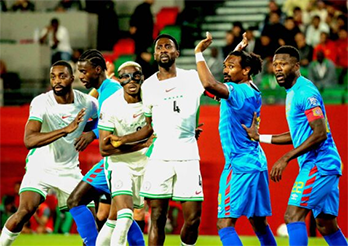
The NFF’s petition, formally filed on December 15, 2025, challenges the eligibility of at least six DR Congo players who featured in the November 2025 African play-off final in Rabat, Morocco. Among those specifically named are Aaron Wan-Bissaka and Axel Tuanzebe, both of whom have previously represented England at youth levels before switching international allegiance.
Nigeria’s argument rests on two principal pillars:
- Irregular switches of nationality: The NFF questions whether the players’ changes of international allegiance complied fully with FIFA’s statutes governing eligibility.
- Dual citizenship concerns: Nigeria further contends that the players hold European passports, which it claims conflicts with Congolese nationality laws prohibiting dual citizenship, and alleges that clearances may have been secured through misrepresentation.
The match itself ended 1–1 after regulation time, with DR Congo prevailing 4–3 on penalties, thereby eliminating the Super Eagles from the African pathway to the 2026 World Cup.
FECOFA has firmly denied the allegations, insisting that the players satisfied FIFA’s connection requirements and were lawfully issued Congolese documentation.
Legal Complexity Beyond the Pitch
At the heart of the dispute lies a familiar tension between domestic nationality laws and FIFA’s eligibility framework.
Under FIFA regulations, players may switch national associations if they meet defined criteria related to ancestry, birthplace, or residency, and provided they have not been cap-tied at senior competitive level.
However, FIFA’s system does not automatically defer to the internal citizenship restrictions of sovereign states in the same manner as national courts might.
This creates a grey area: even if a country’s constitution restricts dual nationality, the determining authority for international football eligibility remains FIFA’s Players’ Status Committee and, where necessary, the FIFA Disciplinary Committee.
Legal analysts note that for Nigeria to prevail, it would need to demonstrate not only inconsistencies in domestic law but also procedural breaches within FIFA’s transfer-of-association process, a far higher evidentiary threshold.
Should FIFA rule in Nigeria’s favour, the consequences would be seismic.
The Super Eagles could be reinstated into the Intercontinental Play-off tournament scheduled for next month in Mexico. In that event, Nigeria would likely face the winner of the Jamaica versus New Caledonia fixture for a final berth at the 2026 World Cup.
Such a ruling would not only alter the competitive landscape but also carry significant financial and reputational implications. Participation in the intercontinental play-off offers substantial revenue opportunities and the prospect of global exposure ahead of a World Cup jointly hosted by the United States, Canada and Mexico.
Conversely, a dismissal of the protest would close Nigeria’s last competitive route to the tournament, intensifying scrutiny of administrative and technical decisions that led to elimination on the field.

For now, uncertainty prevails.
The absence of official confirmation regarding any verdict underscores the opaque nature of football’s judicial processes, where timelines are rarely publicised and rulings often emerge without advance notice.
As Monday ended without resolution, the atmosphere mirrored Beckett’s enduring metaphor — anticipation without arrival.
For Nigeria, the question remains not only whether justice will be served, but when — and in whose favour.

Stay ahead with the latest updates!
Join The Podium Media on WhatsApp for real-time news alerts, breaking stories, and exclusive content delivered straight to your phone. Don’t miss a headline — subscribe now!
Chat with Us on WhatsApp