


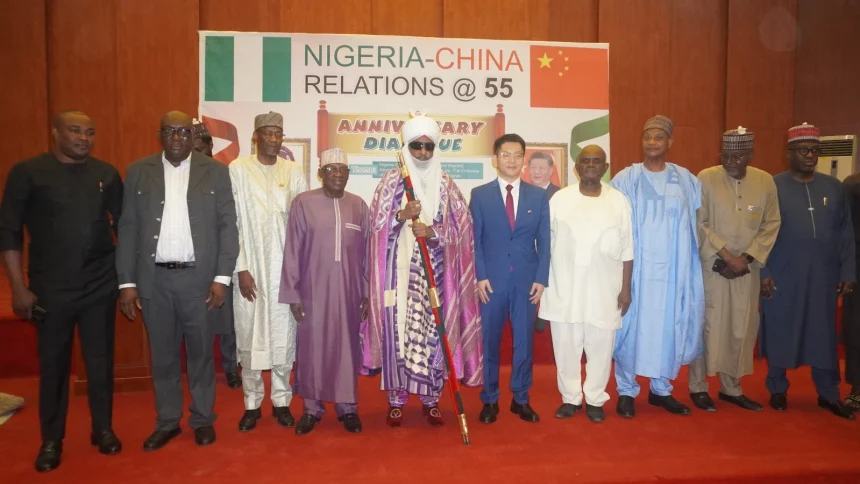
Nigeria and China celebrated 55 years of diplomatic relations on Wednesday in Abuja, reflecting their enduring partnership in trade, investment, and infrastructure development.
At the anniversary dialogue themed ‘Nigeria/China at 55 and Beyond,’ officials from both countries highlighted the importance of deepening economic collaboration, promoting domestic industrial growth, and pursuing strategic engagement to ensure Nigeria fully benefits from Chinese investments and the African Continental Free Trade Agreement.
On February 10, 1971, China and Nigeria established diplomatic relations, embarking on a journey of more than half a century marked by solidarity and mutual support.

In his remarks, the Emir of Kano, Mohammed Sanusi II, called for a strategic reset in Nigeria’s relationship with China, describing the 55-year diplomatic partnership as a “work in progress” with “unfinished business.”
Reflecting on the long history of bilateral ties, Sanusi traced his personal connection to the relationship back to 1971, when his father was appointed Nigeria’s first ambassador to China.
He recalled hearing as a schoolboy that his father had been posted to Beijing at a time when China was still largely impoverished and emerging from internal upheaval.
The emir noted that China’s transformation over the past five decades offered lessons for Nigeria, pointing to “dramatic gains in education and poverty reduction.”
He stressed the strategic importance of deploying seasoned diplomats to key global posts as part of Nigeria’s foreign policy.
Sanusi referenced the appointment of George Bush, later United States President, as the US representative in China during a critical period in bilateral relations.
“A nation’s posts are important for strategic purposes. So you have someone like George Bush, who was so high up there because China was so important, America sent their most experienced and trusted intelligence officer to be the most junior diplomat there. And China sent theirs to America,” he said.
The emir contrasted this with what he described as a misplaced preference among some diplomats for more glamorous Western capitals over strategically important destinations.
“Now, if you send a diplomat to a strategic African country, he would rather go to Paris or London because they are up to the glamour, not the strategy.
“So it is also a learning point for me.” He emphasised that diplomatic deployments must align with long-term national interests, particularly in emerging geopolitical realities.
“You could see where you should locate yourself as a country in the whole sphere of global geopolitics,” he said, urging policymakers to think beyond immediate prestige and focus on strategic engagement.
The emir stressed that while infrastructure development by Chinese firms in Nigeria was welcome, the country must prioritise domestic production and industrialisation.
“It’s good for Chinese businesses. It’s not the best for the Nigerian economy, because we would like to produce,” he said, lamenting the decline of Nigeria’s textile and manufacturing industries.

Sanusi warned that without a deliberate strategy, Nigeria could lose out to smaller West African countries in attracting Chinese manufacturing investments under the African Continental Free Trade Agreement.
“If we are not careful as a country, the Chinese will come and set up factories in Cotonou, in Accra, and produce not for the market in Benin, which is very small, but for Nigeria.
“We need to make sure, since we are the biggest market for the African content of the free trade agreement, we need to make sure that we are the hub for manufacturing and production,” he said.
Sanusi urged the Federal Government to pursue focused economic diplomacy that prioritises power plants, factories and job creation.

In his address, the Chargé d’Affaires of the Chinese Embassy in Nigeria, Zhou Hongyou, described the occasion as significant for both nations.
Zhou, who represented the Chinese Ambassador to Nigeria, Yu Dunhai, reflected on the history of the relationship, stating, “For 55 years, China and Nigeria have been trusted friends who stand together through thick and thin,” noting that “Every milestone has rested on the principles of mutual respect and win-win cooperation.”
He described both nations as “a key force in Global South cooperation.”
Highlighting economic ties, Zhou said, “Nigeria has become China’s largest engineering contracting market in Africa and a vital partner in trade and investment,” adding that recent trade and investment figures “vividly illustrate the dynamism and vast potential of our partnership.”
He referred to the 55th anniversary as a “new milestone,” emphasising the importance of recent high-level engagements between the two countries.
“China places great importance on its relationship with Nigeria and stands ready to work closely with the Nigerian side,” Zhou said, stressing the need to “jointly advance modernisation, and build a China–Nigeria community with a shared future.”

On global affairs, he stated, “We will stand for fairness and justice, oppose unilateralism and bullying, and address global challenges together.”
Looking ahead, he said, “China stands ready to work hand in hand with Nigeria to implement the important consensus of our two Heads of State.”
Also, the Minister of Foreign Affairs Amb. Yusuf Tuggar called for a strengthened economic partnership between Nigeria and China while stressing the opportunities presented by China’s Zero Tariff Treatment and its potential to accelerate Nigeria’s economic diversification.
Tuggar, represented by the Director, Asia, and Pacific Division at the Ministry, Amb. Muhammed Haidara, described the theme of the dialogue as “a moment of genuine possibility. It challenges us to imagine a future where trade is not simply an exchange of goods, but an exchange of opportunities; where market access becomes a bridge to industrial strength; and where cooperation becomes a catalyst for shared prosperity.”
Since establishing diplomatic ties in 1971, Nigeria and China have developed a partnership spanning infrastructure, technology, investment, and trade.
Tuggar said, “China stands today as one of Nigeria’s most significant partners. Nigeria, in turn, remains a vital anchor for China in Africa — a nation of scale, ambition, and unyielding entrepreneurial spirit.”
Acknowledging the challenges ahead, the minister said, “Opportunities do not convert themselves into outcomes. Nigeria must confront the constraints that limit export competitiveness — from infrastructure and logistics to standards, certification, and market intelligence.”
He highlighted ongoing government reforms aimed at enhancing port efficiency, trade facilitation, export financing, and quality assurance.
The Director, Centre for China Studies, Charles Onunaiju said, “At 55 years, Nigeria and China are considerably accomplished in their bilateral cooperation and now, at a crucial historical starting point. This simply means that, even though they have traversed a very productive trajectory and are a good example of a respectable and mutually beneficial international cooperation, what is ahead is even greater.”
Stay ahead with the latest updates!
Join The Podium Media on WhatsApp for real-time news alerts, breaking stories, and exclusive content delivered straight to your phone. Don’t miss a headline — subscribe now!
Chat with Us on WhatsApp