



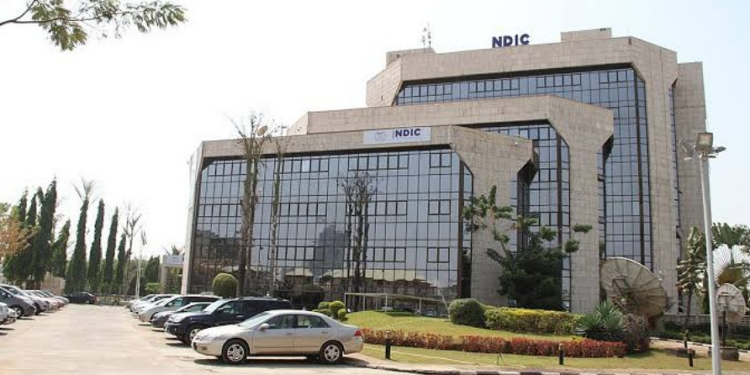
The Nigeria Deposit Insurance Corporation (NDIC) says it does not rely on government bailouts to reimburse depositors in the event of a bank failure.
Instead, the NDIC uses the Deposit Insurance Fund (DIF), which is primarily funded through premiums paid by licensed deposit-taking banks.
The clarification was made by Mr. Thompson Oludare Sunday, the Managing Director and Chief Executive Officer of the NDIC, during a presentation at the 37th Enugu International Trade Fair.

The NDIC’s statement aimed to reassure Nigerians that their funds are protected without burdening the national budget.
What NDIC is saying
Represented by Mrs. Gimbo Hawa, Director at the NDIC, Mr. Sunday emphasized that the corporation is equipped to handle payouts from the DIF swiftly, avoiding the lengthy bureaucratic processes that would typically be associated with seeking government assistance.
- “This system ensures that the Corporation can respond swiftly without straining the national budget,” he said.
Sunday also highlighted that the NDIC’s coverage now protects about 99% of depositors across Nigeria’s banking system.
In 2024, the coverage limits were adjusted to better reflect current economic conditions. For example, depositors in Deposit Money Banks, Mobile Money Operators, and Non-Interest Banks now have coverage up to N5 million, while Microfinance and Primary Mortgage Bank depositors are covered for up to N2 million.
Get up to speed
The Deposit Insurance Premium, paid by deposit-taking banks, is a statutory requirement to ensure that the NDIC can guarantee the protection of depositors up to the maximum insured amount (currently N5 million) in case of a bank’s failure.
This payment helps to fund the DIF, which allows the NDIC to act quickly and ensure depositors are compensated without delays or reliance on government funds.
However, in a statement in December, Mr. Sunday raised concerns about the NDIC’s ability to build a robust DIF due to the mandatory fiscal deductions, such as the 50% cost-to-income policy.
These mandatory payments are affecting the NDIC’s flexibility, as they limit the available funds needed to strengthen the DIF.
The NDIC has sought exemptions from these mandatory fiscal remittances to ensure it can continue effectively protecting depositors.
More insights
During the meeting at the Enugu International Trade Fair, Mr. Sunday also discussed the role of technology in streamlining claims processing.
He noted that the Bank Verification Number (BVN) system enables quick reimbursements, with NDIC using alternative accounts linked to depositors’ BVNs to credit customers within days after a bank failure.
For depositors who have balances exceeding the insured limits, Mr. Sunday explained that their funds are not lost.
Instead, they are compensated through liquidation dividends, which come from the recovery of debts owed by the failed institution, the sale of its assets, and the realization of its investments.

What you should know
In line with its mission to protect depositors, the NDIC recently made a second liquidation dividend payment of N24.3 billion to depositors of the defunct Heritage Bank.
- These funds were released after the Central Bank of Nigeria (CBN) revoked Heritage Bank’s operating license in June 2024.
- The NDIC’s ability to make such payments was made possible by successful debt recovery, asset disposal, and investment realization efforts.
- Mr. Sunday emphasized that these developments further highlight the NDIC’s commitment to safeguarding the financial interests of Nigerians, ensuring that the banking system remains stable and transparent, even during difficult times.
Stay ahead with the latest updates!
Join The Podium Media on WhatsApp for real-time news alerts, breaking stories, and exclusive content delivered straight to your phone. Don’t miss a headline — subscribe now!
Chat with Us on WhatsApp