Israel began attacking Hezbollah in Lebanon early Monday, shattering a fragile truce that had been in place for about a year and threatening to destabilize the region, as both the United States and Israel ramped up strikes on Iran.
The Israeli military said it was responding to attacks from Hezbollah, the Iran-backed militant group. The group took responsibility for the attacks and said it was acting to avenge the death of Ayatollah Ali Khamenei. Iran’s supreme leader was killed on Saturday in a joint U.S. military operation, dying in an Israeli missile strike based on U.S. intelligence.
In the second day of intense airstrikes and bombing runs on Iran, the United States and Israel hit more than 2,000 targets, while Iran launched hundreds of missiles and drones against Israel and Persian Gulf countries.

One strike killed three U.S. soldiers at a base in Kuwait. President Trump expressed condolences for the slain American troops and predicted there would be more causalities in the coming days. “Sadly, there will likely be more before it ends,” he said. “That’s the way it is. Likely be more.”
In an interview with The New York Times, the president said the United States intended to keep up the attack on Iran for “four or five weeks,” but he didn’t lay out a clear plan for how power might be transferred to a new government. In a video on Sunday, Mr. Trump repeated his calls for the Iranian people to take over, but later refused to say how — or if — his administration would defend them.
Amid fears of a wider conflagration with no clear endgame, Mr. Trump said that Iran’s new leadership had let him know they wanted to speak to him and that he was willing to do so. But early Monday, Ali Larijani, Iran’s top national security official, said on social media that the Islamic Republic would not negotiate with the United States.
The three U.S. troops killed in action in Kuwait, who were not identified, were the first Americans to die in the war with Iran. At least nine people were killed in a strike in central Israel, the country’s worst casualty event since the start of the conflict. At least five people were killed in the United Arab Emirates, Kuwait and Bahrain, which all host U.S. military bases, and four people were killed in Syria, according to official reports tallied by The New York Times.
The Israeli military said on Sunday that it had struck Iranian missile launchers, air defense systems, missile launchers, plus government headquarters and command centers. The United States kept up a barrage of strikes on Sunday, targeting Iran’s ballistic missile program and trying to sink the Iranian Navy, a U.S. Central Command official said. U.S. forces struck Iran’s “hardened” ballistic missile facilities and destroyed the headquarters of the Islamic Revolutionary Guards Corps and sank at least one warship, the military said.
Iranians received text messages early Sunday from the armed forces warning them against protesting. Any actions seen as disrupting security would be “met with the iron fist” of the Revolutionary Guards,” read the message, which was viewed by The Times.
Here’s what else to know:
- Oil tanker ablaze: Videos verified by The Times showed an oil tanker, the Skylight, ablaze off the coast of Oman on Sunday. It was one of three ships in the Persian Gulf that reported coming under attack after Iran’s Revolutionary Guards Corps claimed it had targeted U.S. and British tankers in the region.
- School death toll: Iranian state media reported that dozens of children had been killed at a girls’ elementary school near a naval base. The death toll at Shajarah Tayyebeh school in southern Iran rose to at least 115 people on Sunday, according to Iranian state and state-affiliated media. It appears to be one of the worst mass casualty events of the American-Israeli bombing campaign so far.
- American casualties: The U.S. Central Command said that, in addition to the three service members killed, several other troops “sustained minor shrapnel injuries and concussions and are in the process of being returned to duty.”
- Iranian succession: Iran’s top national security official, Ali Larijani, announced on Sunday that an interim committee would run the country until a successor to the supreme leader was chosen. The Israeli strikes killed several other senior Iranian figures, Iranian state media said. The power to choose a new supreme leader rests with the Assembly of Experts, a conservative body of clerics.
- Shipping effects: The fighting shut down shipping through the Strait of Hormuz, the conduit for one-fifth of the world’s oil supply, according to shipping companies and Tasnim, Iran’s semiofficial state media. The shipping company Maersk said it was halting some shipping through the Red Sea, hundreds of miles to the west.
March 2, 2026, 1:43 a.m. ET19 minutes ago
President Joseph Aoun of Lebanon condemned the launching of rockets from Lebanese territory, writing in a post on X that it undermined the efforts by the Lebanese government to “to keep Lebanon away from the dangerous military confrontations taking place in the region.”
Using Lebanon as a platform for wars “that have nothing to do with us will expose our homeland, once again, to dangers,” he wrote, adding that the country was “still working to heal the wounds” from the height of the last escalation between Hezbollah and Israel in 2024.
March 2, 2026, 1:32 a.m. ET29 minutes ago
Eyal Zamir, the Israeli military chief of staff, said Israelis should “prepare for many prolonged days of combat ahead” after Israel launched attacks on Hezbollah overnight. The wide-scale Israeli attacks in Lebanon followed rocket fire from the Iranian-backed militia at Israeli territory.


March 2, 2026, 1:04 a.m. ET58 minutes ago

Iranian attacks in the Gulf in retaliation for the American-Israeli campaign continued this morning. People in Bahrain, Qatar, and the United Arab Emirates reported hearing loud explosions early Monday. Air-raid sirens sounded in Bahrain, warning of impending attack, the country’s interior ministry said. Iran says it is targeting U.S. bases in the Gulf, but its drones have also hit targets like hotels and international airports, killing and wounding civilians.
March 2, 2026, 12:23 a.m. ET2 hours ago
The Israeli military just said it had begun launching an additional wave of strikes against Hezbollah in Lebanon, after the widening escalation expanded there overnight.

March 2, 2026, 12:20 a.m. ET2 hours ago

An unmanned drone appears to have caused minor damage at a British Air Force base in Cyprus, a government spokesman said on social media. The spokesman, Konstantinos Letymbiotis, did not specify the origins of the drone or the nature of the incident at the Akrotiri base, but said it happened shortly after midnight. Britain operates sovereign military bases on the mediterranean island under a 60-year-old agreement.
March 2, 2026, 12:14 a.m. ET2 hours ago
Residents of Jerusalem were awakened right at 7 a.m. on Monday by warning alerts, followed by sirens, followed by the dull blasts of what sounded like missile interceptors overhead.
March 1, 2026, 11:42 p.m. ET2 hours ago
Iran’s top national security official said the country will not negotiate with the United States. Ali Larijani’s social media post referenced a Wall Street Journal report that, citing U.S. and Arab officials, said he had made a fresh attempt to resume nuclear talks with Washington. President Trump also said on Sunday that Iran’s new leadership had let him know they wanted to speak to him and that he was willing to do so, but Larijani’s post seemed to contradict that.

March 1, 2026, 11:24 p.m. ET3 hours ago

Iranians received a text message from a verified Revolutionary Guards number early Sunday morning warning them against taking to the streets to protest. “Any action that disrupts security will be viewed as cooperation with the enemy and will be met with the iron fist of the intelligence wing of the revolutionary guards,” read the message, which was viewed by The New York Times.
March 1, 2026, 11:07 p.m. ET3 hours ago
One person was killed and two others were seriously injured in Bahrain after debris from an intercepted missile fell onto a foreign-owned ship in Salman Industrial City and sparked a fire, the country’s ministry of interior said on social media early Monday.
March 1, 2026, 10:31 p.m. ET4 hours ago
Javier HernandezReporting from Tokyo
Japan’s prime minister, Sanae Takaichi, on Monday urged Iran to cease its attacks on neighboring countries and to seek a “diplomatic solution.” “We will continue to make all necessary diplomatic efforts, working with the international community, to quickly de-escalate the situation,” she said during an appearance before Parliament.
In her carefully worded comments, Takaichi did not address Trump’s decision to strike Iran. Japan is concerned that a prolonged conflict could wreak havoc on trade routes and disrupt imports of oil and liquefied natural gas.
March 1, 2026, 10:22 p.m. ET4 hours ago
Fighting between Israel and Hezbollah reignites as Iran war expands.

Sirens sounded in northern Israel not long after midnight, early on Monday morning. Within hours, explosions rocked the outskirts of Lebanon’s capital, Beirut. And a fragile truce was broken.
The Israeli military announced that it had begun striking Hezbollah targets in Lebanon early Monday after projectiles were launched from Lebanon into Israel. No injuries or damage had been reported, but it was the first such attack since the cease-fire between Israel and Lebanon in November 2024 led to the official end of conflict with Hezbollah, according to Israel’s public broadcaster.
Hezbollah took responsibility for the strikes in a statement, saying it was acting in response to repeated Israeli attacks and to avenge the death of Ayatollah Ali Khamenei, Iran’s supreme leader and a vital patron for the Lebanese militant group. He was killed on Saturday in a strike on his compound in Tehran in the U.S.-Israeli war against Iran.
Israel accused Hezbollah of “operating on behalf of the Iranian regime.”
“Hezbollah opened a campaign against Israel overnight, and is fully responsible for any escalation,” Lt. Gen. Eyal Zamir, the Israeli military’s chief of staff, said in a statement.
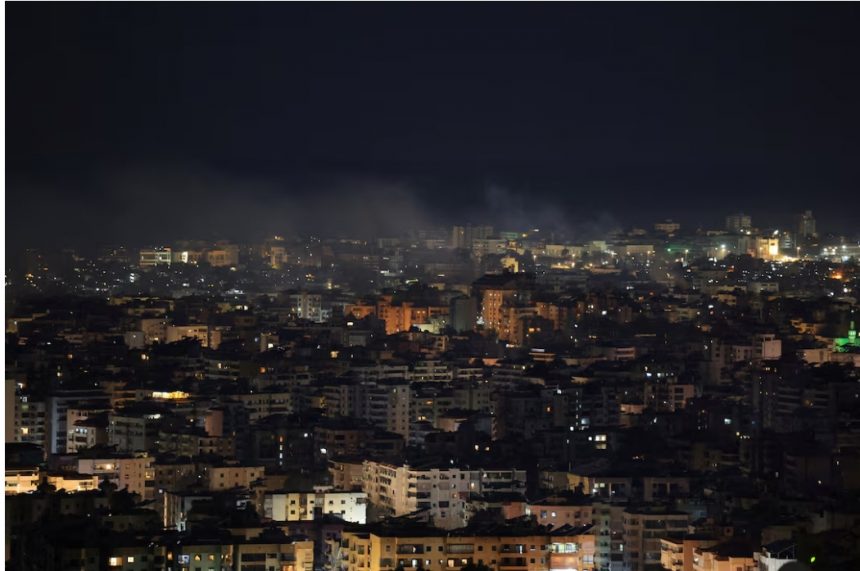
Around Beirut, many residents woke up to the sound of explosions around 3 a.m. as the Israeli strikes targeted the southern outskirts of the city in a densely populated commercial and residential area known as the Dahiya, which is a Hezbollah stronghold.
While Israel has regularly attacked southern and eastern Lebanon since reaching a cease-fire with Lebanon that officially ended fighting with Hezbollah in November 2024, the area near the capital has rarely been hit by strikes since the truce went into effect.
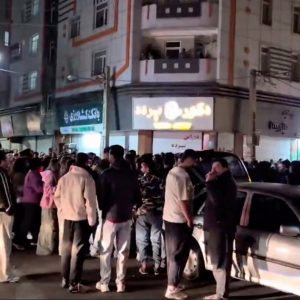
The latest attack sent many residents fleeing from the Dahiya into the city, fearing further strikes. The roads leading out of the area were packed with people and cars as residents rushed to leave.
Sally Hijazi, 33, said that after she woke up to the sound of explosions she ran to her 4-year old daughter’s room, picked her up and rushed out of their apartment with her husband. “We didn’t know where to go,” she said.
“I’m so afraid. I don’t know what to do,” Ms. Hijazi added. “They carried out the strikes without any evacuation warnings, nothing at all.”
The Israeli military urged residents in about 50 villages in eastern and southern Lebanon to immediately evacuate their homes to avoid harm as it targeted Hezbollah, warning that those who remained near Hezbollah facilities were putting their lives at risk.
Israel has carried out near-daily strikes on what it says are Hezbollah sites in Lebanon. Just last month, Lebanon’s public health ministry said that at least 10 people were killed in Israeli strikes. Israel’s military said it had targeted Hezbollah command centers in the east of the country.
Nawaf Salam, Lebanon’s prime minister, called the latest launches from Lebanon into Israel “irresponsible,” in a post on social media early on Monday. He said that regardless of the perpetrators, such actions endangered Lebanon’s security and safety and gave Israel reason to attack.
“We will not allow the country to be dragged into new adventures,” he said, adding that Lebanon would take all measures necessary to protect its people. Mr. Salam did not name the militant group Hezbollah in his post, but it came after Israel and Hezbollah both announced that they had launched attacks.
Pranav Baskar and Dayana Iwaza contributed reporting.
March 1, 2026, 9:33 p.m. ET4 hours ago
The Israeli military urged residents in approximately 50 villages in eastern and southern Lebanon to immediately evacuate their homes to avoid being harmed in possible Israeli strikes against Hezbollah. It said those who remain near Hezbollah facilities are putting their lives at risk.

March 1, 2026, 9:20 p.m. ET5 hours ago
Oil prices rose as much as 13 percent when markets opened, underscoring the economic risks of the widening conflict in the Middle East. International oil prices had already climbed about 20 percent this year, nearing $73 a barrel on Friday, and then briefly crossed $82 a barrel on Sunday before retreating as the trading day opened in Asia.
March 1, 2026, 8:58 p.m. ET5 hours ago
Markets across Asia retreated Monday morning as investors weighed the potential for disruption to energy supplies and global logistics following the strikes against Iran. In Tokyo, the benchmark Topix index fell more than 1 percent, while Taiwan’s Taiex opened down roughly 2 percent. Stock market futures also pointed to a decline for the U.S. session when trading begins on Monday.
March 1, 2026, 8:57 p.m. ET5 hours ago
Strikes on the southern edge of Beirut early Monday sent many residents fleeing from the area into the city. Sally Hijazi, 33, said that, after she woke up to the sound of explosions, she ran to her 4-year-old daughter’s room, picked her up and rushed out of her apartment in Dahiya with her husband.
“We didn’t know where to go. My parent’s house is also in Dahiya, so going there wasn’t an option,” Hijazi said. “I’m so afraid. I don’t know what to do. They carried out the strikes without any evacuation warnings, nothing at all.”
March 1, 2026, 8:54 p.m. ET5 hours ago
Nawaf Salam, Lebanon’s prime minister, called launches from Lebanon into Israel “irresponsible,” regardless of the perpetrators, saying it endangers Lebanon’s security and safety and gives Israel reason to attack, in a post on social media early on Monday in the Middle East. “We will not allow the country to be dragged into new adventures,” he said, adding that Lebanon would take all measures necessary to protect its people. Salam did not name the militant group Hezbollah in his post, but it came after Israel and Hezbollah both announced that they had launched attacks.
March 1, 2026, 8:41 p.m. ET5 hours ago
Christoph Koettl and Christiaan Triebert
Windows were blown out at Tehran’s Revolutionary Court, according to a short video verified by The New York Times. A satellite image, and other videos posted to social media, showed heavy smoke billowing from the immediate area where the court is located. It is unclear whether the court itself was the target, or whether it sustained blast damage from a strike on an adjacent government building, which includes a police-related facility.

March 1, 2026, 8:31 p.m. ET6 hours ago
Lt. Gen. Eyal Zamir, the Israeli military’s chief of staff, said in a statement early on Monday that “Hezbollah opened a campaign against Israel overnight, and is fully responsible for any escalation.” Israel had earlier announced that it was targeting Hezbollah in Lebanon because the militant group was acting in support of Iran.
Still, despite a cease-fire that has been in place since late 2024, Israel has continued to carry out near-daily strikes on what it says are Hezbollah sites in Lebanon. Just last month, Lebanon’s public health ministry said that at least 10 people were killed in Israeli strikes. Israel’s military said it had targeted Hezbollah command centers in the east of the country.
March 1, 2026, 8:22 p.m. ET6 hours ago
Christina GoldbaumReporting from Beirut, Lebanon
Many residents in Beirut woke up to the sound of explosions around 3 a.m. local time, as the Israeli military began striking Hezbollah targets in the southern outskirts of Beirut, an area that is traditionally a bastion of support for Hezbollah. While Israel has regularly attacked southern and eastern Lebanon since reaching a cease-fire with Hezbollah in November 2024, the densely populated southern edges of Beirut known as the Dahiya have rarely been hit by strikes since the truce went into effect.

March 1, 2026, 8:10 p.m. ET6 hours ago
The Al Manar network, which is owned by Hezbollah, published a statement in which the militant group took responsibility for the strikes on Israel.
March 1, 2026, 8:04 p.m. ET6 hours ago
The Israeli military said early on Monday that it had begun striking Hezbollah targets in Lebanon. The statement came after the military said it had intercepted one projectile from Lebanon and that other projectiles had fallen into open areas with no injuries or damage reported. The military, in its latest statement, accused Hezbollah of “operating on behalf of the Iranian regime, opening fire against the state of Israel and its civilians.”
Israel’s public broadcaster reported that the launches from Lebanon into Israel early Monday were the first of this kind since the cease-fire between Israel and Lebanon in November of 2024.
March 1, 2026, 7:50 p.m. ET6 hours ago
Zolan Kanno-Youngs called President Trump from West Palm Beach, Fla. David E. Sanger and Tyler Pager reported from Washington.
In an interview, Trump says the war could last up to five weeks.

President Trump said on Sunday that the U.S. military intends to sustain its assault on Iran for “four to five weeks” if necessary, insisting that it “won’t be difficult” for Israel and the United States to maintain the intensity of the battle even as he warned of the possibility of more American casualties.
In a brief telephone interview with The New York Times, Mr. Trump offered several seemingly contradictory visions of how power might be transferred to a new government — or even whether the existing Iranian power structure would run that government or be overthrown.
Among the options he suggested was an outcome similar to what he engineered in Venezuela, in which only the top leader was removed during an American military strike and much of the rest of the government remained in place, but newly willing to work pragmatically with the United States.
The assault on Iran is considered far more complex and risky than the operation to capture Nicolás Maduro, who was Venezuela’s leader, in part because Iran’s leadership oversees extensive military abilities and because of deep divides in Iranian society over the country’s course. And unlike Venezuela, Iran has sustained an active nuclear program.
The interview with Mr. Trump seemed to reflect the degree to which his administration remains uncertain about how the next few weeks will unfold, both on the battlefield and in the creation of a replacement government in Tehran.
But he insisted the Pentagon retained plenty of forces, missiles and bombs to sustain the military assault “if we have to.”
Asked how long the United States and Israel could keep up this level of attacks, he responded: “Well, we intended four to five weeks.”
“It won’t be difficult,” Mr. Trump added. “We have tremendous amounts of ammunition. You know, we have ammunition stored all over the world in different countries.”
He made no mention of the Pentagon’s concerns that the conflict could further deplete reserves that military strategists have said are critical to retain in scenarios like a conflict over Taiwan or Russian incursions into Europe.
During the roughly six-minute call, Mr. Trump said he had “three very good choices” about who could lead Iran, although he declined to name them. Earlier on Sunday, Iran’s top national security official, Ali Larijani, said that an interim committee would run the country until a successor to the supreme leader was chosen.
Mr. Larijani oversaw the abruptly ended negotiations for a nuclear deal with the United States, and in January was targeted in sanctions by the Trump administration for his role in the crackdown on anti-government protesters.
Mr. Trump did not answer a question about whether he thought Mr. Larijani could lead the government of Iran.
The president offered a variety of often inconsistent visions of how a new government could take shape after the targeted killing of Ayatollah Ali Khamenei, who ruled the country for more than three decades until he was killed by an airstrike on Saturday.
When pressed on his plans for a transition of power, Mr. Trump said he hoped Iran’s elite military forces — including hardened officers of the Islamic Revolutionary Guard Corps who have held substantial influence and profited from the existing regime — would simply turn over their weapons to the Iranian populace.
“They would really surrender to the people, if you think about it,” he said.
It was those same security forces — in particular, the Basij, which organizes local militia — that opened fire on street protesters in January and killed thousands.
Then he offered a very different model of what the transition of power in Iran might look like, referring repeatedly to his experience in Venezuela after he ordered a Delta Force team to seize Mr. Maduro.
“What we did in Venezuela, I think, is the perfect, the perfect scenario,” Mr. Trump said.
His answer implied that what worked in Venezuela would work in Iran, a nation with about three times the population and a military and clerical leadership that has ruled with increasing repression since the 1979 revolution. Over the past several weeks, Mr. Trump has repeatedly brought up Venezuela as the model of a successful operation and hoped to replicate aspects of it in Iran, identifying leadership that would be more cooperative and friendly to the United States.
But he has been told by his advisers that the vast differences in cultures and history made it virtually impossible to apply the strategy used in Venezuela — in which the existing government was kept in place, after it agreed to take instructions from Washington — and try to replicate it in Tehran.
Nonetheless, Mr. Trump appears enamored of using a Venezuela-like model in Iran.
“Everybody’s kept their job except for two people,” Mr. Trump said of the outcome in Venezuela.
He was vague on the question of who should be in the top ruling position in Iran after the ayatollah’s death, or even who should decide.
At first, when asked whom he wanted to lead Iran, he said, “I have three very good choices.” He added: “I won’t be revealing them now. Let’s get the job done first.”
But then he described a scenario in which the Iranian people would overthrow the existing government.
“That’s going to be up to them about whether or not they do,” Mr. Trump said. “They’ve been talking about it for years so now they’ll obviously have an opportunity.” That would, of course, be the opposite of the Venezuela model that he had said minutes earlier he wanted to replicate.
Mr. Trump also said he did not think that the Arab states in the Persian Gulf were needed to join the United States in striking Iran, even though Tehran has targeted many of them — and Israel — with retaliatory missile and drone attacks.
Mr. Trump spoke from Mar-a-Lago, about 36 hours into the conflict, and soon after he received news of American casualties. Saying he could only speak briefly because he said he was about to meet with “the generals,” he acknowledged that his administration expected more casualties, based on projections offered by the Pentagon.
“Three is three too many as far as I’m concerned,” Mr. Trump said. “If you look at projections, they do projections, it, you know, it could be quite a bit higher than that.”
“We expect casualties,” he added.
But he professed confidence that Iran would, in the end, bend to America’s and Israel’s will. “The country has been very substantially weakened, to put it mildly,” he added.
Already, the United States and Israeli forces have killed a number of Iran’s military leaders, leaving a power vacuum that the Iranian government was already seeking to fill.
Mr. Trump said that he was open to lifting sanctions on Iran if the new leadership showed itself to be a pragmatic partner.
But he also refused to say how — or if — his administration would defend the Iranian people he has said should overthrow the current government.
“I don’t make a commitment one way or the other; it’s too early,” Mr. Trump said. “We have work to do and we’ve done it very well. I’d say we’re quite ahead of schedule.”
Mr. Trump added that the U.S.-Israeli military strikes had “knocked out a big portion” of the Iranian navy, including nine ships and the navy headquarters.
After about six minutes, Mr. Trump said he had to end the interview.
Later Sunday afternoon, he returned to Washington.
March 1, 2026, 7:08 p.m. ET7 hours ago
In the early hours of Monday in the Middle East, the Israeli military said that its Air Force had begun an additional wave of strikes in the “heart of Tehran,” the capital.
March 1, 2026, 6:46 p.m. ET7 hours ago
The Israeli military said in a statement that, shortly after midnight in the Middle East, sirens had sounded in parts of northern Israel “following projectiles launched from Lebanon.” Later the military said that it had intercepted one projectile from Lebanon and that “several projectiles fell in open areas.” There were no injuries or damages reported.
March 1, 2026, 6:26 p.m. ET8 hours ago
Iran’s strikes on Gulf states reach the hundreds.

Iran has fired hundreds of missiles and drones at Gulf states in retaliation after the barrage of American and Israeli strikes over the past two days. The majority of the Iranian attacks were intercepted, according to the governments of the Gulf countries.
Iran has launched at least 390 missiles and 830 drone attacks across the Persian Gulf, home to several U.S. military bases, according to government reports. The United States Central Command said on Sunday that Iran had attacked more than a dozen locations in the region, including civilian centers like airports, hotels and residential areas.
On Sunday, the United Arab Emirates’ Defense Ministry said 541 drones had been fired on the country, and 506 of them had been intercepted. It added that Iran had fired 165 ballistic missiles, of which 152 were destroyed, and 13 fell in the sea.
Bahrain’s state news agency said the country’s air defense systems had shot down 45 Iranian missiles and nine drones.
Qatar’s Interior Ministry said in a televised address on Saturday that 66 missiles had been fired by Iran, but did not clarify how many had been intercepted. At least 16 people were injured, it said. On Sunday, the Defense Ministry said it had intercepted 18 ballistic missiles, but did not say if others had made direct hits.
Kuwait’s Defense Ministry said on Sunday that the country’s air force had intercepted 97 ballistic missiles and 283 drones over two days. At least one person was killed and more than 30 were injured, the authorities said.
March 1, 2026, 5:49 p.m. ETMarch 1, 2026
A strike on a girls’ school kills 115, Iranian state media says.
VideoU.S. and Israeli airstrikes on Feb. 28 caused extensive damage to a school in Minab, Iran, witness videos verified by The New York Times show. Women wailed as rescue workers searched through rubble for survivors and victims.
At least 115 people, most of them likely children, were killed in a strike on a girls’ elementary school in southern Iran on Saturday, health officials and Iranian state media said.
The search for survivors in the rubble of the Shajarah Tayyebeh school in the southern town of Minab ended Sunday, according to Mohammad Radmehr, the governor of Minab, Iranian state media reported. It appeared to be the deadliest attack in the ongoing American-Israeli bombing campaign.
Several videos and images verified by The New York Times showed that at least half of the two-story school was destroyed in the explosion. Emergency workers with the Red Crescent could be seen alongside families desperately combing through the rubble, which was littered with schoolbooks and book bags covered in blood and ashes. Portions of the building jutted out from the rubble, with bits of colorful murals visible on what were once the walls of the school. Desks were piled with debris.

In other verified videos, rescue workers retrieved a severed arm from the rubble. Victims were laid out in body bags at the scene, where throngs of people were gathered among ambulances and rescue workers.
“The Minab school incident has no comparison with any other incident,” said Pirhossein Kolivand, the head of Iran’s Red Crescent, in a video posted on social media on Sunday.
“Even in Gaza,” he added, there had not been such a high number of students killed simultaneously, calling the attack “a unique and bitter incident.”
Times reporters are trying to confirm the death toll and details about the attack. It was not immediately clear why the school had been hit, or which country’s forces had done so.
The United Nations cultural and education agency, UNESCO, condemned the strike, saying in a statement on social media on Sunday: “The killing of pupils in a place dedicated to learning constitutes a grave violation of the protection afforded to schools under international humanitarian law.”

Intentionally attacking a school, hospital or other civilian structure is a war crime, and indiscriminate strikes also violate the law. Even if schools are used for military purposes, the law requires armed parties to avoid or minimize harm to civilians and civilian infrastructure, according to the International Committee of the Red Cross.
Citing in part the strike on the school, the Center for Civilians in Conflict, a Washington-based nonprofit dedicated to minimizing civilian harm in war, on Sunday called for “immediate de-escalation, maximum restraint, and urgent action to protect civilians and civilian infrastructure.”
Malala Yousafzai, the Pakistani campaigner for female rights and the youngest recipient of a Nobel Peace Prize, said on social media on Saturday that she was “heartbroken and appalled” by the strike.
The school is adjacent to a naval base belonging to Iran’s most powerful military force, the Iranian Revolutionary Guards Corps, or IRGC. Satellite images reviewed by The Times show that, in 2013, the school building was part of the base. Roads led to and from other areas of the base to the school building that was struck on Saturday. But by September 2016, satellite images show, the same building had been walled off and was no longer connected to the base.
The New York Times
Other witness videos shared by Iranian media and verified by The Times showed dark plumes of smoke billowing from two buildings inside the naval base, indicating that it had been targeted in Saturday’s wave of Israeli and U.S. strikes.
VideoCreditCredit…Iran International News
The Israeli military did not respond to requests for comment on Sunday.
“We are aware of reports concerning civilian harm resulting from ongoing military operations,” Capt. Tim Hawkins, a U.S. Central Command spokesman, said on Saturday. “We take these reports seriously and are looking into them.”
He added that protecting civilians was of “the utmost importance.” No new details were available from Central Command on Sunday.
The midmorning strike on Shajarah Tayyebeh was one of two attacks that appeared to have hit schools on Saturday. Another strike appeared to have hit the Hedayat High School in Iran’s capital, Tehran, near 72nd Square in the district of Narmak, local media and rights groups said. Two students died in that attack, according to the U.S.-based Human Rights Activists News Agency, which focuses on Iran.
A spokesman for the Red Crescent Society said on Saturday that nearly 750 people had been injured and that more than 200 had been killed in attacks across 24 provinces, Iranian state media reported.
Video production by Cynthia Silva.


March 1, 2026, 3:52 p.m. ETMarch 1, 2026
Iran has lost around half of its ballistic missile launchers, Israeli official says.

The Israeli military said on Sunday that airstrikes it has conducted since last June had destroyed about 200 Iranian ballistic missile launchers and rendered dozens more inoperable, roughly half of the launchers Iran currently has.
The strikes in the current assault and a previous one last summer, known as “Rising Lion,” have also targeted Iran’s central explosives manufacturing facility, which supplies materials for missile warheads and other weapons programs, including rockets, drones and cruise missiles.
Before Israel launched its 12-day air attack on Iran last summer, Israeli intelligence had determined Iran was seeking to significantly increase its ballistic missile production and fortify its underground infrastructure.
At the time, Israel estimated Iran’s stockpile stood at roughly 3,000 missiles, but intelligence reports suggested the Iranians planned to produce as many as 8,000 missiles by 2027, “posing a real, direct and existential threat to the State of Israel and the Middle East,” according to one such report.
Despite setbacks caused by the 12-day conflict last year, Iran has been working to rebuild its missile production capabilities, according to Israeli authorities. Recent output has been estimated at dozens of missiles a month and has appeared to be accelerating.
Reports suggest Iran has also been seeking components from abroad to restore its surface-to-surface missile arsenal. Those missiles and their launchers were a prime target of Israeli and U.S. airstrikes on Saturday and Sunday.
The Israeli military was also seeking to destroy factories producing advanced anti-tank systems intended for Hezbollah in Lebanon, as well as specialized research sites, according to a military official who spoke on the condition of anonymity to discuss military strategy. The strikes are intended to delay weapons development “by several years,” the official said.
Stay ahead with the latest updates!
Join The Podium Media on WhatsApp for real-time news alerts, breaking stories, and exclusive content delivered straight to your phone. Don’t miss a headline — subscribe now!
Chat with Us on WhatsApp