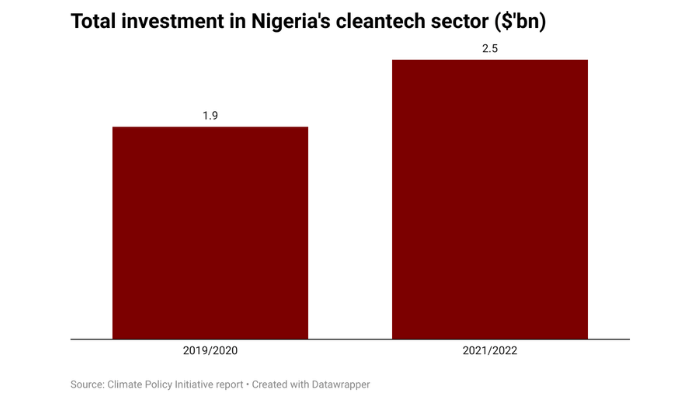
Nigeria’s clean-energy sector is attracting a wave of fresh capital as the country battles persistent power shortages and rising fuel costs.
From solar to mini-grids and battery storage, investors are doubling down on solutions designed to provide reliable, affordable electricity to millions.
In April 2025, Lagos-based Arnergy, which provides distributed solar-plus-storage systems for homes and businesses, closed an $18 million Series B round, which is an extension of a previous $15 million raise. The deal was led locally by CardinalStone Capital Advisers, with participation from international development financiers and impact investors, including Breakthrough Energy Ventures, British International Investment (BII), Norfund, EDFI Management Company, and All On.

The company said the funds will be used to scale deployments nationwide, where demand for off-grid power continues to surge.
The momentum is not limited to startups. In March 2025, Nigeria signed a $200 million agreement with pan-African renewable energy operator WeLight to build hundreds of mini-grids for rural and peri-urban areas.
Officials estimate the project could bring electricity access to more than a million people, underscoring the government’s reliance on private developers to drive large-scale renewable rollouts. This investment surge reflects a wider trend across Africa.
According to the International Energy Agency (IEA), private-sector clean-energy investment on the continent nearly tripled between 2019 and 2024, climbing from about $17 billion to almost $40 billion. That influx of capital is creating a pipeline of bankable projects, helping local renewable companies scale, and positioning energy as one of the fastest-growing sectors for African startups.
Read also: Reps propose Renewable Energy Fund to boost clean energy projects in Nigeria
Venture capital activity also rebounded strongly in 2025, with African startups raising $1.42 billion across 243 deals in the first half of the year. Energy companies are increasingly visible among growth-stage raises, attracting investors eager for climate-aligned opportunities with proven revenue models.
Multilateral lenders and development-finance institutions are further amplifying this momentum. In January 2025, the Asian Infrastructure Investment Bank (AIIB) and the Islamic Development Bank (IsDB) joined a coalition pledging roughly $6 billion to accelerate electrification across Africa—funding aimed at de-risking investments and leveraging more private capital into grid and off-grid projects.
Despite the positive outlook, experts warn that Nigeria’s chronic power problems remain unresolved.
Etulan Adu, Oil and gas analyst noted that while clean-energy investments are growing, they have yet to solve the country’s electricity crisis.
“With the frequent collapse of the national grid and failure to meet electricity demand, solar has become an alternative energy solution,” Adu said.
“Decentralised solar solutions, such as mini-grids and solar home systems, are especially impactful in rural areas. They provide reliable power for homes, schools, and businesses while reducing dependence on fossil fuels and volatile fuel prices.”
He added that scaling clean-energy projects also generates jobs across manufacturing, installation, and maintenance, benefiting both livelihoods and local economies.
Mercy Ndubueze, an investment analyst at WEAV Capital, emphasised the dual impact of investments in Cleantech as sustainability and profitability.

“Climate resilience is no longer optional; it’s a necessity,” she said. “Nigeria has vast untapped potential in cleantech, both in terms of impact and returns. Solar providers not only tackle the energy crisis but also generate strong profits.
“With the growth of carbon credits, companies can create new revenue streams from CO₂ offsets. The upfront costs are high, but the long-term benefits outweigh them,” Ndubueze noted.
Read also: Clean Energy investment faces half-trillion dollar hit
Beyond Arnergy, several Nigerian startups secured major funding rounds in 2024–2025. Konexa, a UK-based energy company active in Nigeria, raised $18 million from Climate Fund Managers and Microsoft’s Climate Innovation Fund to build a private renewable electricity trading platform.

Beacon Power Services secured a $12 million Series A led by Partech to expand its AI-powered grid management solutions. Salpha Energy received $1.3 million from Shell-backed All On to scale solar access in underserved communities.
SunFi raised $1 million in early 2025 from Ventures Platform and other regional investors to grow its clean-energy financing platform. In total, Nigerian startups raised over $400 million in funding in 2024, with clean energy and climate tech sectors standing out as key areas of focus despite broader economic headwinds.
The Nigerian government is actively supporting the transition. Its Energy Transition Plan (ETP), which targets net-zero emissions by 2060, has attracted significant international backing. The World Bank alone has invested over $2 billion in Nigeria’s power sector in the past five years.
Domestic investors are also stepping up, with local venture capital firms increasingly leading rounds and providing on-the-ground expertise. At the same time, policies promoting local manufacturing of solar panels and inverters aim to reduce import reliance, create jobs, and strengthen Nigeria’s renewable energy value chain.
The Nigerian Investment Promotion Commission (NIPC) has further liberalised ownership structures, allowing 100 percent foreign ownership in renewables and offering tax incentives and customs duty exemptions to attract foreign direct investment (FDI).
Stay ahead with the latest updates!
Join The Podium Media on WhatsApp for real-time news alerts, breaking stories, and exclusive content delivered straight to your phone. Don’t miss a headline — subscribe now!
Chat with Us on WhatsApp