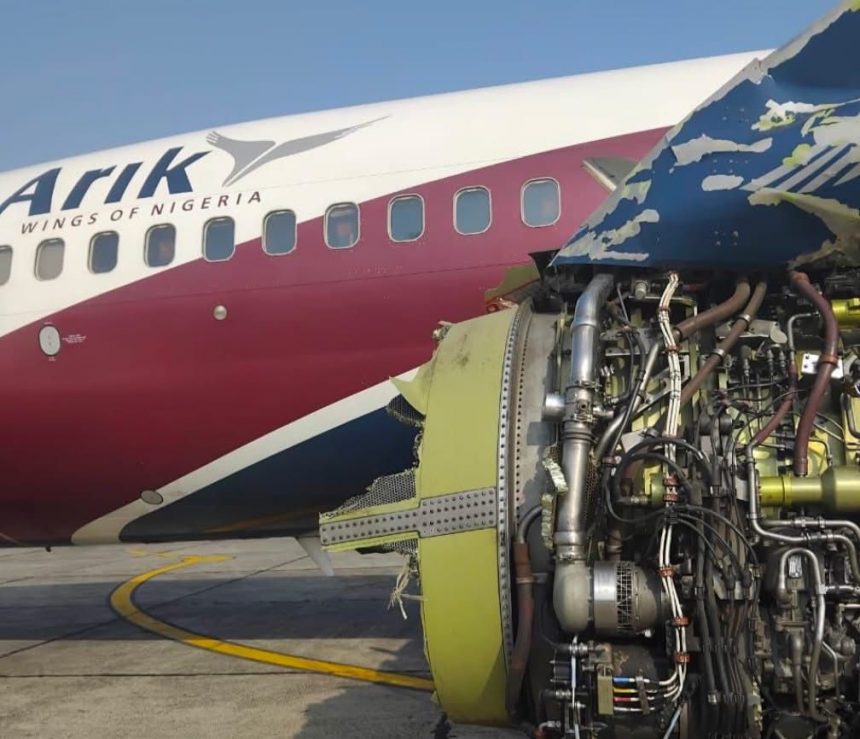
On February 11, about 80 passengers reportedly survived what could have been a deadly plane crash on Nigerian soil, following an engine fault on an aircraft operated by Arik Air.
The aviation firm said its Boeing 737-700 aircraft operating a Lagos-Port Harcourt flight on Wednesday diverted to Benin airport after the crew “heard a loud bang from the left engine”.
The flight W3-740, with registration number 5N-MJF, was said to be descending into Port Harcourt International Airport, Omagwa, when the incident occurred.

The Nigerian Safety Investigation Bureau (NSIB), currently investigating the incident, said preliminary observations indicated significant damage to the affected engine.
Following the “in-flight engine anomaly” — as described by the NSIB — the crew was said to have conducted a precautionary engine shutdown “in line with established safety procedures, and diverted to Benin airport.
“There were no injuries to passengers and crew as all 80 passengers on board were safely disembarked,” Arik Air had said in a public communication.
‘THE LONGEST 14 MINUTES OF MY LIFE’
Advertisement
The trip began like any other: a smooth climb, normal cabin sounds, and the quiet comfort of believing everything was routine, a source who was on the flight told TheCable.
“We were ascending steadily, and for a while, nothing felt out of place. Until it happened,” the source said.
What followed, she said, was a sudden, terrifying bang and the aircraft instantly began to “vibrate violently, threateningly”.
“I turned toward the window, and what I saw froze me. Panic erupted,” the source said.
“The cabin filled with confusion, voices trembling, and cries of “Jesus!” echoing everywhere. In that moment, fear became a physical thing. Heavy and suffocating.
“I remember asking myself quietly: “Is this how I will depart this earth?”
Bracing for “the worst” amidst the chaos, she said a “tall dark lady — calm, composed, likely the lead cabin crew — emerged after consulting with the cockpit and spoke to the passengers”.
The cabin crew member was said to be “human and reassuring” in her speech, which the passenger said carried control — “something stronger than words”.
“She told us we were safe [and] explained that the crew was handling the situation professionally and that we would be landing at an alternate airport in about 14 minutes,” the source said.

“It sounded short, but I can tell you honestly — it was the longest 14 minutes of my life.
“Yet, minute by minute, something changed. The fear began to loosen its grip.
“Not because the situation was pleasant… but because the crew was extraordinary.”
She said the Arik flight crew remained composed, attentive, and courageous “throughout what felt like an ugly episode”.

According to the source, the passengers were guided “with procedure and empathy”.
In the account of another passenger, the incident was described as a “loud explosion” that triggered “panic and screams” in-flight.
“Some people were praying and calling on the name of Jesus. I noticed a lot of concern around those sitting by the window,” he said.
“But the Captain assured us, and the calmness of the cabin crew members was a bit reassuring, though the tension remained. We are so grateful to God that we landed safely and there [were] no casualties nor any injury.”
‘SAFE LANDING DUE TO PILOT’S EXPERIENCE, CALM JUDGEMENT’
While this outcome has been described as a “miracle” in some quarters, industry bigwigs attributed it to the captain’s competence.

Rather than luck or the intervention of some metaphysical forces, Alex Nwuba, president of the Aircraft Owners and Pilots Association of Nigeria (AOPAN), linked the safe landing to the pilot’s experience on the Boeing 737, his background with Aero Contractors and Mobil Aviation, and years of recurrent training.
“He didn’t rely on luck; he relied on training, procedures, and calm judgment,” Nwuba said.
Speaking to TheCable, Ebenezer Soji Amusan, an aviation expert, said the pilot in command handled the situation professionally and deserves credit for a job well done.
He also attributed the outcome to the captain’s competence.
“We should be proud of him as a Nigerian pilot,” he said.
Amusan, however, said such incidents happen in airline operations globally, noting that pilots worldwide are trained to handle them whenever they occur.
“That is why their training is known to be very rigorous and they must obtain international accreditation before flying an aircraft. It’s not a local or national affair. It’s international,” the author said.
ENGINE UNCONTAINED FAILURE AND CAUSES
The incident, which has since been described mainly as a “loud bang or explosion” and an “in-flight engine anomaly”, is known as an engine uncontained failure (EUF) in the aviation industry.
The EUF happens when internal engine parts disintegrate and exit the engine casing at high speed.
While EUFs are rare, experts said such incidents are not new and occur in the aviation industry globally.
Providing a historical context, Akin Olateru, ex-director-general of the NSIB, said past engine uncontained failures recorded in the industry were “due to fatigue failure of the blades”.
“Sometimes it could be improper maintenance by the engineer. Another thing that could have happened is due to human error. A lot happens under human error,” he said.
WHY ARIK MISHAP WASN’T FATAL
Available literature suggests that EUFs can be deadly because engine debris can exit at high speeds in other directions.
This, according to SKYbrary, an electronic repository of aviation safety knowledge, could pose potential danger to the pressurised aircraft structure, adjacent engines, the integrity of the flight control system and, possibly, “directly to the aircraft occupants”.
Olateru said one good thing about the Arik mishap was that there was no fuselage penetration.
“If there were to be a fuselage penetration, that would have led to depressurisation. And definitely, that would probably have led to fatality,” the aviation professional said.
“So, the pilot did a very good job. The moment they noticed this occurrence, they went straight to the next airport, which was Benin.”
A GLANCE AT GLOBAL OCCURRENCES AND NSIB’S TASK
Although EUFs have been adjudged a rare phenomenon in aviation, multiple global media reports show that engine problems are not uncommon with the Boeing 737 aircraft.
In April 2018, the left engine of Southwest Airlines flight 1380 exploded, hurling pieces of the cowling in all directions. A fragment reportedly hit a window, causing an explosive decompression that partially sucked a passenger out of the plane. The passenger later died from injuries.
In 2025, a jet owned by the same airline suffered an engine failure and safely diverted to a nearby airport.
ABC News, on April 19, 2025, reported that a Southwest Airlines flight heading to Cabo San Lucas from Houston, Texas, was forced to return and make an emergency landing due to an engine issue.
In addition, the cowling — the protective covering of a plane engine — on a Southwest Airlines aircraft fell off during takeoff in April 2024, and struck the plane’s wing flap.
Although the reported cases were linked mostly to the same airline, the incidents occurred on the Boeing 737 aircraft family.
Yet, Olateru insists that the incidents are not particular or restricted to the 737 aircraft, emphasising that “We’ve had a history of the same problem with other aircraft”.
“I don’t think anybody should worry about 737. The aircraft is safe,” the expert said.
However, he advised the NSIB to ensure that there are no larger issues with the aircraft worldwide that could pose a threat to airlines.
“Is there anything that could affect all 737 engines that has the same issue? Something that is a threat to all operators around the world,” the former NSIB chief said.
“So that’s one thing I expect NSIB to look at, because that’s the whole essence of accident investigation, to prevent a reoccurrence.
“So, you need to look and be sure that there is no larger issue in this occurrence. There is nothing that could affect the operation of the 737 engine.”
As Nigerians await the report of the NSID, Olateru re-echoed the position of many stakeholders who believe the Arik Air pilot and cabin crew should be honoured.
“I give it to the crew on the flight. They didn’t panic,” he said, explaining that dealing with emergencies requires “being solid and in control”.
“They took the right decision [and] diverted the airplane to the nearest airport.”
Credit: The Cable
Stay ahead with the latest updates!
Join The Podium Media on WhatsApp for real-time news alerts, breaking stories, and exclusive content delivered straight to your phone. Don’t miss a headline — subscribe now!
Chat with Us on WhatsApp