


…says, ‘I campaigned, Ige travelled abroad’
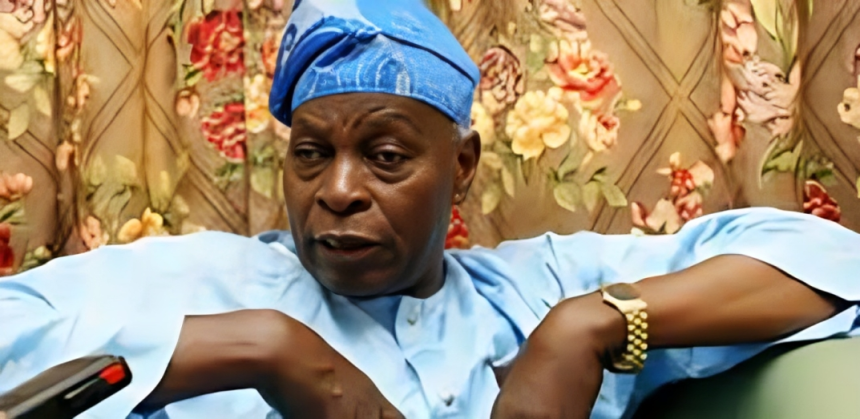
FORMER Secretary to the Government of the Federation and elder statesman, Chief Olu Falae, has revealed how he emerged as the presidential candidate of the Alliance for Democracy (AD) in 1999, defeating the late Chief Bola Ige in what he described as a surprising but hard-earned victory.
Falae, in excerpts from his forthcoming autobiography, The Triumph of Grace, said his emergence followed an intense lobbying effort, strategic consultations, and what he termed a miscalculation by his opponent.
According to him, the process began when Afenifere constituted a 23-member committee to select a consensus candidate for the AD/APP alliance presidential ticket.

The committee comprised elected governors of the AD, party chairmen across the South-West, Kwara and Kogi states, as well as key Afenifere elders.
Falae noted that the composition of the committee was, in his view, “unfair,” particularly as he was neither informed about the meeting that set it up nor given the opportunity to influence its structure. Despite this, he chose not to challenge the decision.
Both aspirants were asked to pay a nomination fee of N500,000. Falae said he promptly submitted a bank draft, while Ige also paid the same amount with “a post-dated cheque.”
Determined to secure victory, Falae embarked on an extensive campaign, visiting each member of the committee individually to solicit support.
“It would be very boring to bring into this autobiography the details of my conversations,” he wrote, “but I went round and saw everybody.”
He recounted visits to key political figures, including Chief Adebodun in Kogi State, who, despite being a long-time ally of Bola Ige, acknowledged Falae’s broader acceptability in Northern Nigeria.
Falae said he leveraged his experience in public service having served as Permanent Secretary, Managing Director of Nigeria Merchant Bank, and later Secretary to the Government of the Federation to convince members of his capacity to lead the country.
He also met with influential elders such as Chief J.O. Odebiyi, former Minister of Education, who subjected him to rigorous questioning on his plans for key sectors.
“I did not want them to feel ignored,” he explained.
Falae contrasted his approach with that of his rival, noting that Ige travelled abroad during the critical period leading up to the decisive meeting at D-Rovans Hotel in Ibadan.
“While I was approaching members of the panel with arguments and logic… I learnt that Chief Bola Ige was away in London. He did not campaign at all, presumably because he was sure of victory.
“The day before the D-Rovans meeting, I went to Ibadan, to be as close as possible to the venue of the meeting, because the meeting was very important to me. To be nominated as Presidential candidate is the highest honour any political party can accord any of its members. It is the nation as a whole, in a general election that could convert that candidate into President. As far as the Party is concerned, it is the highest honour which they gave to Baba Awolowo and which I was now seeking. So, I went to Ibadan a day before to stay with my cousin, Chief Tayo Daniel, in Apata area of Ibadan. From there, I monitored what was going on; to confirm that the meeting was on and to know the outcome of the meeting, as soon as a decision was taken.
When the voting ended, an announcement was made that Chief Bola Ige scored nine votes and Chief Olu Falae scored fourteen votes and, therefore, Olu Falae was declared the candidate of the AD/Afenifere, to be recommended to the National Working Committee of the AD/APP alliance for adoption and ratification.

“I was naturally very happy. It was a major progress in my political career. To have succeeded against such a formidable and experienced politician like Chief Bola Ige was close to a miracle,” he said.
While he described the victory as “close to a miracle,” Falae admitted that the outcome triggered controversy, with allegations that money influenced the process claims Falae firmly denied.
“There were allegations that money changed hands during the D-Rovans election. I pray that God will forgive those who made such false and wicked allegations.
“In the circumstances, it would be a sacrilege to offer money to respected elders like Chief Adekeye who was then in his nineties, Chief (Jonathan) Odebiyi who was a Minister in the 1950s, Chief Adebodun, retired Justice Adewale Thompson and newly elected governors. To think of giving them money would be obscene, and I want to state categorically in this autobiography that I have never offered a bribe to anybody to do me a favour and I have never accepted a bribe from anybody for doing my duty…”
Falae attributed part of his success to lingering resentment among some party elders over Ige’s past political decisions, particularly his refusal to step down for Archdeacon Emmanuel Alayande during the 1979 governorship race in Oyo State.
Following his emergence, Falae said he made efforts to reconcile with Ige, sending emissaries and eventually meeting him in Ibadan in the presence of prominent figures.
At the meeting, he said Ige acknowledged his (Falae’s) qualities and agreed, at least verbally, to support his campaign in the South-West.
However, the fragile truce soon showed cracks when Ige publicly distanced himself from claims that he would lead Falae’s campaign.
Despite the tensions, Falae maintained that his victory was the product of strategy, persuasion, and what he described as divine grace.
“The Yoruba say, bo se wu Olorun lo n sola e God bestows His grace as He pleases,” he wrote.

The autobiography, The Triumph of Grace, is scheduled for public presentation in the coming days. Saturday Tribune got an advance copy during the week.
Stay ahead with the latest updates!
Join The Podium Media on WhatsApp for real-time news alerts, breaking stories, and exclusive content delivered straight to your phone. Don’t miss a headline — subscribe now!
Chat with Us on WhatsApp