

The image may have been fake, but with each passing day Canada is coming to terms with the fact that the threat could be real.
Canadians woke up Tuesday to an all-too-familiar troll ripping through their social media feeds. US President Donald Trump shared an image on Truth Social depicting him speaking to European leaders with an AI-generated map in the background, showing the US flag plastered over Canada, Greenland, and Venezuela.
So far, so normal for Canada’s relationship with President Trump, which has been repeatedly tested in the past year.

What is different now is Canada’s reaction. The feelings of shock and offense have given way to resolve and a newfound preparedness to help Canada cope with provocative, even menacing, demands from the Trump administration.
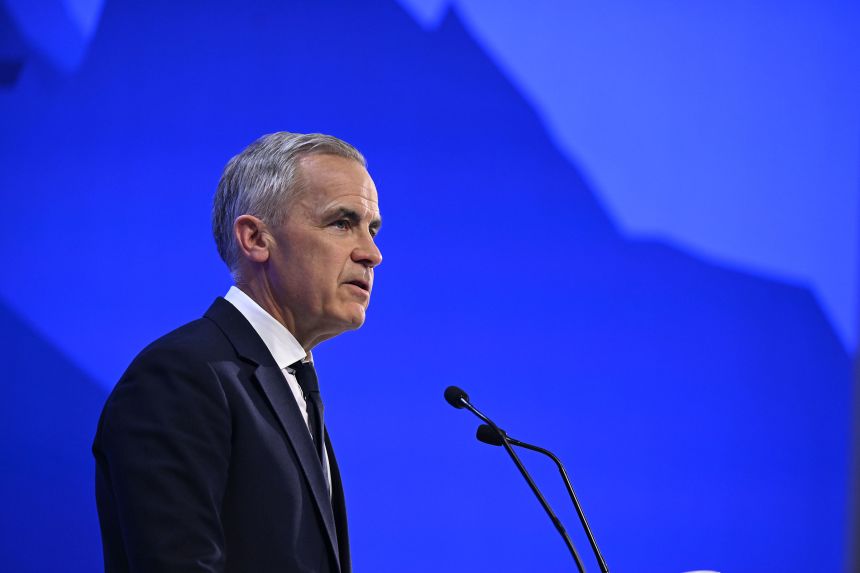
Canada’s Prime Minister Mark Carney charted a path forward for Canada Tuesday warning that stronger countries have been using “economic integration as weapons,” “tariffs as leverage,” and “supply chains as vulnerabilities to be exploited.”
While he did not name the US in his speech at the World Economic Forum in Davos, Switzerland, Carney characterized it as a global “rupture” and not a transition, adding that “middle powers must act together because if we’re not at the table, we’re on the menu.”

Canada’s defense commitment
Canada has spent nearly a billion dollars fortifying its southern border. It will now spend billions more in the years to come protecting its northern one.
Carney reiterated in Davos that Canada stood “firmly with Greenland and Denmark and fully support their unique right to determine Greenland’s future,” and said Russia remained the greatest threat to Arctic security.
“We are working with our NATO allies, including the Nordic Baltic 8, to further secure the alliance’s northern and western flanks, including through unprecedented investments in over-the-horizon radar, submarines, aircraft, and boots on the ground, on the ice,” he said.
Canada in recent months has made a point of showcasing its newfound commitment to defense, and Arctic security, in particular.
One of Carney’s first acts as prime minister was to commit more than 4 billion dollars to an “Over-the-Horizon” radar system to provide early warning radar coverage for threats in the Arctic. He also committed to a larger, sustained military presence in the Arctic for years to come.
But with Trump, Canada’s defense and strategic goals have become more complicated. Canada shares one of the world’s largest land borders with the US and one of the world’s largest maritime borders with Greenland.
For decades, Canada has conducted joint defense operations and planning with both NATO and NORAD (North American Aerospace Defense Command), including a NORAD mission in Greenland this week.
NORAD confirmed in a statement that aircraft operating from bases in the continental United States and Canada would be in Greenland to “support various long-planned NORAD activities, building on the enduring defense cooperation between the United States and Canada, as well as the Kingdom of Denmark.”
But will this kind of cooperation and new military spending be enough for the Trump administration?
It remains an open question, which the US ambassador to Canada hoped to dodge during a radio interview last week.
Ambassador Pete Hoekstra was asked during an interview with CJAD 800 Radio in Montreal whether the US “would have to act” if it decided Canada could not adequately defend its Arctic borders.
Hoekstra responded that the question was “almost purely hypothetical” adding that“…the indications from the Canadian government has been that “we want to very, very closely coordinate and cooperate with the United States on Canada’s north.”
Canadian officials do not deny that they are currently weighing whether to send troops to Greenland in a symbolic show of support for its sovereignty.

The decision gives more weight to Carney’s Davos speech where he asserted there is a third path where “the power of legitimacy, integrity, and rules will remain strong, if we choose to wield them together.”
Source: edition.cnn.com
Stay ahead with the latest updates!
Join The Podium Media on WhatsApp for real-time news alerts, breaking stories, and exclusive content delivered straight to your phone. Don’t miss a headline — subscribe now!
Chat with Us on WhatsApp