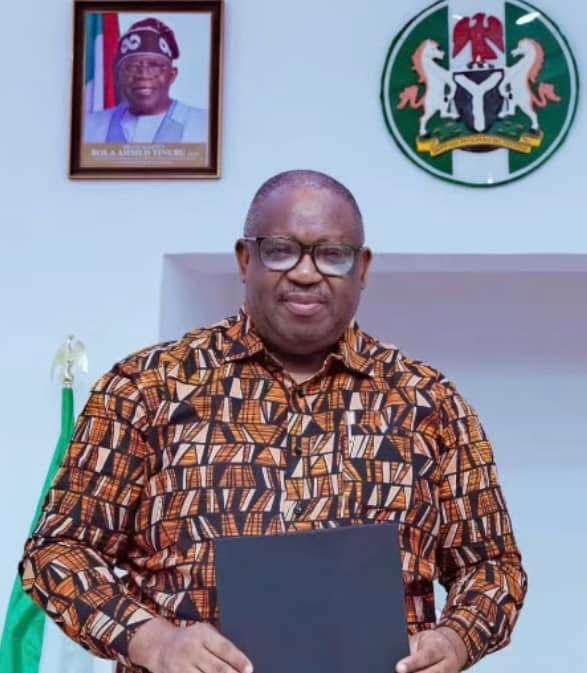
Governor Caleb Mutfwang of Plateau State is set to be presented with an APC membership card on Friday, 2nd January, 2026, at the Victoria Gowon Hall in Jos.
This followed his formal resignation from the Peoples Democratic Party (PDP) and the need to make good his promise to join the All Progressives Congress (APC).
This event, which would be witnessed by national figures, stakeholders in the Plateau project, and party dignitaries, is significant in so many ways.

Historically, it stands as a deft move, as no governor on the Plateau since the return of democracy in 1999 has demonstrated with the same gusto that the interest of the people of the state supersedes his.
While others chose to act for their own political interests, Mutfwang has chosen to put the people first by subsuming his own interest under what will be beneficial to the people.
Rather than remain in the PDP, where he’s coming from, or pick an opposition party, where he would be applauded for being politically correct, he chose what would be for the general good and chose to move in a direction that would serve the overall interest of the people of the state by moving to the ruling party at the center.
This is a wise move, as it reinforces the belief of the people of the state in a progressive government.
Since the First Republic, Plateau has been a progressive state yearning for a leadership that would bring home the bacon in line with progressive principles.
Gov. Mutfwang seems to have read the handwriting on the wall and decided that being in the opposition would only be high on rhetoric but hardly accelerate development at home. So he chose to do the right thing.
Since the APC national chairman, Prof. Nentawe Yilwatda, announced the defection, politics in the state has not been the same.
People recall with nostalgia the glorious years Plateau has had by identifying with the party at the center, which has brought several federal institutions, like the orthopedic hospital, Jos; the National Open University; several polytechnics; roads; and other developments to the state.
This is why the event where the governor would formally be handed the party’s card has been described as a bold attempt to reposition the state on the same path as Nigeria’s political mainstream.
The concern for many as to whether this decision serves the people’s interest or merely reflects elite political calculation has been answered by various analyses rightly enunciating the positive impacts it would have on the state.
This is with the knowledge that beyond party symbolism, such alliances bring access to the center and accelerate implementation of key government policies.
For a state that is rich in potential but challenged by insecurity and uneven growth, such access is what is needed to enhance the living standards of the people.
In Nigeria’s political structure, proximity to the center determines influence and effectiveness, as states governed by parties outside the ruling coalition are exposed to coordination gaps, particularly in areas such as insecurity, infrastructure, and large-scale development deficits.

Governor Mutfwang’s APC moment is therefore a pragmatic decision to close this gap and align Plateau with federal policy direction and decision-making.
Stronger cooperation with national security institutions could enhance response capacity and restore confidence in affected communities, while economically, alignment with the center would ease access to federal infrastructure projects, agricultural interventions, social investment programs, and private sector confidence.
However, political boldness carries its own risks. Party realignment often demands delicate balancing—managing new alliances while retaining the trust of long-standing supporters.
With alignment also comes pressure for rapid dividends: better roads, improved security, inclusive economic opportunities, and responsive governance. The room for excuses narrows, and performance becomes the sole currency of credibility.

The initial fear of naysayers that the governor would be a peripheral player if he aligns the state with the center is being replaced with optimism.
Already, Gov. Mutfwang is gradually building consensus as a leader that will not only bring Plateau to the mainstream but also the entire North Central to add traction to President Bola Tinubu’s Renewed Hope Agenda.
The Governor has been diminishing anxieties by putting round pegs in round holes to work with him, like the appointment of Rt Hon Ahmed Idris, the Deputy Speaker of the 9th Assembly and a devoted APC National leader, as the Amirul Hajj of the 2026 Muslim pilgrimage.
As a previous chairman of the Plateau State Pilgrims Board, he comes with experience and intuitive knowledge.
Governor Mutfwang uses such alignments to strengthen unity across Plateau’s diverse communities. He has shown early signs of collaborating in increased federal access translating into local impact felt in rural and urban areas alike as governance rises above lines to deliver stability and shared prosperity.
There’s the need for his team to therefore develop strategies to contain the bid by some to set a Trojan horse in order to throw spanners in the works of the alignment due to the selfish calculations.

At the end of the day, the true verdict of the decision taken by the governor will not come from party platforms but from the lived realities of Plateau citizens in the months ahead.
Yakubudari@gmail.com
Stay ahead with the latest updates!
Join The Podium Media on WhatsApp for real-time news alerts, breaking stories, and exclusive content delivered straight to your phone. Don’t miss a headline — subscribe now!
Chat with Us on WhatsApp