Travelling, they say, is the most effective Geography teacher. Nowhere has that lesson been more vivid than in Morocco during the ongoing Africa Cup of Nations, a competition that has doubled as a passport to discovery. Beyond goals and scorelines, the journey has unfolded across landscapes that explain why Moroccans affectionately describe their country as “The Kingdom of Light.”
Thanks to the thoughtful hospitality of the Moroccan National Association of Media and Publishers (ANME), the Africa Cup of Nations became far more than a football assignment. It turned into an excursion—one that carried me to places I would never have imagined visiting under the familiar routines of tournament coverage.
One such return journey on Tuesday led me back to Tangier, the legendary coastal city that has long served as Africa’s gateway to Europe. I arrived confident that I knew Tangier inside out. After all, this was my fourth visit. Its medina, cafés, sea breeze and cosmopolitan history felt familiar. Or so I thought.

Tangier, it turns out, always has another chapter.
Beyond Proximity to Europe
Yes, Tangier is famed as Africa’s closest point to Europe, gazing across the narrow waters at Spain. But the city is far more than a geographical footnote. It is a layered crossroads of continents, cultures and currents—both human and natural. This latest visit peeled back yet another layer, revealing landmarks that had somehow escaped me on previous trips.
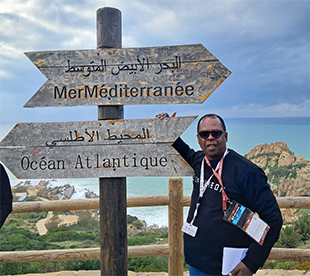
The most breathtaking of them all was Cape Spartel, a place locals proudly describe as where two seas shake hands.
A Climb Through Living Landscapes
The journey itself set the tone. A tourist open-roof bus snaked its way up the undulating but impressively well-paved terrain, climbing steadily away from the city. From the elevated seats, Tangier unfolded in moving pictures: stretches of manicured botanical gardens, clusters of camels resting nonchalantly by the roadside, and pockets of small, inviting beaches tucked between rocky outcrops.
With every bend, the air grew cooler and the views wider. The road felt less like a commute and more like a guided lesson in physical geography, ecology and tourism planning—each curve revealing another postcard moment as we ascended toward the summit.
Where Two Seas Meet
Cape Spartel is not merely a scenic lookout; it is a living geography lesson. Here, the deep blue of the Mediterranean Sea meets the vast, restless Atlantic Ocean in a dramatic convergence that feels almost ceremonial. Standing at the edge, you sense movement, history and power—two great bodies of water acknowledging each other before continuing their separate journeys.
From the hilltop overlooking the Strait of Gibraltar, the Mediterranean flows eastward while the Atlantic pushes west toward the Americas, forming a two-layer exchange with currents moving in opposite directions at different depths. To the naked eye, the Mediterranean appears a calmer, deeper blue, contrasting with the visibly restless Atlantic.
The convergence of two great seas. The darker one is the Mediterranean, and the lighter coloured one is the Atlantic Ocean as viewed by Kunle Solaja
One member of Team ANME, Mamoune Kadiri, pointed to a cliff to my right and calmly noted that it was Spain, less than 14 kilometres away from Morocco and the African continent. In that instant, continents felt closer than ever.
Light, Wind and Memory
One historic feature anchoring the site is the Cape Spartel Lighthouse, a silent sentinel that has guided ships for generations. Around it, a beautifully organised tourist centre blends nature with thoughtful infrastructure, making the site accessible without diluting its raw grandeur.
Cliffs plunge toward the water below, winds whisper stories of ancient sailors, and the horizon stretches endlessly. Tangier, true to character, was windy. I paid the price for inadequate warm clothing, leaving with a cold and catarrh—small souvenirs from a place where the breeze never truly rests.
Yet what struck me most was not just the physical beauty, but the symbolism. Morocco, in calling itself the Kingdom of Light, seems to speak of clarity—of history, identity and place. At Cape Spartel, that light feels both literal and metaphorical, illuminating the meeting of seas, continents and cultures.
As the Africa Cup of Nations continues, the memories will naturally include goals, matches and stadium noise. But for me, one of the tournament’s most enduring legacies will be this rediscovery of Tangier—proof that even familiar destinations can still surprise, and that travel, when given the chance, remains the finest Geography teacher of all.

Stay ahead with the latest updates!
Join The Podium Media on WhatsApp for real-time news alerts, breaking stories, and exclusive content delivered straight to your phone. Don’t miss a headline — subscribe now!
Chat with Us on WhatsApp