



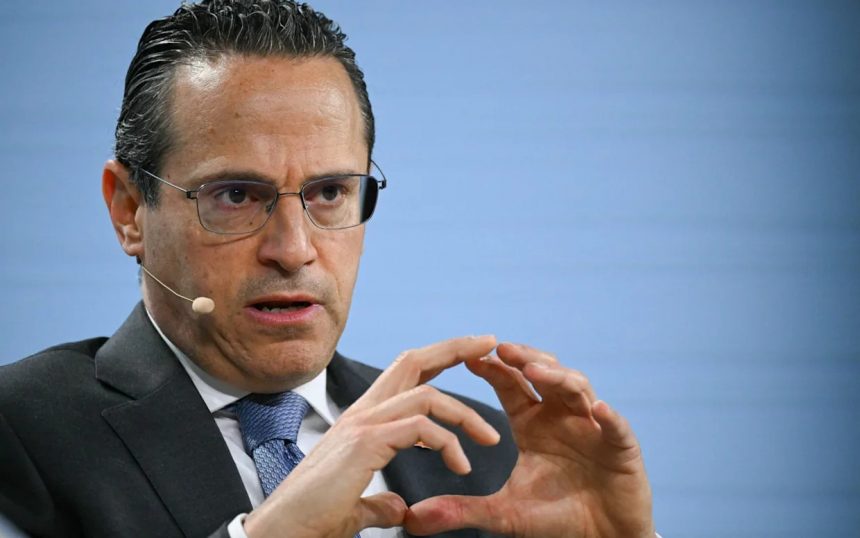
Europe risks fuel shortages as soon as next month as the fallout from the Middle East crisis deepens, the boss of Shell has warned.
Wael Sawan, the company’s chief executive, said the global oil and gas supply squeeze had already forced parts of Asia to cut energy consumption and that the “ripple effect” threatens to spread west within days.
He warned this meant European governments may need to curb energy demand – a step not taken since the 2022 energy crisis – to prevent shortages.

Around one fifth of the world’s oil and liquefied natural gas (LNG) supplies are trapped in the Gulf following Iran’s closure of the Strait of Hormuz.
Military sources said on Tuesday that Britain was leading efforts to reopen the vital trade choke point, with planners considering deploying mine-hunting drones from chartered civilian “motherships”.
Meanwhile, Donald Trump is preparing to send in paratroopers for a possible ground invasion of key islands along the Iranian coast. Yet, the US president also insisted on Tuesday that peace talks with Tehran were taking place.
JD Vance, the vice-president, is being lined up as a negotiator for the first time as Iran is refusing to talk with Mr Trump’s Middle East envoys, sources told The Telegraph.
Gulf sources said that the Iranians would not meet Steve Witkoff and Jared Kushner, accusing them of “backstabbing” at previous nuclear talks before the war started.
With the conflict now in its fourth week, the International Energy Agency has called on countries to reduce oil and gas consumption by encouraging more remote working, lower road speed limits, and greater use of public transport.

In Asia, where countries are heavily reliant on oil and gas from the Middle East, governments have already imposed four-day working weeks, urged people to use less air conditioning and suspended overseas trips for bureaucrats.
Speaking at an industry conference in Houston, Texas, Mr Sawan said European governments may soon need to take similar measures.
“It is a ripple effect,” he said. “We see south Asia first to get that brunt, that moves to south-east Asia, north-east Asia and then more so into Europe as we get into April.
“So we are trying to work with governments to alert them to the levers they may need to pull – including demand‑side measures, what they need to do around storage, what they need to do around purchasing stock and so on and so forth.”
Bankers have said a prolonged energy shock could plunge Britain into a recession, while the RAC Foundation said rising petrol prices had already cost drivers hundreds of millions of pounds extra at the pumps.
The Government said on Tuesday night that officials were monitoring the situation, but the UK had a “diverse and resilient energy supply”.
Energy industry sources also cautioned that potential fuel shortages were an unlikely “worst-case scenario” that would only unfold if the US-Israeli war with Iran dragged on into the summer.

Markets have been sent into a panic by the conflict, driving up the price of oil and gas by 40pc and 60pc in the past four weeks.
The situation has been worsened by Iranian threats to strike ships passing through the Strait of Hormuz, effectively trapping one-fifth of the world’s oil and LNG supplies in The Gulf.
In Asia, that has triggered a scramble for alternatives – putting countries such as China, Japan and South Korea in competition with Europe for shipments from America, the world’s largest oil and LNG exporter.
Ashley Kelty, an oil and gas analyst at Panmure Liberum, said: “There are lots of American cargoes now being redirected to Asia because they are paying more.”

Households fear looming recession
A senior UK energy industry source acknowledged that the situation described by Shell’s chief executive was “one of the worst-case scenarios but still absolutely possible”.
The source added: “At the moment, people are less worried about the physical security of supply and more about prices.
“Remember, even at the height of the last energy crisis, when we lost huge gas volumes from Europe, we still managed to ensure security of supply.”
But they added: “Clearly there is a point – and it is hard to know exactly when, perhaps June or July – where you get substantial rises in prices and the question becomes whether Europe is actually willing to pay to get it.”
At that point, they said, prices may be so high that households and businesses start to self-ration.
Ministers have powers under the Energy Act to take control of petrol supplies during emergencies. Those powers were previously used in 2000 when striking hauliers blockaded fuel depots.

However, Adam Bell, a former government energy official at consultancy Stonehaven, said he did not think Britain was nearing that situation yet.
Instead, he expects ministers to reach for “softer” demand curbs such as driving speed restrictions or home-working guidance before contemplating any tougher measures.
He added: “If you are going to do anything in the short term, it will be that.”
To combat the energy squeeze, the European Commission has already urged member states to reduce gas storage targets for the coming winter.
Separately on Tuesday, Wall Street bankers said the UK was heading for a recession if the energy price shock continues.
Morgan Stanley said the Bank of England could raise interest rates if energy prices fail to come down, which would be likely to cause an economic downturn by the end of 2026.
Bruna Skarica, the chief UK economist at Morgan Stanley, said Britain would face “a pronounced UK recession at the turn of the year” if energy prices stay at recent highs in the coming months and borrowing costs rise.
Simon French, the chief economist at Panmure Liberum, said a recession in the final six months of the year was now “a real possibility”.
Huw Pill, the chief economist at the Bank of England, also warned that “there are limits to what the MPC [monetary policy committee] can do” to protect households from the energy price shock.
The fallout from the Middle East could also lead to food inflation hitting 8pc by June 2026 if the oil shock persists, according to the Institute of Grocery Distribution. That is more than double the current rate of 3.6pc.
Middle classes may be excluded from support
Rachel Reeves has suggested she will exclude the middle classes from any future support on energy bills.
The Chancellor told the Commons on Tuesday that contingency planning was under way to keep costs down as the conflict in the Middle East continued.
However, she said that she would not roll out an “unfunded, untargeted package of support” similar to the one introduced by the Tories after the Russian invasion of Ukraine in 2022.
Household energy bills were capped at £2,500 despite soaring oil and gas prices provoked by Moscow’s war with Kyiv.
Ms Reeves said: “As we respond to this crisis, we must learn from the mistakes of the past.
“The previous government pushed up borrowing, interest rates, inflation and mortgage costs with an unfunded, untargeted package of support under Liz Truss that gave support to the most wealthiest of households.”
Ms Reeves said energy bill support would be “for those who need it most”, adding that she would “update on fuel pricing within the next month”.
The support will reportedly be limited to people on benefits because officials will struggle to develop a system to means-test support for all poorer households in time.
Ms Reeves asked about the potential for establishing an “income threshold” for lower-earning households but has been told such a system will not be ready quickly enough, The Times reported.
HM Revenue and Customs (HMRC) records the income of individuals, but energy bill support will have to be targeted at households. A project to link up the information began in January but is set to take more than a year.
The Chancellor is instead likely to rely on eligibility criteria for the Warm Homes Discount, which is limited to those on means-tested benefits.
Source: The Telegraph
Stay ahead with the latest updates!
Join The Podium Media on WhatsApp for real-time news alerts, breaking stories, and exclusive content delivered straight to your phone. Don’t miss a headline — subscribe now!
Chat with Us on WhatsApp