

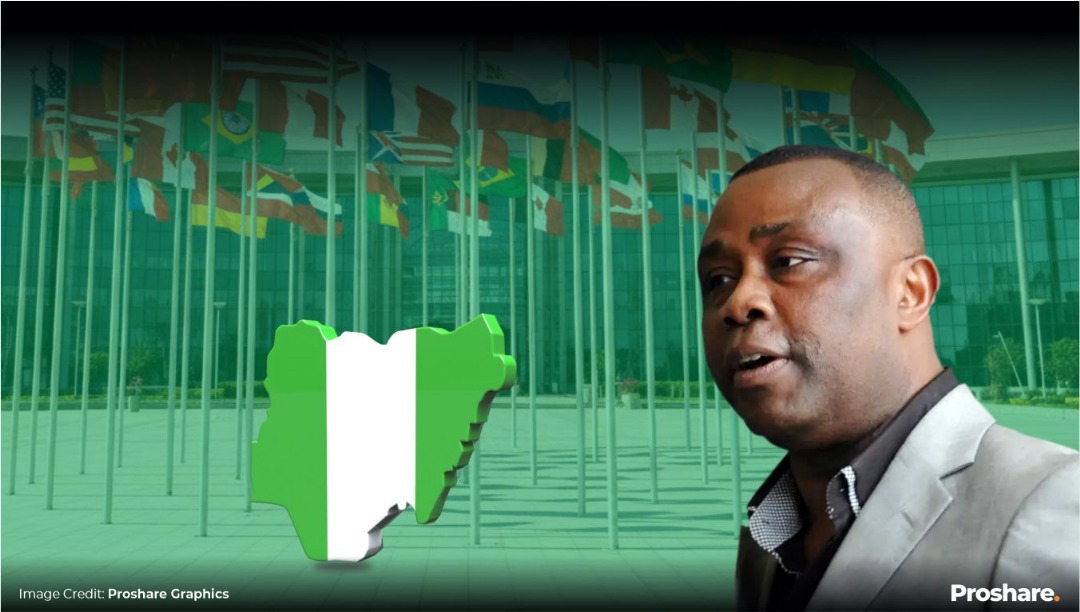
When the “Giant of Africa” Loses Its Voice Abroad
As Nigeria’s embassies remain without substantive ambassadors deep into President Bola Ahmed Tinubu’s first term, Collins Nweke reflects on the consequences of a diplomacy adrift and the lessons Nigeria must learn from countries that treat diplomacy as a national asset, not a political afterthought.
President Bola Ahmed Tinubu probably deserves a place in the Guinness Book of Records. It will be for the wrong reasons, though. He is the first and only Head of State to leave Nigeria’s foreign missions without substantive ambassadors for what could well be the entire duration of his first four-year term.

Never in Nigeria’s post-independence history has there been such an extended vacuum in the nation’s diplomatic representation abroad. For career diplomats who have spent over 25 years rising through the ranks in expectation of an ambassadorial posting, which is the crown jewel of service, this is a betrayal. For political appointees, the so-called “ambassadors-by-appointment,” it is an embarrassment of delayed patronage. And for the Nigerian Diaspora, who have long acted as informal trade envoys and soft-power ambassadors, this is nothing short of fatigue. They are wary of having to fill institutional gaps left by a government that seems to have misplaced its diplomatic script.
It is not that Nigeria lacks foreign policy professionals. The Ministry of Foreign Affairs remains staffed with highly trained, globally respected officers. The tragedy lies in political indecision, bureaucratic lethargy, and perhaps a dangerous underestimation of what diplomacy truly means in the 21st century.
The Price of Absence
Diplomacy is not ceremonial. It is strategic. It is the currency of global respect, the lubricant of trade, and the insurance policy for national reputation. When a nation leaves its embassies headless, it leaves its image unattended, its interests undefended, and its citizens unprotected.
Imagine Belgium without ambassadors during a migration crisis, or Singapore without envoys during trade negotiations. Unthinkable! Yet Nigeria has normalized this vacuum.
Trade missions that could have unlocked export opportunities now fall silent. Diaspora-led business forums must lobby rather than collaborate with embassies on autopilot. International investors encounter uncertainty when letters of credence remain unsigned, and multilateral agencies quietly recalibrate expectations. Nigeria’s foreign policy, already stretched thin, now flounders in administrative purgatory.
It’s a paradox of enormous proportions. A country that confidently flaunts itself as the Giant of Africa, now conducts its foreign relations like a distant cousin of serious nations.
Diplomacy That Works: What the Best Do Differently
To grasp how far Nigeria has drifted, it helps to look at countries where diplomacy is treated not as ritual but as a refined craft. Diplomacy is a tool of power, prosperity, and permanence.
France runs one of the world’s most sophisticated diplomatic schools: the École Nationale d’Administration (ENA). It institutionalises merit-based training. The French diplomatic corps functions like a fine-tuned orchestra: professional, disciplined, and anchored in national interest rather than political expedience. Ambassadors are chosen for competence, and la Francophonie serves as both cultural and economic leverage.
Singapore, though small, practices what can be called precision diplomacy. Its envoys are problem-solvers, not protocol officers. Their task is to secure trade routes, digital alliances, and knowledge partnerships. Singapore’s guiding mantra — “friends with all, enemies with none” — is applied through policy consistency, continuity, and institutional memory.
The Nordic nations – Denmark, Sweden, Finland, and Norway, go further by embedding diplomacy in public service ethics. Their embassies double as innovation hubs, sustainability partners, and cultural connectors. Ambassadors are measured not only by political results but also by developmental outcomes and the partnerships they forge.
Four Lessons Nigeria Must Learn from Global Bests

Diplomacy has evolved beyond the handshake and the photo-op. It is now about economic intelligence, diaspora leverage, and narrative control. From the world’s best, Nigeria can learn four core lessons:
- Institutionalise Meritocracy
Appoint ambassadors on merit, not political loyalty. Establish a modern Nigerian Diplomatic Academy modelled on France’s ENA — one that trains diplomats in economic strategy, climate policy, digital trade, and cultural diplomacy.
- Rebuild the Chain of Trust
International partners crave predictability. Nigeria must develop a coherent foreign policy doctrine — something akin to Singapore’s steadiness — where diplomats speak from a unified script, not improvisations born of domestic confusion.
- Empowering the Diaspora as Strategic Assets
In the absence of ambassadors, diaspora Nigerians have been the face of the country abroad. Rather than accidental envoys, they should be intentional partners in the delivery of foreign policy. Israel, India, and Ireland already anchor economic diplomacy in their diaspora networks. Nigeria must leverage the Diaspora in its 4D Foreign Policy mantra as a springboard to catch up.

- Fuse Diplomacy with Development and Trade
Every mission abroad should be a hub for trade and innovation, with measurable KPIs in terms of investments facilitated, jobs created, and partnerships brokered. Diplomacy should yield dividends, not décor.
A Final Plea for Common Sense
Diplomacy without diplomats is like a ship without a captain. It is technically afloat, but directionless. President Tinubu may be preoccupied domestically, but the world is not waiting. Nations are constantly redrawing alliances, crafting trade corridors, and negotiating digital futures. In this race, Nigeria cannot afford to be both participant and spectator.
When or if the President finally appoints ambassadors, he must resist the temptation of political reward. What Nigeria needs are professionals who view the embassy not as exile, but as an enterprise; not as a vacation, but a vocation. The time has come to return diplomacy to diplomats, merit to meritocracy, and Nigeria’s voice to the global stage. Because a silent nation, no matter how populous, soon becomes invisible.
Stay ahead with the latest updates!
Join The Podium Media on WhatsApp for real-time news alerts, breaking stories, and exclusive content delivered straight to your phone. Don’t miss a headline — subscribe now!
Chat with Us on WhatsApp