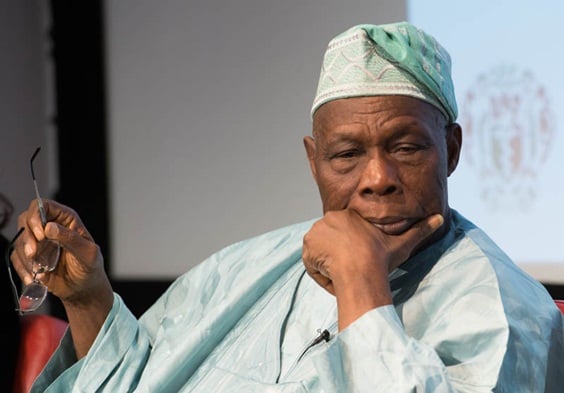
The other morning, before the sun fully stretched its golden arms over Lagos, my phone vibrated with urgency. A message had landed in one of those ever-busy WhatsApp groups where breaking news competes with breaking rumours:
“LISTEN AND READ FORMER PRESIDENT OLUSEGUN OBASANJO; LATEST MEMOIRS…”
The tone was solemn. The emojis were funereal. The message announced that a 94-year-old Olusegun Obasanjo had written a soul-shaking farewell letter to Nigerians and was “about to leave this world.”

I paused.
First, Obasanjo is not 94. He was born in 1937. A small detail perhaps. But facts have a stubborn way of exposing fiction. Second, if Olusegun Obasanjo were truly bidding farewell to life, Nigeria would not be reading it first on WhatsApp. But I read on.
The prose was soft. Reflective. Philosophical. It spoke of “living in the waiting room,” of “gold that cannot be eaten,” of regret over missed birthdays and unspoken apologies. It was beautifully written — almost too beautifully written. It sounded like something lifted from a global motivational calendar, gently adapted, then pinned onto the shoulders of a former president to give it weight. And that is how digital folklore is born.
In the old days, folklore travelled by moonlight. Stories were told by the fireside. Legends gathered exaggeration as they moved from village to village. A hunter became a warrior. A chief became a demigod.
Today, folklore travels by data bundles. It no longer needs the village griot. It needs only a smartphone and a forward button. Somewhere, someone writes a universal reflection about life and regret. It floats anonymously on the internet. It is too powerful to remain orphaned. So we look for a father for it. We search for a famous name to adopt it. Mandela. The Pope. A billionaire. A dying president. Anyone with moral gravitas. And so borrowed wisdom is manufactured.
The psychology is simple. A truth without a famous signature struggles to trend. The same truth, attributed to a former president, becomes gospel. The irony is delicious. We distrust our leaders in life but believe them instantly in death.
There is something about a farewell letter that melts skepticism. We imagine a man standing at the edge of eternity, stripped of ego, finally honest. It appeals to our appetite for closure. We want our powerful men to confess regret. We want them to admit they missed birthdays. We want them to tell us gold cannot be eaten. But there is a problem. When we manufacture confessions for public figures, we are not elevating truth; we are eroding it.
Obasanjo has written extensively. In My Command and later in Under My Watch, he did not hide behind soft metaphors. He was direct, sometimes combative, often analytical. His prose carried the firmness of a soldier and the calculation of a statesman. One may agree or disagree with him, but his voice is unmistakable.
The WhatsApp letter had none of that voice. It was globalised emotion. It could have been written by a retired banker in Canada or a philosopher in Seoul. It carried no Nigerian dust on its sandals. No Abeokuta memory. No reference to war, power, prison or politics. It was existential poetry wearing a borrowed agbada.
This is how misinformation becomes seductive — not because it is malicious, but because it is meaningful. The letter was not evil. In fact, it was wise. It advised people to apologise quickly, to value family over money, to pursue their dreams before time runs out. There is nothing wrong with those messages. The danger lies in the attribution. Once we normalise attaching profound words to the wrong mouths, we quietly loosen society’s grip on verification. We become comfortable with emotional truth over factual truth. And that is a slippery slope.
Today it is a harmless motivational letter. Tomorrow it may be a fabricated policy statement. Next week it may be a fake medical advisory. Soon, the line between inspiration and deception dissolves. The speed of digital transmission has outpaced the discipline of digital verification.
In journalism school, we were taught to confirm from at least two independent sources. Today, many confirm from two WhatsApp groups.
The tragedy is not that people forward messages. The tragedy is that we forward without pausing. A simple question would have dissolved the illusion:

Has any credible news platform reported this?
Silence.
Has Obasanjo’s media office confirmed this?
Silence.

Is he even 94?
Silence again.
But in the digital age, silence is often drowned by excitement. There is also a deeper cultural layer to this phenomenon. Nigerians, like many societies, carry an almost spiritual reverence for “last words.” We treat them as distilled wisdom. We want the departing patriarch to summarise life in four neat lessons. When real life refuses to provide such cinematic closure, we invent it. And perhaps that is what this viral letter truly reveals — not Obasanjo’s state of mind, but ours. We are hungry for reflection in a noisy age. We are tired of insults and jibes from our leaders. So we create a gentler version of them. A reflective elder. A repentant titan. A philosopher at dusk. It is easier to rewrite powerful men than to confront them. But history does not appreciate forgery.
When we attach fabricated tenderness to real figures, we blur their authentic legacies. Obasanjo’s life — military ruler, civilian president, prisoner, elder statesman — is already dramatic enough. It does not require fictional regret to make it profound.
The greater lesson here is about intellectual hygiene. Every generation must develop antibodies against misinformation. In the era of radio, propaganda travelled by airwaves. In the era of television, by images. In the era of social media, by intimacy. A WhatsApp message feels personal. It arrives from a friend, a pastor, a cousin. It feels trustworthy because it comes from someone we know. But familiarity is not verification.
As I read the viral letter that morning, I found myself smiling. Not because it was true — but because it was instructive. It became a mirror reflecting the age we live in. An age where wisdom is crowd-sourced. Where attribution is optional. Where emotional resonance outruns factual accuracy. Where the forward button is faster than thought. Perhaps the real farewell message we need is not from a former president, but from our collective conscience:

Pause before you forward. Ask before you amplify. Verify before you believe. The manufacturing of borrowed wisdom may feel harmless, but it chips away at the foundation of credible discourse. Truth does not collapse in one dramatic explosion. It erodes quietly, forwarded message by forwarded message.
And so, that morning, Obasanjo did not die. What almost died was our vigilance. Fortunately, vigilance can be revived. It begins with a question. It survives with discipline. It flourishes with responsibility. In an age where everyone is a publisher, let us also be editors. Because the future of truth may depend not on what we write — but on what we refuse to forward
Stay ahead with the latest updates!
Join The Podium Media on WhatsApp for real-time news alerts, breaking stories, and exclusive content delivered straight to your phone. Don’t miss a headline — subscribe now!
Chat with Us on WhatsApp