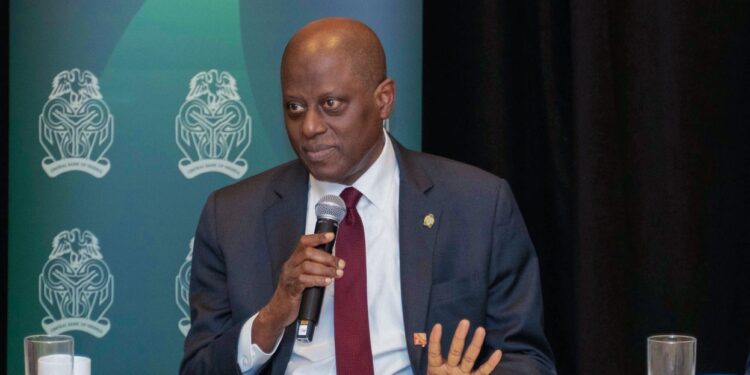
The Central Bank of Nigeria (CBN) has warned that the rapid expansion of private digital payment platforms and stablecoins could threaten foreign exchange stability and trigger capital flow pressures in emerging markets.
This warning was issued by the CBN Governor, Olayemi Cardoso, during a plenary speech at the G-24 Technical Group Meetings held on Thursday in Abuja.
He noted that although digital payment systems present major opportunities for financial inclusion and operational efficiency, they also introduce structural vulnerabilities that require proactive regulatory oversight.

What Cardoso is saying
Cardoso said the growth of digital payment platforms and stablecoins presents both opportunities and systemic risks for emerging economies. He warned that without proper coordination, these innovations could weaken monetary control and destabilise foreign exchange markets.
- “The opportunities of digital payments come with equally significant risks. The expansion of private digital payment platforms and stablecoins raises concerns about: Currency substitution and weakened monetary transmission, Increased FX volatility and capital flow pressures, Systemic importance of non-bank payment providers, Regulatory arbitrage and fragmentation.”
- “Without coordination, digital cross-border payments risk becoming fragmented across jurisdictions, entrenching dominant currencies and platforms, reducing interoperability, increasing costs and undermining the ability of Emerging Market and Developing Economies (EMDEs) to safeguard monetary sovereignty,” Cardoso stated.
The CBN Governor stressed that global regulatory alignment is critical to prevent fragmentation that could undermine developing economies’ ability to manage liquidity and exchange rate stability effectively.
More insights
In her opening remarks, Director of the G-24 Secretariat, Dr Iyabo Masha, said global growth remains uneven across regions despite pockets of resilience. She explained that while some countries are driving momentum, overall expansion lacks the strength needed for inclusive transformation.
- “In South Asia, countries like India are driving global growth momentum, spurred by strong domestic demand and advancements in digitalization, while Pakistan is cautiously balancing recovery with ongoing reform needs. Latin America continues to see modest growth, with some nations, including Mexico contending with weak external demand and sluggish investment.”
- “Across all these regions, a clear pattern emerges: while growth exists, it lacks the power needed for sustainable, job-rich economic transformation that would ensure substantial economic progress and convergence.”
She noted that the pattern across developing regions shows growth without the depth required to deliver long-term development gains.
Get up to speed
Nigeria has witnessed a significant rise in digital payment adoption in recent years. The surge reflects broader efforts to deepen financial inclusion and modernise the country’s payment infrastructure.
The development highlights the rapid scale of Nigeria’s digital payment ecosystem even as regulators weigh potential macroeconomic risks.
What you should know
The G-24 is an intergovernmental grouping of 29 developing countries that coordinate positions on global monetary, financial and development issues. It serves as a platform for member countries to harmonise their stance on international economic governance.
- The group is headquartered in Washington, DC, and holds ministerial-level meetings twice yearly on the sidelines of the IMF and World Bank meetings.
- African members include Nigeria, South Africa, Ethiopia and Côte d’Ivoire.
- Asian members include India, Pakistan, Sri Lanka and the Philippines, while Latin American and Caribbean members include Brazil, Argentina, Colombia, Peru, Guatemala and Mexico.
- Founded about 54 years ago during a period of deep economic uncertainty, the G-24 was created to strengthen the collective voice of developing countries in international monetary and development finance discussions.
The body continues to play a strategic role in shaping policy conversations affecting emerging and developing economies.
Stay ahead with the latest updates!
Join The Podium Media on WhatsApp for real-time news alerts, breaking stories, and exclusive content delivered straight to your phone. Don’t miss a headline — subscribe now!
Chat with Us on WhatsApp