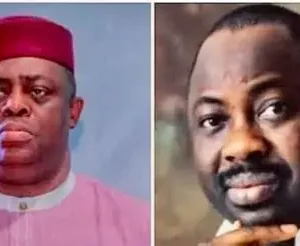




Politics, like theatre, occasionally produces moments so dramatic that the audience must pause and ask whether the actors have forgotten the script.
One such moment unfolded recently in Ondo State when its governor, Lucky Aiyedatiwa, addressed journalists during a media chat to mark his second anniversary as an elected governor. What should have been a routine anniversary reflection suddenly opened the door to a debate that is now rippling across political circles: Is the governor preparing to test the limits of the Nigerian Constitution in pursuit of another term?
For a man whose very name appears to be an anthem of destiny, the unfolding drama carries the weight of irony.
The Name That Promised Destiny
Among the Yoruba, names are never accidental. They are prophecies whispered into the future.
The governor’s name reads almost like a divine memo about destiny.
Lucky.
Orimisan.
Aiyedatiwa.
Each carries a subtle declaration of fortune. “Lucky” needs no translation. “Orimisan” in Yoruba thought evokes the belief that one’s ori, the spiritual head that governs destiny, is properly aligned. And “Aiyedatiwa” boldly suggests that “the world has become ours.”

It is a trilogy of destiny.
And for a long time, many believed that destiny was indeed smiling on the governor.
When his former boss, Rotimi Akeredolu, fell ill and later passed on, Aiyedatiwa moved from deputy governor to the big chair amid tense political currents. Not only did he survive that turbulent transition, he went on to win an election of his own.
To his admirers, it looked like the prophecy of his name was working overtime.
But destiny, as history repeatedly reminds us, often collides with law.
The Constitutional Brick Wall
At the centre of the current controversy is Section 182(3) of the 1999 Constitution (as amended).
The provision states plainly: A person who was sworn in as governor to complete the term for which another person was elected shall not be elected to such office for more than a single term.
There are no metaphors in that sentence. No proverbs. No Yoruba mysticism.
Just plain constitutional English.
In simple chronology:
In 2023, Aiyedatiwa was sworn in as governor to complete the tenure of Akeredolu. In 2025, he won election for his own four-year mandate.
For many constitutional lawyers, that is the end of the journey. One completion term. One elected term. Nothing more.
Yet the governor’s comments during the media chat suggested he may be considering another interpretation of the law. According to him, his legal team would review the situation and determine the next steps.And that is where the story becomes fascinating.
Why Test What Looks So Clear?
Political observers across Nigeria are now asking a question that echoes across drawing rooms, newsrooms and party offices: Why attempt a constitutional stretch that appears so difficult to defend? Is it the classic African politician’s attachment to power?
Is it a belief in destiny so strong that even the constitution must adjust?
Or is there a deeper political calculation unfolding behind the scenes? Rumours, as always in politics, have begun to swirl.
In Akure’s political grapevine, whispers suggest that some loyalists are urging the governor to “test the waters” legally, believing that courts might adopt a creative interpretation.
Others claim powerful political actors are quietly encouraging the idea, hoping the controversy itself could reshape succession calculations within the ruling party.
Another rumour circulating in political salons suggests something more strategic: that the talk of another term may simply be a bargaining chip in future political negotiations.
In Nigerian politics, nothing is ever as simple as it first appears.
A Familiar Nigerian Political Instinct
For students of Nigerian political history, the episode evokes memories of the dramatic third-term saga associated with former President Olusegun Obasanjo.

Despite a constitution that clearly limited presidents to two terms, the country once witnessed an elaborate attempt to alter that provision. Political machinery moved. Alliances formed. Denials were issued. The attempt eventually collapsed under public outrage.
But the lesson remains: power has a strange gravitational pull in politics.
Many politicians believe that once destiny has elevated them, stepping aside becomes almost unnatural.
The Risk of Overstretching Luck
If Governor Aiyedatiwa indeed chooses to pursue the constitutional argument to its final destination, the journey may come with serious risks.
First is legal embarrassment. Courts tend to have little patience for interpretations that stretch plain constitutional language beyond recognition.

Some analysts even joke that judges might one day begin penalising litigants for wasting judicial time with what they call “academic adventures.”
Second is political reputation. A leader who appears determined to bend constitutional rules may inadvertently weaken the very democratic legitimacy that brought him to power.
Third is future political capital. In a country where political careers often extend beyond a single office, a controversial constitutional battle today could complicate ambitions tomorrow.
And finally, there is the irony embedded in the governor’s own name.
For a man called Lucky, destiny has indeed been generous. Few politicians experience the rare sequence he has enjoyed: from deputy to governor, from accidental successor to elected leader.
Yet history often shows that the moment when leaders push their luck too far is the moment when luck quietly exits the room.
In the end, the unfolding drama presents a paradox worthy of political literature. A man whose name proclaims fortune now stands at a constitutional crossroads.
On one side lies the quiet dignity of completing a historic journey: from deputy governor to elected leader who respected the limits of the law.

On the other lies a risky experiment, an attempt to stretch destiny beyond the boundaries drawn by the constitution.
Whether this debate will end in courtrooms, party negotiations, or political retreat remains uncertain.
But one thing is clear.
In politics, as in life, even the luckiest destiny occasionally encounters a document stronger than fate.
The constitution.
And if that document holds firm, the political story of Lucky Aiyedatiwa may end with a curious twist of irony: the day when luck itself met its limit.
I rest my case
Tooki is a Special Adviser on Media and Communications Strategy to the National Chairman of the All Progressives Congress (APC). He is also a founder of BusinessWorld Newspaper and can be reached via [email protected]
Stay ahead with the latest updates!
Join The Podium Media on WhatsApp for real-time news alerts, breaking stories, and exclusive content delivered straight to your phone. Don’t miss a headline — subscribe now!
Chat with Us on WhatsApp