



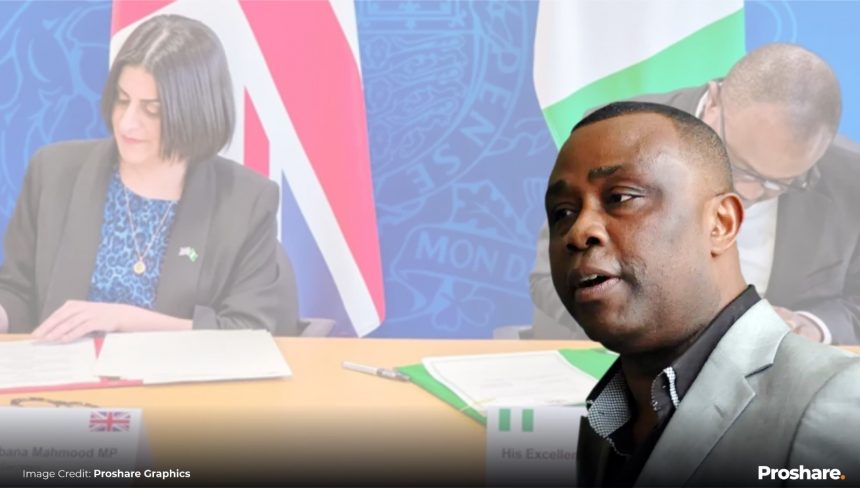
The evolving migration arrangement between the United Kingdom and Nigeria is being widely interpreted through the narrow lens of deportation enforcement. Yet, as argued in this OpEd, such a reading understates the deeper strategic context in which the agreement sits. What is presented as an administrative mechanism to accelerate returns is, in effect, part of a broader negotiation architecture spanning trade, investment, mobility, and regulatory cooperation.
Nigeria Business Guide
Collins NWEKE argues that the central issue is not whether Nigeria fulfils its sovereign obligation to receive its citizens, but whether it extracts commensurate value in return. Framed correctly, migration becomes an instrument of economic diplomacy, where mobility, capital flows, and national reputation are negotiated in tandem. The implication is evident in an outcome that ensures the balance between compliance and leverage determines whether this partnership reinforces asymmetry or advances mutual economic interest.

Nigeria must reframe the UK–Nigeria Migration Deal as a source of economic leverage.
The recent announcement by the UK Government of a new partnership with Nigeria to “speed up removals” has predictably triggered familiar reactions. There are concerns in some quarters and quiet approval in others.
Yet reducing this agreement to a migration story fundamentally misunderstands its significance. This is not primarily about deportations. It is about state capacity, bilateral leverage, and the evolving architecture of economic diplomacy between two unequal but interdependent partners.
According to the UK Government (March 2026), the agreement enables British authorities to return Nigerian nationals who have exhausted legal remedies more efficiently by recognising “UK-issued letters” as valid identity documentation, thereby removing the delays associated with emergency travel certificates. The same statement notes that returns to Nigeria have nearly doubled to approximately 1,150 annually, within a broader figure of nearly 60,000 total returns since 2024.
But buried within that same announcement is a far more consequential reality: this migration arrangement sits alongside a £746 million UK export-finance facility for the rehabilitation of Lagos Port Complex and Tin Can Island Port, and a broader UK–Nigeria Enhanced Trade and Investment Partnership covering regulation, services, standards, and investment facilitation.
Investment Opportunities Nigeria
In policy circles, quiet questions are being asked: Is this a deal misread as migration, but better understood as diplomacy? The framing is more nuanced; it is not a coincidence, but context.
From Rwanda to Nigeria: A Shift in Method, Not Motive
To appreciate the strategic implications, one must situate this agreement within Britain’s recent migration policy trajectory.
The now-defunct UK–Rwanda migration scheme represented what the UK National Audit Office (2024) described as a high-cost, uncertain-value intervention, with commitments of at least £370 million and additional per-person relocation costs. Publicly, it was widely criticised for its legality, cost, and political symbolism. Its central logic was deterrence through externalisation.
That model has now given way to something more administratively efficient and diplomatically palatable: bilateral acceleration of returns with countries of origin. If Rwanda were performative externalisation, Nigeria risks becoming procedural normalisation. The difference is subtle but important. One was politically loud but operationally fragile. The other is quieter, more efficient, and potentially more consequential.
The Real Question: What Does Nigeria Gain?
Every sovereign nation has the obligation to receive its citizens who no longer have lawful status abroad. That principle is not in dispute. The real question is whether Nigeria is extracting commensurate value for its cooperation. Here is why: if migration enforcement is becoming a form of diplomatic currency, then Nigeria must ensure that mobility, trade, investment, and dignity move together.

The UK Government itself acknowledges that this agreement is part of a broader cooperation framework, including:
- Joint action against visa-route abuse, document fraud, and organised immigration crime
- Collaboration on cyber-enabled fraud and illicit finance
- Discussions on business visa access and mobility pathways
- Institutionalised dialogue through the 2025 UK–Nigeria Migration, Justice and Home Affairs framework
This wider architecture confirms that what is presented as a migration agreement is, in reality, a multi-sector bilateral negotiation.
Mobility as Economic Diplomacy
Nigeria Economy Reports

Nigeria must therefore resist the temptation to respond emotionally or passively. Instead, it should reframe migration cooperation as an instrument of economic diplomacy.
At its core, migration is not merely about the movement of people, but about the movement, and potential loss or circulation, of human capital, skills, and enterprise that underpin national competitiveness. The facts support this approach. Nigeria is not merely a “country of origin” in migration terms. It is:
- The UK’s largest African visa market
- A growing source of financial and fintech investment in the UK, with firms such as LemFi, Kuda, Moniepoint, Fidelity Bank and Zenith Bank expanding operations
- A key partner in infrastructure, regulatory alignment, and services trade
These realities were explicitly referenced in the UK Government’s March 2026 communication. This creates a natural symmetry:
- If Britain seeks faster removals, Nigeria should secure faster legitimate mobility
- If Britain seeks enforcement cooperation, Nigeria should demand measurable trade and investment outcomes
- If Britain seeks readmission efficiency, Nigeria should insist on dignity, due process, and reputational fairness
Anything less risks reducing the partnership to compliance.
The Danger of Narrative Imbalance
One subtle but important feature of the UK announcement is its language. It was firmly rooted in domestic political messaging about “border control,” “system abuse,” and “restoring order”.

This is understandable within the context of British politics. But Nigeria must be careful not to internalise a narrative that inadvertently casts its citizens as a problem to be managed rather than as partners in mobility and enterprise. A mature diplomatic response requires neither outrage nor acquiescence, but strategic clarity.
Nigeria must cooperate where sovereign obligations demand it. But it must also ensure that cooperation does not become asymmetry. This is important for the Diaspora because they are often left to clean up any mess left behind by deliberate narrative imbalance.
The Diaspora, long a driver of investment, innovation, and reputation, should not be left to continually correct distorted narratives. The message is clear: do not add new ones.
Four Strategic Imperatives for Nigeria
Market Analysis Reports
To achieve a balance, four policy directions are essential:
1. Establish a Reciprocity Framework
Nigeria should clearly articulate what it expects in return for accelerated readmission:
- Streamlined business and investor visa pathways
- Transparent and accountable visa adjudication processes
- Expanded mobility for students, researchers, and professionals
The existing UK–Nigeria bilateral communiqués already link migration to prosperity. Nigeria must now make that linkage measurable.
2. Insist on Dignity and Due Process
With the introduction of UK-issued identification letters as a basis for return, safeguards become even more critical:
- Verification accuracy
- Legal exhaustion confirmation
- Protection of family unity
- Humane reception and reintegration
The 2025 bilateral framework explicitly references “safe, dignified and respectful processes”. Nigeria should operationalise this commitment.
3. Create an Economic Diplomacy Scorecard
Nigeria Economy Reports
If the UK can count removals, Nigeria should count outcomes:
- Improvements in visa processing for legitimate travellers
- Trade facilitation gains
- Investment inflows and partnerships
- Progress on infrastructure and regulatory cooperation
Migration cooperation must deliver economic value, not just administrative efficiency. This is precisely where diaspora-enabled economic diplomacy becomes critical, translating mobility into measurable gains in development and productivity.
4. Separate Criminality from Mobility
The UK framework groups together foreign offenders, visa overstayers, fraud networks, and irregular migrants. Nigeria should cooperate robustly on crime. But Nigeria must also resist any narrative that conflates mobility with criminality.
A credible partnership distinguishes clearly between:
- Criminal conduct, which must be prosecuted
- Administrative irregularity, which must be managed
- Legitimate mobility, which must be enabled.
From Compliance to Leverage
Nigeria Business Guide
At its core, the UK–Nigeria migration deal is not about deportation. It is about how nations negotiate the terms of mobility in an era of economic interdependence and political pressure.
Nigeria has a choice. It can treat this agreement as a routine act of compliance or as an opportunity to redefine the terms of engagement. In modern diplomacy, the issue is not whether citizens can be returned. It is whether cooperation returns value, respect, and opportunity to the nation receiving them.
That is the standard Nigeria must now set and defend.
About the AUTHOR
Collins NWEKE is an International Trade Consultant & Economic Diplomacy researcher. He was a former Green Councillor at Ostend City Council, Belgium, where he served three consecutive terms until December 2024. A first-generation migrant who transitioned from civil society activism into elected office, he writes frequently on democracy, governance, and Africa–Europe relations. He is the author of the forthcoming book ‘Economic Diplomacy of the Diaspora’. He is also a Distinguished Fellow of the International Association of Research Scholars and Administrators, serving on its Governing Council. A columnist for The Brussels Times, Proshare, and Global Affairs Analyst with a host of media houses, Collins writes from Brussels, Belgium. X: @collinsnweke E: admin@collinsnweke.eu W: www.collinsnweke.eu
Stay ahead with the latest updates!
Join The Podium Media on WhatsApp for real-time news alerts, breaking stories, and exclusive content delivered straight to your phone. Don’t miss a headline — subscribe now!
Chat with Us on WhatsApp