



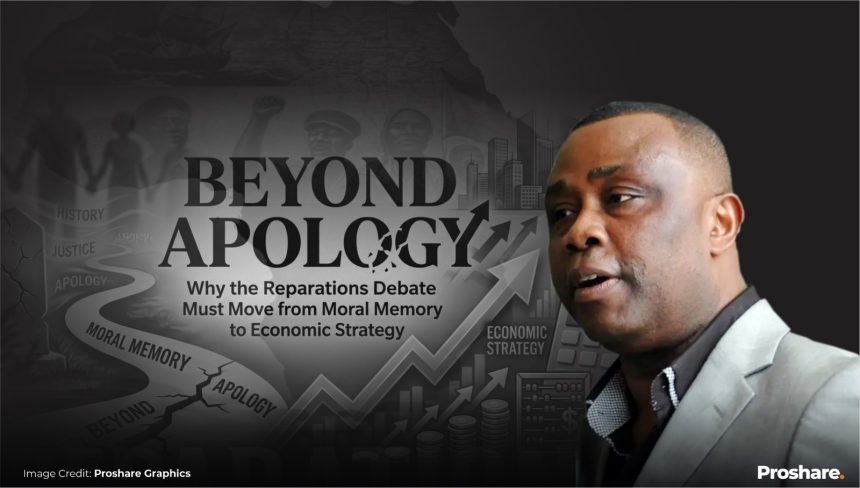
Justice as Architecture: Reparations, Structural Redress, and the Remaking of the Global Economic Order:
Economic forecast reports
John Mahama’s March 25 call at the UN General Assembly is not simply a restatement of historical grievance; it is a signal. It marks the moment when the reparations conversation shifted register: from remembrance to policy architecture, from symbolic acknowledgement to structured economic redress.

In this OpEd, Collins NWEKE argues that the transatlantic slave trade was not a tragedy that happened to Africa. It was an extractive economic system that happened for Europe. That distinction carries enormous consequences for how reparations should be designed, not as compensation for the past, but as instruments of rebalancing for the future. The question before the global community must now shift from whether justice is owed, to whether the institutional will exists to engineer it intelligently.
On March 25, marked globally as the International Day of Remembrance of the Victims of Slavery and the Transatlantic Slave Trade, a renewed call emerged from John Mahama, urging the United Nations General Assembly to recognise transatlantic slavery as one of the gravest crimes in human history and to advance the case for reparations.
This call is neither new nor unexpected. What is different, however, is its timing, framing, and growing geopolitical resonance. It signals a shift from historical remembrance to policy-oriented justice, from symbolic acknowledgement to structured redress.
At its core, the transatlantic slave trade was not simply a moral failure; it was an economic system of extraction. Between the 15th and 19th centuries, an estimated 12 to 15 million Africans were forcibly transported across the Atlantic according to the Slave Trade Database of UNESCO. The consequences were profound including demographic depletion, institutional disruption, and long-term developmental distortion across the African continent.
Simultaneously, this system generated immense wealth in Europe and the Americas, contributing to industrialisation, capital accumulation, and the foundations of modern global economic hierarchies, according to the World Bank, 2023 inequality reports and the UNDP Human Development Reports. To describe slavery, therefore, merely as a historical tragedy is to understate its enduring structural consequences.
From Historical Injustice to Structural Imbalance
The growing call for reparations reflects a deeper realisation: that the legacy of slavery is not confined to the past. It is embedded in present-day inequalities between nations, within societies, and across racial lines.
It has long been argued by Economic historians that Africa’s underdevelopment cannot be fully understood without reference to centuries of forced extraction. The removal of productive populations weakened state formation, disrupted technological progress, and created vulnerabilities later exploited during colonial expansion.
Yet, the reparations debate must avoid the trap of deterministic victimhood. Africa’s present condition is shaped by a complex interplay of history, governance, and global systems. Slavery explains part of the story, but certainly not its entirety. This nuance is critical. It shifts the conversation from blame to responsibility, from grievance to policy design.
What Should Reparations Mean?
If reparations are to be meaningful, they must move beyond symbolism. Apologies, while important, are insufficient. What is required is a framework of developmental justice that addresses both historical harm and contemporary inequality.
Four pillars are essential.
1. Formal Recognition and Accountability

States and institutions that benefited from slavery must move beyond expressions of regret to formal acknowledgement of responsibility. This aligns with evolving norms in international law concerning crimes against humanity and historical redress.
2. Knowledge and Institutional Investment
Investment portfolio management
Slavery did not only extract labour; it erased histories, identities, and knowledge systems. Investments in African universities, research institutions, and cultural preservation are therefore central to reparative justice, as argued in the UNESCO, Memory of the World Programme.
3. Economic Partnership and Structural Financing
Rather than one-off payments, reparations should take the form of long-term economic frameworks: infrastructure financing, technology transfer, and preferential trade arrangements. This is where diaspora networks become critical actors, aligning with emerging models of diaspora-led economic diplomacy as suggested in Economic Diplomacy of the Diaspora.
4. Debt and Financial Justice

There is a growing argument that parts of Africa’s sovereign debt burden are historically rooted in unequal global systems shaped by slavery and colonialism. Debt restructuring or targeted relief could therefore form part of a broader reparative framework, a position favoured by the International Monetary Fund and the World Bank.
In essence, reparations should not be framed as compensation for the past, but as investments in a fairer global economic order.
Would Africa Have Been Better Off Without Slavery?
Counterfactual history is always complex, but the evidence points in a clear direction.
Pre-slavery Africa was home to dynamic civilizations, sophisticated governance systems, and extensive trade networks, from the empires of Mali and Songhai to the commercial hubs of the Swahili Coast. The transatlantic slave trade disrupted these trajectories, creating a developmental discontinuity.
The large-scale removal of young and productive populations weakened economic systems, undermined state capacity, and contributed to cycles of instability. These effects, compounded by colonialism, delayed Africa’s integration into modern industrial and technological systems.

Economic forecast reports
However, Africa’s future cannot and should not be defined by this past. The more relevant question is not what might have been, but what can now be built.
From Moral Argument to Economic Architecture
The significance of John Mahama’s call lies not only in its moral force, but in its potential to catalyse a coalition of the Global South: Africa, the Caribbean, and Latin America, capable of advancing a unified position within global institutions.
For such a coalition to succeed, three conditions are necessary:
- Diplomatic coherence across African states
- Strategic alignment with Caribbean reparations movements (e.g., CARICOM initiatives)
- Clear policy frameworks that translate moral claims into actionable programmes
Without these, the reparations debate risks remaining rhetorical.
In the final analysis, justice must be strategy. The call for reparations is, ultimately, not about revisiting history. It is about reshaping the future. If approached strategically, it can move beyond moral discourse to become a tool of economic transformation, institutional strengthening, and global rebalancing.
As I have consistently argued in my work on economic diplomacy, Africa’s engagement with the world must be grounded not in grievance, but in structured agency. Reparations, properly framed, offer such an opportunity. The question, therefore, is not whether justice is deserved. It is a question of whether the global system is prepared to design it intelligently.
Stay ahead with the latest updates!
Join The Podium Media on WhatsApp for real-time news alerts, breaking stories, and exclusive content delivered straight to your phone. Don’t miss a headline — subscribe now!
Chat with Us on WhatsApp