
While billions of naira flow through government coffers and SUVs glide into private garages, pupils in Akwa Ibom classrooms sit on bare floors waiting for desks that were budgeted but never delivered.
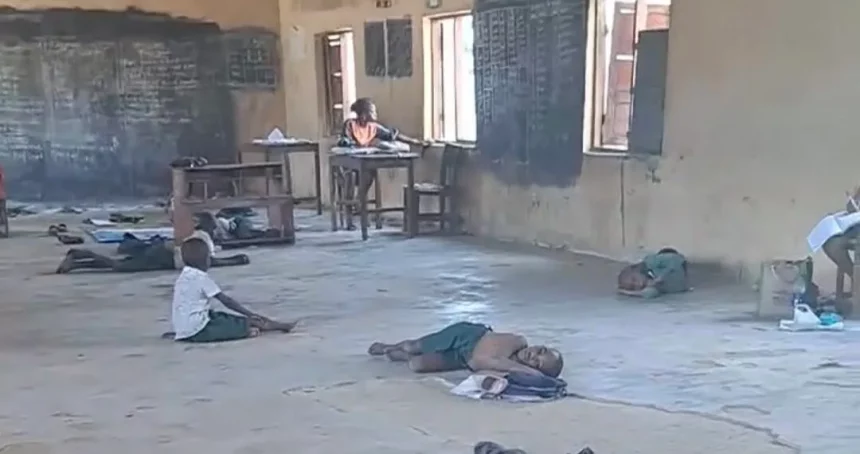
A disturbing video from a public primary school in Ibiaku Itam, Itu Local Government Area of Akwa Ibom State, surfaced on social media recently. The footage captured a classroom in disrepair, lacking basic facilities, exposing a quiet emergency that is gradually becoming the norm in oil-rich Akwa Ibom.
Inside the classroom at Primary School, Ibiaku Itam in Ikot Mbonde Community, only four functional dual desks were visible. Four pupils sat on a desk meant for two. Several children sat on the bare floor, hunched over exercise books. Some lie flat on their stomachs to write. Others balanced on broken planks. One of their teachers, without a table, perched on a stool.
The windows were dilapidated, the floor cracked, and the roof sagged.

The footage was a scene that could easily be mistaken for a forgotten rural outpost. However, this school is within the Uyo capital city.
A drop in the ocean
According to the 2022 approved budget, Akwa Ibom has 1,164 public primary schools. The Governor Umo Eno administration is constructing 31 model primary schools, one in each local government area of the state. Though not all are completed, those inaugurated have new structures and modern seats. But if you take out the 31 model schools, you still have 1,133 others, many of which are unattended to.
In many of these unattended schools, especially in rural and semi-urban communities, old, broken, or inadequate seats remain the norm. Primary School in Ibiaku Itam is not an isolated case; it reflects what obtains across the state.
Budgets that did not sit
Documents reviewed by PREMIUM TIMES showed that Mr Eno’s administration budgeted for seats in public schools, but it appears the administration did not consider it a priority.
The first budget prepared and executed by the administration was the 2023 revised budget. In it, N16 million was approved for 400 dual desks, 50 pupil plastic tables/chairs, and 100 children’s plastic tables/chairs for Early Childhood Care Development Education (ECCDE) centres.
However, the Budget Performance Report covering January to September 2023 showed no expenditure was made on these items.
In 2024, the administration repeated the budgetary provision for the seats. N12 million was budgeted for 1,000 dual desks for public primary schools, and 50 plastic tables/chairs for pupils. Again, between January and September 2024, there was no recorded expenditure.
No publicly available records exist for expenditures made between October and December for 2023 and 2024. Official requests to the Commissioner for Education and the Chairman of the State Universal Basic Education for the data were not responded to.
In 2025, the allocations included N1 million for 400 children’s plastic chairs; N1.6 million for 1,000 dual desks; N2 million for 50 pupil plastic tables/chairs; N4 million for 100 plastic chairs for primary pupils; and N4 million for 100 children’s plastic tables/chairs for ECCDE centres.
The state has not published its 2025 Budget Performance Report, which provides detailed expense information. It remains unknown if funds were spent on seats for primary schools.
PREMIUM TIMES sent enquiries to the Commissioner for Education, Ubong Umoh, and the Chairman of the State Universal Basic Education Board (SUBEB), Anietie Etuk, requesting data on the number of seats procured for pupils and teachers, costs, and beneficiary schools between 2023 and January 2026.
The newspaper also requested clarification on why the ministry’s routine monitoring and oversight failed to identify the inadequacies at Ibiaku Itam Primary School, and what concrete plans the ministry has for 2026 to address the identified shortages of seats in primary schools.
The education commissioner, through the ministry’s information officer, Nkoyo Inyangette, responded on 16 February: “We are working on it, will furnish you with feedback soon.” The official has yet to get back since then.

The SUBEB chairman dismissed the viral footage as “Facebook content creation,” insisting that the state has been paying counterpart funding to the Universal Basic Education Commission to unlock funds for necessary infrastructure within primary schools in the state.
When asked for clarification on whether the state depended solely on the federal government’s matching grant to address the needs of primary schools across the state, Mr Etuk promised to provide detailed data on the seats provided by the administration across schools by 18 February evening. A follow-up reminder on 19 February afternoon through WhatsApp was read but not answered as of the time of this report.
Billion-naira question
The rot in Akwa Ibom public schools existed long before Governor Eno’s administration.
In 2018, PREMIUM TIMES published a six-part investigative series on how corruption, poor budget planning and implementation, and outright neglect led to the near collapse of public education in the state. One of the series focused on the decayed infrastructure at a top science college, where students were raised in squalor “like animals”, while another focused on how unpaid teachers were dying.

However, the situation has persisted under Mr Eno.
In 2025, Akwa Ibom recorded its highest-ever revenue – N1.134 trillion. The state reported total spending of N1.330 trillion.
Among the year’s prominent expenditures was the donation of SUVs to seven former deputy governors and political party leaders, including the APC’s Stephen Ntukekpo and PDP’s Aniekan Akpan, as well as the chairman of the state chapter of the Inter-Party Advisory Council, Blessing Umoh.

The deputy governors who benefited were Etim Okoyo, Chris Ekpenyong, Michael Udofia, Patrick Ekpotu, Nsima Ekere, Valerie Ebe and Moses Ekpo.
Among them, Mr Ekpenyong later served as a senator between 2019 and 2023, while Mr Ekere served as managing director of the Niger Delta Development Commission from 2016 to 2018.
Each SUV, according to the 2025 approved budget, costs N100 million. Ten of them amounted to N1 billion.

Citizens questioned the priority given to former deputy governors who were already pampered by state funds. They also questioned why public funds should be used for the luxury comforts of political party leaders, given the wide social infrastructure gaps in the state.

At the 2025 procurement rate as contained in the 2025 approved budget, N40,000 per table/chair is budgeted for primary schools based on a N4 million allocation for 100 units. N1 billion could procure at least 25,000 seats for pupils.
Twenty-five thousand seats would not merely furnish a classroom. They could transform learning conditions across dozens of schools. Instead, in Primary School Ibiaku Itam, pupils sit on the floor.
Second chance in 2026
In the 2026 budget, allocations for seats to primary schools have significantly increased – N18.57 million for 100 children’s plastic tables/chairs for ECCDE centres, and N18.57 million for 100 plastic tables/chairs for pupils.
For the first time, beneficiary schools are explicitly named – N5.57 million has been approved for 30 pupil plastic tables/chairs at Emeroke, Eastern Obolo Local Government Area, and Migrant Farmers Children School in Odu, Itu Local Government Area.
Additionally, 600 dual desks are approved for each of the following schools: Lutheran Primary School, Obio Ubuim (Nsit Ubium); Annang Peoples School, Ukpom Abak; Primary School Ikot Obio Eka, Etinan; and Methodist Central School, Ete, Ikot Abasi, at a combined cost of N62 million.
While specificity marks progress, history tempers optimism, since this is not the first time funds have been budgeted for school seats.
Billions to local government councils, silence on primary responsibility
Under Section 2 of the Fourth Schedule of Nigeria’s 1999 Constitution, local government councils participate in the provision and maintenance of primary education.
Checks into FAAC allocations show that Itu Local Government Area, where Ibiaku Itam Primary School is located, is not gasping for resources. From January to November 2025, Itu received N4.62 billion in FAAC allocations, excluding internally generated revenue.
Yet Itu, like other councils in Akwa Ibom, does not publish its budget online despite the requirement under the Akwa Ibom State Fiscal Responsibility Law (Volume III, Cap 56, Laws of Akwa Ibom State 2022).
Section 47(2) mandates all Ministries, Departments and Agencies, including local governments, to maintain functional online portals that publish budgets, implementation reports, and audited financial statements.
Findings show that no local government council in the state, including Itu, has its budget available online.
When contacted, the Itu council chairperson, Ubong Nkutt, hung up the phone after our reporter introduced himself. Further calls were unanswered. A follow-up message seeking clarification on 2025 and 2026 seat provisions for primary schools and plans to address the deficit at Ibiaku Itam was not answered as of the time of filing this report.
It is inhuman – Experts
Education experts say the scene in Ibiaku Itam Primary School, among other schools where pupils sit on bare floors to learn, is more than an infrastructure failure; rather, it is a direct assault on effective learning.
Idongesit Archibong, a professor in the Department of Early Childhood Education at the University of Uyo, told PREMIUM TIMES that discomfort fundamentally undermines the learning process.
“For you to study effectively, you must not be uncomfortable,” he said. “In learning, method, environment and content are very important. If any of these is missing, learning is no longer effective.”
Mr Archibong explained that the physical environment directly shapes how teachers deliver lessons and how pupils participate. At the primary level, where demonstration methods are crucial, seating arrangements matter.
“Sitting on the floor will affect the teacher’s teaching method. The demonstration method, which is needed for pupils at that age, becomes more tedious, and participation becomes difficult compared to when pupils are seated properly at desks,” he said.
He warned of psychological and physical effects, too. “The floor is hard. The child cannot concentrate. The concentration level will be very poor. Everything about such learning is very negative. It is very bad and inhuman to allow kids to sit on the floor and learn in primary school. No government should subscribe to that.”
Mr Archibong posed a question to those in authority. “Imagine you are the Speaker of the House of Assembly. Will you allow your child to go to school and sit on the floor?
“If you are in the corridors of power, you should ensure these children at least learn like your own children. These are children of parents who voted for you. The least the government can do is give them a minimum level of comfort while learning.”
Also, Akanimo Sampson of Rebuilders Foundation, a civil society organisation working with children and young people, said the organisation’s field engagement shows that pupils who sit on bare floors are negatively affected. And that is reflected in the children’s performance.
“When children sit on bare floors to learn, it sends a powerful psychological message before any lesson is taught,” she said.
“It tells the child, silently but consistently, that their comfort, dignity and learning experience are not important. Over time, this affects concentration, self-worth, motivation and even how seriously they take education.”
Ms Sampson said that learning is not purely cognitive. “It is physical and emotional. A child who is uncomfortable, distracted by pain or fatigue, cannot fully engage, explore curiosity or retain information.”
For her, the situation reflects a deeper governance problem. “In a system where luxury vehicles are routinely provided for political office holders, it is difficult to argue that the absence of basic classroom seating is due to a lack of resources. It reflects a lack of awareness of what truly drives development.”
According to her, if government officials fully understood the long-term impact of early learning environments, providing chairs for pupils would never be in question.
“Education cannot be claimed as a priority when the most basic learning conditions are ignored. Investing in children is not charity; it is nation-building. How a society treats its learners today determines the quality of its leaders, workforce and citizens tomorrow,” she said.
Source: Premiun Times
Stay ahead with the latest updates!
Join The Podium Media on WhatsApp for real-time news alerts, breaking stories, and exclusive content delivered straight to your phone. Don’t miss a headline — subscribe now!
Chat with Us on WhatsApp