
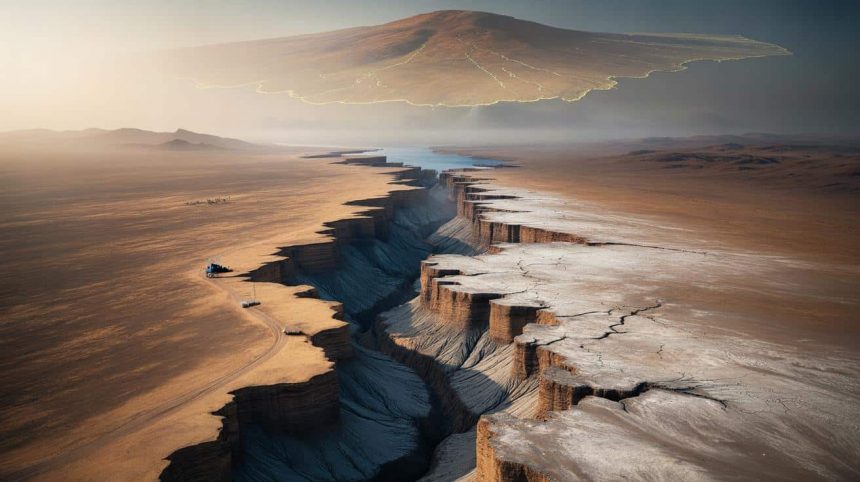
The old Toyota minibus rattles across a dusty track in Ethiopia’s Afar region, the horizon shimmering in the heat. On one side, jagged black lava fields stretch as far as the eye can see. On the other, the pale crust of a salt plain crunches under the wind, like a dried-out ocean bed frozen in time. The driver points ahead, casually, to a faint fracture line tearing through the ground. “That’s the crack everyone on the internet talks about,” he laughs, as though he’d just shown you a pothole, not the scar of a planet in slow motion.
Somewhere beneath those baking rocks, Africa is literally pulling itself apart.
And the wildest part is: there’s video that lets you watch it happen.

Africa is tearing at the seams, and the ground is showing it
Stand near the Dabbahu rift in northern Ethiopia and the earth feels strangely unfinished. The landscape looks freshly broken, like something split with a giant chisel yesterday and left out to dry. Deep fissures slice across the desert floor, some wide enough to swallow a car, others barely a few fingers thick, zigzagging toward the horizon.
Geologists call this stretch of land a “triple junction”: the meeting point of three tectonic plates. The African continent here isn’t one solid block but two huge slabs — the Nubian Plate to the west and the Somali Plate to the east — slowly drifting away from each other.
We like to think of continents as fixed. The Afar region is where that illusion goes to die.
The story caught global attention in 2005, when a 60‑kilometer-long crack opened in just a few days after a massive underground magma intrusion. Locals woke up to find the ground split, roads severed, and fresh volcanic vents steaming in the desert air. It wasn’t a CGI disaster movie, it was their backyard.
Satellite teams rushed into action. Radar images from ESA and NASA showed the surface stretching and sinking, frame by frame. What looked like a solid desert plain was behaving more like warm bread dough being pulled apart.
For people who actually lived there, though, it was simpler: one morning, a familiar track to a nearby village suddenly stopped at a cliff where there had been flat ground.
Scientists say the Afar Depression is one of the very few places on Earth where you can see a continental breakup as it happens, not just read about one in a textbook. The Red Sea and the Gulf of Aden press in from the north and east, feeding a massive rift system running through Ethiopia, Kenya, and Tanzania. Seismic stations record tiny shivers of movement. GPS posts sit stubbornly in the heat, inching apart by a few millimeters each year.
Put all of this together and a bigger picture emerges: Africa isn’t just cracking randomly, it’s reorganizing. **Given enough time, this slow-motion divorce will carve a brand new ocean into the heart of the continent.** The “when” is measured in millions of years, not news cycles, but the “how” is already written on the ground.
The new ocean, the viral videos, and what they really show
Every few months, a video goes viral: a dramatic trench yawning across a Kenyan field, a road snapped like a twig, a narrator breathlessly announcing “Africa is splitting in two right now.” The clip usually shows the 2018 crack that opened near Mai Mahiu in Kenya’s Rift Valley. Cars teeter on the edge, people stare into the void, and the whole thing looks like the first scene of the end of the world.
On a purely human level, the footage hits a nerve. You watch that raw gash in the earth and feel how thin the surface really is. The temptation is to believe it appeared out of nowhere or that a continent broke on a Tuesday.
Reality, as usual, is less cinematic but more fascinating.
Geologists who went to the Kenyan site quickly found clues. Parts of the crack had followed pre‑existing faults in the ground. Heavy rains had softened the soil. When the underlying material slid, the surface collapsed and the older fracture suddenly became visible — like peeling wallpaper away from a hidden crack in the wall.
Was it linked to the bigger East African Rift system? Yes. The rift is the long-term architect carving this whole corridor from Ethiopia down to Mozambique. Was that single event “the moment Africa split”? No. It was one loud creak from a house that’s been slowly shifting for tens of millions of years.

*That’s the strange thing about geological time: it’s both incredibly slow and occasionally brutally abrupt.*
The East African Rift itself is the star of countless explainer videos and animations. One widely shared NASA animation compresses millions of years into seconds, showing the Nubian and Somali plates drifting apart, the Afar Depression sinking, and a narrow strip of blue water eventually flooding in from the Red Sea. You can almost watch a new coastline sketch itself across the continent.
Behind that smooth animation is a mountain of raw data. Satellite altimetry, seismic readings, field measurements, and volcanic gas samples all tell parts of the same story. The crust under Afar is thinning, magma is rising, and the region is subsiding. **This is how every ocean we know began: as a rift on a continent that didn’t yet realize it was doomed to separate.**
Let’s be honest: nobody really thinks about continental drift while scrolling on their phone in bed. Yet those short, glossy videos are one of the rare times deep time actually trends.

How scientists read the cracks, step by tiny step
If you picture scientists discovering the split by stumbling on a giant crack, that’s only a tiny slice of the story. Most of the real work happens far from the camera, with boots dusty from days in the field and eyes tired from nights reading data. The “method” is almost stubbornly patient.
First, teams plant GPS stations — metal posts drilled straight into the rock — across the rift zone. These stations talk to satellites and track their own position to within a few millimeters. Over years, researchers watch them drift apart like dots on a rubber band being slowly stretched.
Then they combine that with seismic networks, listening to the planet’s internal creaks and murmurs, mapping where rock fractures or magma moves.
It’s easy to imagine this all as a clean, linear process, with one big study answering everything. The reality is messier. Instruments get buried by ash, stolen, eaten by rust, or chewed on by curious animals. Data comes back with gaps. Satellites miss a pass because of clouds or technical issues.
We’ve all been there, that moment when you think you’ve finally understood a problem and then a new piece of information blows your neat theory to pieces. Geologists live in that moment professionally. They argue, revise models, go back to the same crack five years later, notice something they missed the first time.
There’s something oddly comforting in that: the people studying the end of a continent are also dealing with broken batteries and muddy boots.

“What we’re seeing in Afar is the birth of an oceanic basin,” explains one geophysicist who has worked in the region for over a decade. “Not for us, not for our grandchildren, but in about 5 to 10 million years. The plates don’t care about our schedule.”
To keep things from feeling abstract, scientists often break the huge story into smaller, tangible anchors:
- Visible cracks and sinkholes – Local events like the Kenyan fissure become entry points to talk about the deeper rift system.
- Time‑lapse satellite videos – These compress decades of movement into seconds, turning slow drift into something you can actually feel.
- Simple numbers – “A few millimeters per year” sounds tiny, until you multiply it by millions of years and realize whole oceans fit inside that patience.
A continent’s future coastline, and what it does to your sense of time
One day, long after our cities are gone and our languages forgotten, a ship will sail along a coastline that doesn’t exist yet. On its left: what used to be eastern Africa. On its right: a smaller continental block, maybe carrying parts of Ethiopia, Somalia, and Kenya. Between them: the young ocean that started on a hot, cracked plain in Afar.
That future is baked into the physics of plate tectonics, but emotionally it’s hard to hold. We live in days and decades, not geologic epochs. Our biggest plans usually stretch to retirement, not 10 million years. **Yet standing in front of those African rifts, you feel how temporary “forever” really is for landscapes.**
You don’t have to be a scientist to feel that jolt. Maybe you’ll see one of those videos again — the Kenyan crack, the NASA animation, the Ethiopian lava fields — and this time notice the quiet detail behind the drama: a planet that never truly sits still.
| Key point | Detail | Value for the reader |
|---|---|---|
| Africa is slowly splitting into two plates | The Nubian and Somali plates are drifting apart along the East African Rift | Helps you understand the headlines and viral videos about “Africa cracking” without panic |
| A new ocean will likely form in Afar | Thinning crust, rising magma, and subsiding land match the early stages of past ocean basins | Gives a long-term perspective on how continents and oceans are constantly reshaped |
| Viral “crack” videos are real but partial | Local collapses ride on top of a much slower tectonic process measured in millimeters per year | Lets you separate spectacle from science while still appreciating the awe of the images |
FAQ:
- Is Africa really splitting into two continents?Yes. Geophysical data show the African plate is separating into the Nubian and Somali plates along the East African Rift, a process that will ultimately produce two distinct landmasses.
- Will a new ocean actually form in Africa?Current models suggest a new oceanic basin will open in the Afar region in roughly 5–10 million years, as the rift continues to widen and seawater eventually floods in.
- Did the big crack in Kenya “start” this process?No. That crack is a local expression of a much older, larger rift system that has been active for tens of millions of years. It’s a symptom, not the origin.
- Is this dangerous for people living in East Africa now?The tectonic process is extremely slow on a human scale. The region already faces earthquakes and volcanic activity, but no one alive today will see Africa “split” in a dramatic, sudden way.
- Can we watch the breakup in real time?In a sense, yes. Through satellite imagery, GPS measurements, and time-lapse visualizations, scientists and space agencies regularly release videos and animations that show the rift’s gradual evolution.
Stay ahead with the latest updates!
Join The Podium Media on WhatsApp for real-time news alerts, breaking stories, and exclusive content delivered straight to your phone. Don’t miss a headline — subscribe now!
Chat with Us on WhatsApp