


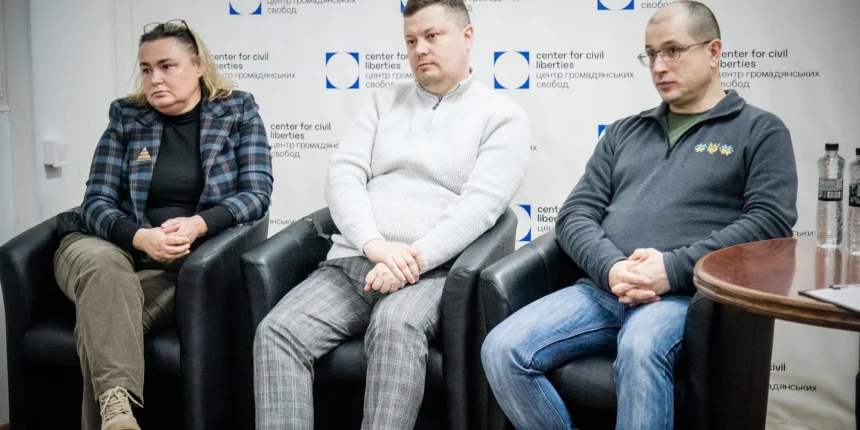
“In their eyes, we deserve no respect. We have no dignity, and there are no values that can be applied to us,” one former prisoner said.
Konstantin Davydenko spent seven years serving a sentence imposed by the Russian Supreme Court in Crimea, which found him guilty of being a Ukrainian spy.
He was locked in a prison facility in Krasnodar, southern Russia. Davydenko calls the prison a terror zone, a place where cruelty was melted only for the sake of it.
“Fear was a key tool in the playbook for tormenting prisoners,” he said to PREMIUM TIMES.

His sentence was passed in June 2019, five years after Russia occupied Crimea, a Ukrainian territory which lies on the northern coast of the black sea. The eastern European peninsula had operated as an autonomous republic with its own constitution and regional government subject to Ukraine’s central government in Kyiv.
But this changed in 2014 after Russia annexed the territory. Ukrainian authorities were replaced by Russians, as was the constitution and the legal system. The entire citizenship regime was also overhauled.
More than 7,000 people, particularly Crimean Tatars — an indigenous Muslim community — have left the peninsula since 2014, according to Ukrainian human rights groups.
Mr Davydenko was one of those who stayed back despite the intimidation, invasive house searches, arbitrary arrest, ill-treatment, and judicial harassment of Ukrainians considered to be dissidents. He worked as a property appraiser and insisted on documenting properties in accordance with Ukrainian legislation until his arrest in 2018.
“I knew it was the kind of thing Russia would forbid. But Russian documents were not accepted by the bank or any legal organisation outside Crimea. They have no legal force,” he said, referring to the refusal of the international community to acknowledge the Russian annexation of the peninsula.
In 2018, Mr Davydenko was accused of collecting state secrets for the Security Service of Ukraine (SBU) and convicted by the Russian court a year later.
He was locked up with 35 other inmates in a cell originally designed for 14 people.
“We were not allowed to shower and wash ourselves. You can imagine what it was like,” he said.
Mr Davydenko spoke of the frequent torture inflicted by the guards. He was often placed in solitary confinement at their whim.
He recounted that the physical and psychological abuse he endured caused his health to deteriorate drastically.
While in prison, Mr Davydenko suffered a stroke, developed a kidney stone, lost his teeth, and his bones weakened. Despite this, he was still denied the medical care his body desperately needed.
“It was a ruthless place,” he said.
The full-scale invasion
The annexation of Crimea in 2014 set the stage for the current Russia-Ukraine war. Until 2022, the tensions between the two countries were essentially part of the many frozen conflicts in Europe.

Although fighting was ongoing in the Donetsk and Luhansk regions, controlled by Russian-backed separatists, there was no full-scale war across the entire country.
Then, in February 2022, as Ukraine under Vladimir Zelensky pushed harder to join NATO, Russian forces launched a full-scale invasion, targeting major cities and infrastructure across the country.


A core theme in Russia’s stated justification was fear of NATO’s eastward expansion. The Kremlin argued that Ukraine’s potential membership in NATO would bring Western military forces to its borders. It framed the overthrow of Ukraine’s pro-Russian government in 2014 as a “coup.”
Russian President Vladimir Putin had warned in 2008 that Russia would consider any attempt to expand the 28-member alliance to its borders as a “direct threat”.

During a press conference last month, Mr Putin said NATO deceived Russia about its expansion plan several times.
In another, much older speech, he said, “Any expansion of NATO to gain a military foothold in Ukrainian territory is unacceptable for us. It is a matter of life and death, a matter of our nation’s historical future. This is not an exaggeration; this is a fact.
“It is not only a very real threat to our interests but to the very existence of our state and to its sovereignty. It is the red line that we have spoken about on numerous occasions. They crossed it.”
To Russia, Ukraine had become a geopolitical adversary rather than a neutral neighbour. From a realist perspective, NATO’s eastward expansion into former Soviet states can be understood as provocative. Several international political analysts have argued that it reinforced long-standing Russian security anxieties and perceptions of strategic encirclement.
However, other analysts have noted that NATO expansion alone does not sufficiently explain the outbreak of war in 2022. If anything, it was a variable among many others, such as Russia’s refusal to accept Ukraine as an independent state, fear that Ukraine’s pro-democracy movement after the 2014 revolution could spread to Russia, and the rise of a more personal and aggressive foreign policy under Vladimir Putin.
The timing of the full-scale invasion has also been noted as revealing the flaw in this claim. For instance, Mr Putin himself had previously acknowledged Ukraine’s right to join NATO. Also, analysts argue that if this were solely about NATO’s eastward expansion, the first round of enlargement in 1999, which brought in Poland, the Czech Republic, and Hungary, should have met serious resistance.

Other analysts also argued that the annexation of Crimea already stifled Ukraine’s ambition to join the alliance.
However, for many Ukrainians, Kyiv is simply exercising its right to make sovereign choices, and Russia, by its actions, clearly violates the sovereignty of an independent nation.
Ukrainians who spoke to PREMIUM TIMES all hold this sentiment. In the last four years, millions of Ukrainians have endured Russian missile strikes on their homes and assets.
Thousands of civilians and soldiers have died on both sides. According to the United Nations, Ukraine recorded more than 2,514 civilian deaths and 12,142 injuries in 2025 alone.
Families have been torn apart, civilians imprisoned, and tortured in Russian facilities. In Lviv, Kyiv, Donetsk, Kharkiv, and other parts of the country, memorials to the casualties are created in symbolic locations, decorated with Ukrainian flags.

From time to time, family members of the deceased visit to offer prayers for the dead. For those whose loved ones are still in captivity, there are prayers for their release.
An inhumane condition
Serhiy Doroshenko, 44, drank from water in a puddle while he was held in Olenivka prison, where dozens of Ukrainian prisoners of war were killed in an explosion in July 2022.
On some nights, he slept in faeces waste that flowed from the toilet into the cell. Other times, he dealt with leeches and infections for which medical treatment was often denied. But these were not Mr Doroshenko’s worst experiences in his three years in captivity.
As a prisoner, he was often transferred to different facilities. He recalled the names of three other Russian prisons where he was subjected to inhumane conditions. Olenivka prison was the first.
Mr Doroshenko was arrested and imprisoned in 2022 while working as a medical volunteer on the frontlines in Donetsk Oblast, in eastern Ukraine. He told PREMIUM TIMES that both medics and civilians are treated with as much disdain as soldiers arrested on the frontline.
According to him, there was a general condescension towards all Ukrainians.
“In their eyes, we deserve no respect. We have no dignity, and there are no values that can be applied to us,” he said.
After Mr Doroshenko was transferred to the second facility in Old Oskol, in western Russia, he was whipped daily. The fear of doing anything to incur the wrath of any of the prison guards worried him. He told PREMIUM TIMES that prisoners at the facility suffered torture, prolonged solitary confinement, and psychological abuse.
His condition did not improve when he was moved to Mordovia. Instead, it worsened.
“Here, it was 16 hours of standing and daily beating,” he said.
Mr Doroshenko spoke of the intense fear that pervaded the prisons during his stay. He explained it as a type that builds distrust among prisoners, even toward themselves. It isolated the prisoners from one another. Survival depended on silence and suspicion.
“You never know who is likely to tell on you. Everyone keeps their opinion to themselves because someone might report to the prison guards,” he said.
“Each colony was different, but torture was a daily reality. Even when I was returned, I did not believe I would be taken home. I was prepared to be transferred to another colony,” he added.
Mr Doroshenko was released in February 2025, in a prisoner exchange between Ukraine and Russia as part of the efforts to secure the return of detainees held on both sides.
The fight for peace
For the families of the prisoners, the uncertainty is almost as punishing as the imprisonment itself.
Olena Tsygipa has been fighting tirelessly for the release of her husband. It has been almost four years since his arrest, and Mrs Tsygipa has remained resilient.
Ukrainian officials disclosed to PREMIUM TIMES that many of those arrested in the frontlines and from occupied territories are often medics volunteering to care for wounded soldiers or residents vocal about their pro-Ukrainian views.
They described this as a tactic intended to silence dissent and intimidate communities in occupied areas.
Mrs Tsygipa’s husband, Serhiy Tsygipa, fell into this category. Before his arrest, he worked as a journalist and made public his views on Russia’s invasion.
The family lived in the occupied city of Nova Kakhovka in the Kherson region, where Mrs Tsygipa also worked as a school teacher.
In March 2022, Mr Tsygipa was arrested. Russian authorities accused him of “espionage,” under Article 276 of the Russian Criminal Code.
According to Mrs Tsygipa, the allegation against him is a fabricated charge used to suppress his Ukrainian patriotism.
However, despite the charges against him, she is determined to be reunited with her husband.
“Russia violates every rule. They violate the Geneva Conventions. They violate humanitarian law. They take prisoners, the people with no weapons, no military uniform,” she said.
Mrs Tsygipa is also resolute in her demand for an end to the war, for an end to Russia’s occupation of Crimea, Donetsk, Luhansk, Zaporizhzhia oblast, and other seized territories.
Many Ukrainians also insist on these demands. This group includes young Ukrainians whose recollection of a pre-war Ukraine is now faint. They insist that lasting peace must be achieved through the withdrawal of Russian forces from occupied territories.
This sentiment underlies the widespread disapproval of the US-devised 28-point peace plan, which includes the cessation of the occupation of the occupied regions by Russia.
Although negotiations are ongoing, Ukrainian President Volodymyr Zelensky has hinted that his country may be forced to cede some of the occupied territories to Russia in order to bring an end to the war.
However, virtually all the Ukrainians spoken to during a PREMIUM TIMES visit to the eastern European country were opposed to ceding territory.
“Asking that we give up our territories is demanding that we willfully allow the violation of our territorial integrity,” a 20-year-old Ukrainian declared.
Stay ahead with the latest updates!
Join The Podium Media on WhatsApp for real-time news alerts, breaking stories, and exclusive content delivered straight to your phone. Don’t miss a headline — subscribe now!
Chat with Us on WhatsApp