


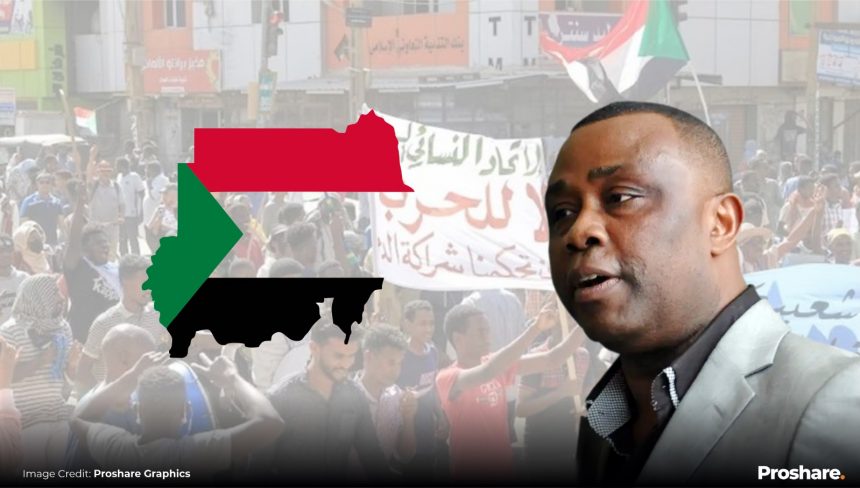
Sudan is the world’s largest humanitarian crisis. The question isnolonger what ishappening? But why isn’t the world acting?
When the siege of El-Fasher finally ended after eighteen months, the world barely noticed. No rolling CNN banners, no special Security Council sessions, no global marches. Yet the fall of this last Sudanese army stronghold in Darfur may well go down as the single bloodiest turning point in the world’s largest humanitarian and displacement crisis. A crisis affecting more people than Gaza, Ukraine, and Myanmar combined.
More than 14 million Sudanese have been displaced. Over 70% of the health system has collapsed. And famine is now a mathematical inevitability, not a future threat. Yet Sudan sits outside our collective conscience, trapped in the blind spot reserved for Africa’s wars. Africa has become that space where outrage dies and impunity thrives.

The problem is no longer ignorance. It is indifference.
A Mass Atrocity in Real Time and in Near Silence
In the days after El-Fasher fell to the Rapid Support Forces (RSF), aid workers described women gang-raped, hospital patients executed, bodies left in the streets, and thousands of civilians detained. The International Criminal Court has taken the rare step of sounding proactive alarm. Not post-factum, but mid-atrocity; warning of evidence of mass killings and sexual violence.
Is the world waiting for the next Darfur? No, we are witnessing the continuation of the first. But unlike 2004, there is no global Save Darfur movement. No summit of conscience. No celebrity megaphone. Sudan today occupies a space somewhere between global fatigue and geopolitical inconvenience. Too complex for empathy, too African for urgency, too fragmented for diplomacy.
Humanitarian workers describe Sudan with a bitter phrase: The biggest crisis nobody wants to touch.
Why Sudan Has Fallen Out of the World’s Moral Perimeter
Three forces have conspired to push Sudan into the shadows:
- First is geopolitical clutter. The world is overwhelmed by simultaneous emergencies. Gaza, Ukraine, Taiwan, Sahel coups, Red Sea tensions. Sudan has been ranked non-strategic by the powers who control leverage.
- Second is cameras, no outrage. Restricted access means no live footage, no visuals of starving children, no images of mass graves. And in a media economy built on images, the unseen becomes the unimportant.
- Third is a divided African response. The eight-country Intergovernmental Authority on Development (IGAD) is fractured. The African Union (AU) is hesitant. The continent has not yet rallied around Sudan the way the Economic Community of West African States (ECOWAS) once rallied around Liberia or Sierra Leone. When Africa hesitates, the world finds permission to look away.
What the World Must Do Now
The international community knows exactly what to do. But will they? The problem is will, not knowledge.
A monitored humanitarian truce
Ceasefire slogans are meaningless without enforcement. What is required is a 72-hour renewable humanitarian pause with third-party monitors: AU / UN / IGAD joint teams physically tracking safe corridors. Not declarations. Presence.
Sanctions that bite, not perform
The war is being fuelled by external money, weapons and political patronage. Targeted sanctions on supply chains, not just individuals, are the only leverage the Rapid Support Force (RSF) and Sudanese Armed Forces (SAF) understand. Freeze fuel, freeze weapons, freeze bank routes or stop pretending diplomacy is happening.

Civilian protection teams in Darfur
If there can be UN monitors in Kosovo and Bosnia, there can be African-led roving protection units in Darfur; especially with women’s groups embedded for Gender-Based Violence (GBV) response. Even small, mobile, unarmed verification teams save lives simply by existing.
A justice track that begins now, not “after peace”
The ICC has learned the lesson of Syria: evidence disappears faster than diplomacy succeeds. Digital, satellite and survivor testimony must be preserved now. Justice delayed is amnesia guaranteed.

A Responsibility Overview of Actors
| Actor | Responsibility |
| African Union (AU) | Invoke Article 4(h): “right to intervene in grave circumstances.” Lead a Darfur Civilian Protection Mission with IGAD support. |
| IGAD | Table a single, unified Sudan roadmap. No more parallel initiatives. Coordinate ceasefire monitoring. |
| United States & EU | Move from statements to sanctions: choke financing, freeze logistics, condition recognition on ceasefire compliance. |
| Gulf States & Egypt | Stop being silencers or sponsors. Use leverage to force their respective allies into talks. |
| UN Security Council | Pass a resolution mandating monitored humanitarian corridors; even if it requires abstention diplomacy. |
| Humanitarian agencies | Shift from access requests to access enforcement with African and local partners. |
| Sudanese diaspora | Become the loudest voice; coordinate global advocacy, track evidence, mobilise remittance relief with protection benchmarks. |
| Media & civil society | Break the blackout. Sudan is not a side story. It is the epicentre of a preventable famine. |
What Is at Stake If the World Does Nothing
The collapse of Sudan will not stay in Sudan. It will:
Split the Sahel–Horn corridor into armed enclaves.
Create the largest famine-driven migration wave since Ethiopia in the 1980s.
Radicalise a generation of young Sudanese abandoned by the world.

Signal to every warlord that mass atrocities are again cost-free.
History is watching to see whether we learned anything from Rwanda, Darfur, Aleppo, Tigray. Or whether those were just moral rehearsals for the next failure.
The Moral Bottom Line
The world’s failure in Sudan is not about lack of capacity. It is about selective empathy. Sudan’s children are not starving because there is no food. They are starving because the world has not decided they are worth feeding. Sudan’s women are not being assaulted because there is no law. They are being assaulted because the law is not being enforced for them.
Sudan is not a forgotten crisis. It is a neglected choice. If the world acts now, we can still save lives.If we wait, we will only be writing apologies.
The author recently appeared on TRT World discussing the content of this opinion editorial. Watch the interviewhere.
Stay ahead with the latest updates!
Join The Podium Media on WhatsApp for real-time news alerts, breaking stories, and exclusive content delivered straight to your phone. Don’t miss a headline — subscribe now!
Chat with Us on WhatsApp