



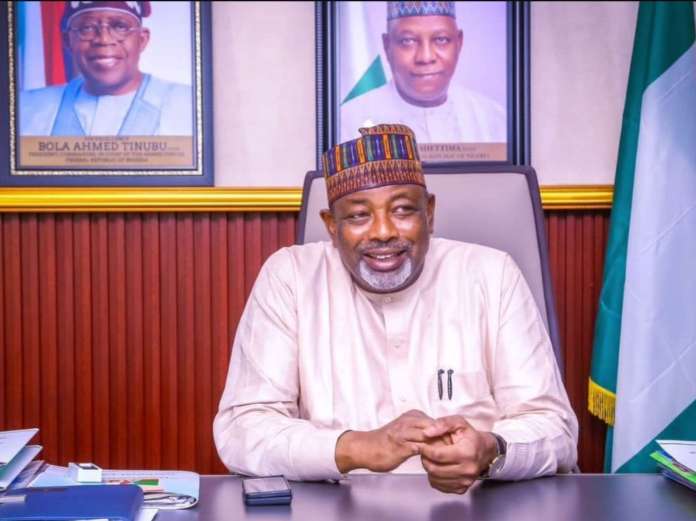
Minister of Agriculture and Food Security, Senator Abubakar Kyari, has dismissed as false and misleading claims of massive annual losses in Nigeria’s agricultural sector, saying the figures are unsupported and politically motivated.
In a press statement dated November 19, 2026, Kyari rejected reports alleging an annual N2.5 trillion loss and a projected additional N10 trillion shortfall, describing the claims as “too wild to be true” and existing only “in the figment of the opposition’s imagination.”
The minister said the 2026 Wet Season Agricultural Performance Survey conducted by the National Agricultural Extension and Research Liaison Services (NAERLS) of Ahmadu Bello University, Zaria, recorded national cereal production of 29.393 million metric tonnes — 1.84 per cent higher than the 2025 figure. Rice production alone stood at 9.626 million metric tonnes.

He said the data puts “to lie the narrative that our agricultural sector is in total collapse.”
Kyari clarified that the 150-day duty-free food import window introduced in 2024 was a temporary measure to bridge supply gaps, improve availability and stabilise prices. The window, he said, expired on December 31, 2024 and has not been renewed, and was never intended to replace domestic production.
He listed ongoing interventions including financing from the Bank of Agriculture, support through the National Agricultural Development Fund, mechanisation partnerships and the establishment of Special Agro-Industrial Processing Zones.
According to him, 2.150 million bags of fertiliser have been distributed free to farmers nationwide, with additional funding approved for more than three million bags of NPK fertiliser ahead of the dry season to boost local manufacturing and production.
Kyari also cited the National Postharvest Systems Transformation Programme (NiPHaST), which focuses on storage warehouses and cold-chain infrastructure to reduce post-harvest losses.
On claims that more than half of Nigeria’s rice mills had shut down, the minister said the assertion does not reflect the full picture. Many mills remain operational, he noted, while government continues to support local processors. Any temporary suspensions, he argued, could not fairly be blamed on the long-expired duty-free window.
He warned that a promise by former Vice-President Atiku Abubakar to reopen the borders could harm the sector through indiscriminate food imports and unfair competition for local farmers.
“Our policy direction is to increase domestic production and decrease dependence on imported food,” Kyari said. “President Tinubu’s charge to us at all times is that we must produce what we consume and consume what we produce.”
He reaffirmed the ministry’s commitment to supporting farmers, strengthening local industries, raising food production, cutting post-harvest losses and making food more affordable, while urging that progress in agriculture be measured by evidence rather than political propaganda.
Stay ahead with the latest updates!
Join The Podium Media on WhatsApp for real-time news alerts, breaking stories, and exclusive content delivered straight to your phone. Don’t miss a headline — subscribe now!
Chat with Us on WhatsApp