
What you need to know:
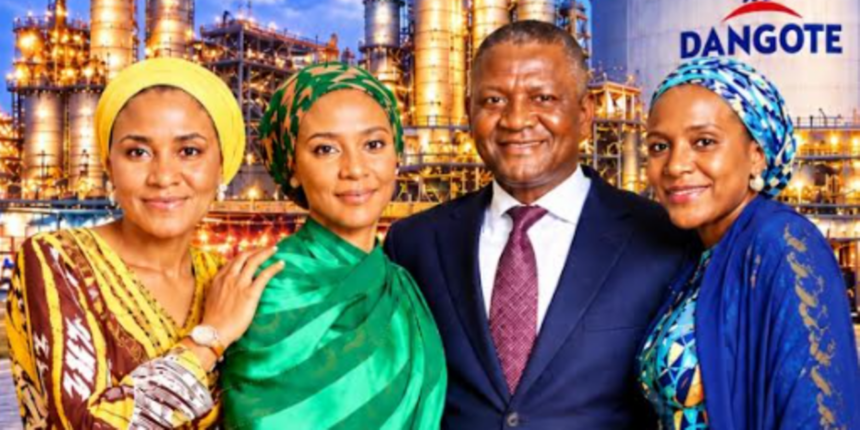
- Mariya, Halima and Fatima have taken up senior positions across the family’s cement, sugar, flour, salt and petroleum businesses.
- The three sisters have built careers spanning corporate strategy, financial management and oil and gas operations within their father’s sprawling business empire.
Aliko Dangote’s father, Mohammed Dangote, was a Hausa business associate of his maternal great-grandfather, Alhassan Abdullahi Dantata, West Africa’s wealthiest resident and the richest African during the colonial era. Aliko’s mother, Mariya Dantata, was the eldest daughter of Alhassan’s son, Sanusi Dantata, a wealthy groundnut merchant from Kano.
Born on April 10, 1957, Aliko sold sweets as a boy while observing his maternal grandfather’s “nattering style with politicians, military generals and the wheeler-dealers in the nation’s inner power circle”. He quickly learnt the intricate nexus between political power and commercial interests.
Aliko began his executive career as a store manager for his grandfather, Sanusi. In 1976, he established his own enterprise, specialising in truck importation after receiving a 500,000-naira loan from his maternal uncle, Usman Dantata. The business was so profitable that he repaid the loan within three months.

In 1977, he relocated a sizeable portfolio of his businesses from Kano to Lagos, 1,100 kilometres away, where he expanded his trading conglomerate, eventually becoming Nigeria’s largest sugar importer.
Following declining oil revenues, the government of President Shehu Shagari introduced austerity measures in 1982, including excise and import duties on 49 items. An import licensing mechanism was also introduced, but Aliko, who had already established government connections, swiftly secured the necessary licences to import cement, rice and flour for repackaging.
In December 1983, Shagari was ousted by Muhammadu Buhari, whose new regime shifted its focus to import substitution and exports. Aliko realigned his Dangote business strategy, opened Dangote General Textile Mills in Kano and began manufacturing and exporting calico fabric and lint.
In the early 1990s, President Ibrahim Babangida relaxed Nigeria’s textile policies, allowing the market to be flooded with second-hand clothes from China and India. The resulting competition crippled Dangote General Textile Mills and his Ikeja-based Nigerian Textile Mills.
By then, Aliko had fathered his eldest daughter, Mariya, from his first marriage to Zainab, before welcoming his second daughter, Halima. In the late 1980s, he had a third daughter, Fatima, from his second marriage to Hajia Rufai. She began her schooling in their hometown of Kano.
Through its government connections, Dangote Cement secured concessions that were ordinarily unavailable to other cement companies. These incentives enabled him to build a bulk cement terminal at the Lagos Apapa port, where ships carrying production inputs offloaded directly at the Dangote Group facility. According to The Dangote Empire: The Pillars of Africa’s Leading Industrialist, Aliko established five cement terminals for the importation and packaging of bulk cement.

Aliko funded Olusegun Obasanjo’s 1999 presidential campaign and, following his election in May, Obasanjo expedited the sale of a 65.96 per cent stake in the government-owned Benue Cement Company to him. Through his Backward Integration Policy, Obasanjo discouraged the importation of cement for local packaging and imposed a blanket ban on imported cement once the country became self-sufficient.
Aliko was granted tax exemptions of up to seven years under Obasanjo’s Pioneer Industry Scheme. His entry into cement manufacturing was bolstered by the fact that “cement prices in Africa are the highest in the world, averaging 200 per cent higher than any other region”. Obasanjo’s policies enabled Aliko to build the Obajana Cement factory at a cost of $800 million, with an annual production capacity of 13.2 million tonnes, before commissioning his third factory in Ogun State.
By then, Aliko’s eldest daughter, Mariya, had begun her undergraduate studies at Bayero University in Kano, qualified as a barrister and proceeded to Coventry University in England. By the time she joined Dangote Industries in March 2016, Dangote Cement was generating $6.63 million daily. The Dangote Sugar Refinery in Apapa, Africa’s largest sugar factory, was generating a further $1.83 million daily.
Mariya began her career at Dangote as a business strategist and risk specialist, focusing on corporate planning and governance across the group. During her tenure, Dangote Cement increased its production from eight million to 28.2 million tonnes annually, strengthening its control of Nigeria’s cement production capacity to 71.7 per cent.
Mariya rose to become the group strategy lead. In 2019, after three years at the group’s headquarters in Ikoyi, Lagos, she was transferred to Dangote Sugar Refinery in Apapa as director of strategy and backward integration. She improved the refinery’s digitisation and mechanisation, rising to become its executive director of operations in 2022, before joining the board of Dangote Cement in July 2025.
Her younger sister, Halima, began her career outside the family business at KPMG in Lagos after completing her marketing studies at the American InterContinental University in London. She obtained an MBA from Webster Business School before completing leadership programmes at the Harvard Kellogg School of Management in Chicago and Columbia Business School in New York City.
In 2008, Halima served as her father’s special assistant before becoming executive director at Nigeria’s National Salt and Seasoning Company. She subsequently rose to become executive director of sales and marketing at Dangote Flour Mills, where she led the company through a major financial turnaround, taking it from losses to profitability, before its sale to Singaporean agribusiness firm Olam.
Fatima, however, the youngest of the sisters and a University of Surrey law graduate, secured what may be considered the most prominent position, becoming an executive at the Dangote Petroleum Refinery and Petrochemicals Complex in Lekki. She began her career at Nigerian law firm Banwo & Ighodalo before joining Dangote Industries in 2012 as an executive assistant and technical strategic specialist.
On February 17, 2026, she was promoted to a senior leadership position overseeing commercial operations in the Dangote Refinery’s oil and gas units, following her appointment as Dangote Industries group executive director of oil and gas commercial operations.
The writer is a novelist, Big Brother Africa 2 Kenyan representative and founder of Jeff’s Fitness Centre (@jeffbigbrother).
Stay ahead with the latest updates!
Join The Podium Media on WhatsApp for real-time news alerts, breaking stories, and exclusive content delivered straight to your phone. Don’t miss a headline — subscribe now!
Chat with Us on WhatsApp