



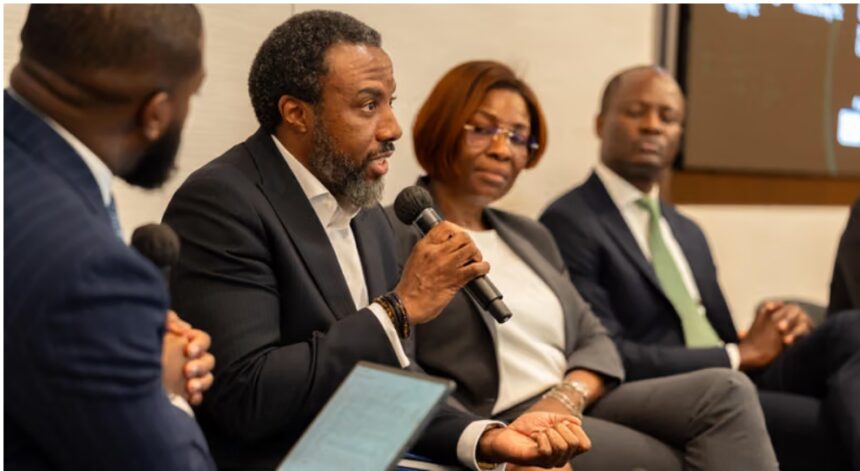
Speaking at the Nigeria–Asia Financial Connectivity Dialogue at J.P. Morgan’s offices in Singapore, Akaraiwe said the Central Bank “has built credibility, has brought in a certain degree of predictability into the market”, creating an opportunity for financial-market institutions to support further development.
He said institutions such as FMDQ could build on that progress through infrastructure and products that help investors enter the market, manage their exposures and access liquidity when they needed to exit. Stronger market infrastructure would also give regulators more efficient ways to oversee financial activity.
Akaraiwe identified broader access to hedging instruments as an important part of that development, giving businesses and investors more ways to manage risk beyond transactions in the spot market.

The impact of reform on capital formation was reflected in the contribution of Temi Popoola, Group Managing Director and Chief Executive Officer of Nigerian Exchange Group.
Popoola said the banking recapitalisation exercise had demonstrated Nigeria’s capacity to accommodate substantial fundraising, supported largely by domestic investors. That experience had strengthened the case for other major businesses to consider public-market financing.
“I really have to say that if there’s been one beneficiary of these reforms, it has been the capital markets in Nigeria,” he said.
Popoola also highlighted collaboration with the CBN that had given the capital market access to Nigeria Inter-Bank Settlement System infrastructure. He said the integration supported investor identification and onboarding, helping connect more Nigerians in the banking system to capital-market opportunities.
He linked that infrastructure to preparations for the proposed Dangote Refinery initial public offering, which he expected to attract wider participation from Nigerians and investors across Africa. Agriculture, technology, infrastructure and healthcare also offered scope for further listings, he said, as those sectors remained underrepresented in public markets.
Mayokun Ajibade, Special Adviser to the CBN Governor on Financial Markets, said the Bank’s work had focused on removing obstacles to functioning markets. Capital was now flowing from multiple sources, he said, with policy consistency and predictability important to sustaining that progress.
He described market development as a shared undertaking between regulators and financial institutions. Banks and other market participants needed to develop products that helped corporate customers manage currency and liquidity risks, particularly in cross-border trade.
Building on that discussion, Akaraiwe outlined opportunities to deepen the use of forwards and develop instruments including non-deliverable forwards, cross-currency swaps and, over time, options.
He said further reform of trade and exchange policies and systems would be necessary to support the deeper markets he envisaged. Integrating policy requirements, exchange-control processes and market data through technology could improve execution and regulatory monitoring, while providing the structure and predictability valued by Asian investors.
Professional competence was another priority. Akaraiwe said FMDQ and the CBN had identified the importance of strengthening market expertise, with a competency framework developed by the Bank being implemented gradually.
Aderinola Shonekan, the CBN’s Director of Trade and Exchange, emphasised the productive investment that closer Asian engagement could support.
She said Nigeria was interested in patient foreign direct investment from businesses that would establish industries and transfer knowledge to the domestic economy. Improving the ease of doing business and strengthening banking support for exporters and importers were important to that ambition.
Ajibade also highlighted the practical connections needed between exchanges, payment systems, market infrastructure and cross-border investment channels. Greater familiarity with Nigerian markets would help Asian investors move from identifying opportunities to completing investments, he said.

For Akaraiwe, the opportunity was to translate the credibility established through the CBN’s reforms into deeper, investable markets. Further policy development, stronger infrastructure and professional expertise would help build on that foundation and support closer engagement with international capital.
The panel was moderated by J.P. Morgan economist Gbolahan Taiwo.
Stay ahead with the latest updates!
Join The Podium Media on WhatsApp for real-time news alerts, breaking stories, and exclusive content delivered straight to your phone. Don’t miss a headline — subscribe now!
Chat with Us on WhatsApp