



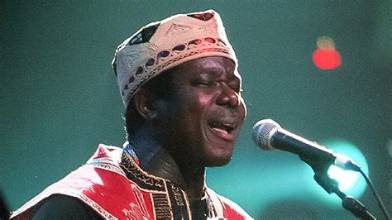
When you hear that a megastar, someone you’ve long idolised, is coming to town, you want to be there by all means — to be right in the crowd, to watch him perform live on stage. You want to sing and dance along with him, and to, ultimately, acquire the bragging rights that you have seen him in the flesh. You want to ask your mates: “Have you ever seen him with your own eyes before?” That will be a badge of honour. This was something to look forward to. And that was me in 1981 when the late Chief Silas Bandele Daniyan, the Ojomu of Mopa, decided to bring King Sunny Ade (KSA), the juju music legend, to our hometown for the funeral of his mother, the late Mrs Abigail Oni Daniyan.
For kids like me, Daniyan was about to do Mopa proud again. He had already made us proud by serving as private secretary to Dr Nnamdi Azikiwe, governor-general of Nigeria (1960-63), on secondment from the government of Sir Ahmadu Bello, the premier of the Northern Region and Sardauna of Sokoto. In the 1950s, the Sardauna had awarded him a scholarship to study economics at University of Hull, England. We believe he was the first economist from the north. He joined the northern civil service and rose to become cabinet secretary before his secondment to the Great Zik. He worked at the Nigerian Industrial Development Bank (NIDB) from 1964 to 1976, retiring as MD.
And now, Daniyan was bringing the legendary KSA to Mopa!

My grandfather, Chief Rowland Osaoloro Oludoyi, a veteran of World War II who was nicknamed “Odomode Soja” (“the young soldier”), had a strict curfew — you must be home by 7pm no matter where you were on the face of Planet Earth. It was a wake-keep and KSA would definitely not come on stage until past midnight — usually after the opening acts had entertained the guests. We thought there was no way on earth my grandfather would allow primary school kids to stay out that late, even though there were no Boko Haram terrorists or bandits at the time. But Baba himself was a fan of KSA, so it was no miracle that he reluctantly granted us a special dispensation to attend the event.
I attended the wake with much older cousins — but the fairy tale did not end well for us. At 9pm, it began to rain. Not drizzle. Rain. Rainstorm. It was an open-air event with just a few canopies. We ran back home wet, disappointed and dejected. We were told the following day that Sunny Ade came on stage past midnight, after the storm, and gave an amazing performance. We already watched his shows on TV and knew how electric he could be, especially with a guitar strapped across his shoulders. This was not the kind of experience you would enjoy through TV screens or third-party narrations. You needed to be right in the middle of it, soaked in the rhythm and lost in the rhymes.
For KSA, the Ondo prince born in Osogbo on September 22, 1946 to a church organist dad and a chorister mum who was also a trader, an event in 1981 changed his life. Island Records, the UK-based record label, had just lost a global star, the legendary Bob Marley, to complications of cancer. They needed to add another third-world artiste to their impressive line-up, which included U2, Grace Jones, Robert Palmer, Steve Winwood, Toots and the Maytals, and Black Uhuru. In 1982, they turned to KSA, who was already a megastar in Nigeria, with his own record label and a nightclub to boot. Island Records only “discovered” him in the same way Mungo Park “discovered” the Niger River.
KSA, who was born as Sunday Adeniyi Adegeye, was soon getting nominated for a Grammy after just a couple of LPs. It was a major break. His first for Island Records, ‘Juju Music’, released in 1982, happens to be my favourite of his over 100 albums, most of which I have listened to in my life journey. As kids, we were not free to listen to KSA: his lyrics could be X-rated — describing a woman’s bosom and waistline in very undressing ways, and sexual acts in barely disguised phrases. With our church minds as kids, we were more comfortable singing and dancing to the juju music of Ebenezer Obey, the Chief Commander. We could not repeat some of Sunny Ade’s lyrics before our elders.
The ‘Juju Music’ album was unusual. For a start, it had seven tracks. Popular Yoruba music leaned heavily on long-running one trackers covering a whole side of an album. That was what we grew up with. Once you started listening to a tape or an LP, you were stuck with it for 20 minutes. Radio stations would just play them in bits. No station would devote 20 minutes to one artiste. The long-running tracks were understandable within the party culture: people would dance for hours and there were instrumental interludes to stave off boredom. Martin Meissonnier, the producer, said the basic recording took just two days — although they had spent weeks trying to shorten the songs.
The Island Records influence saw KSA produce short tracks. This was considered commercially necessary: long tracks were difficult to fit into conventional radio playlists. Fela, the Afrobeat king, refused to adapt to the Western model and had issues with the record labels. He created the Afrobeat rhythm from jazz and highlife, imposing his fingerprint and personality on it with his percussion, multiple horns, pidgin English, and chants. Nobody was going to take that away from him. KSA was pragmatic: he needed to grow his audience. He retained the essence of African music — the melody, the architecture — but also accommodated the Western taste. It was a win-win.
A new Sunny Ade exploded in the 1980s, becoming perhaps Nigeria’s other global star after Fela. Exposed to more sophisticated studio equipment, advanced sound engineering and wider marketing network at Island Records, KSA took juju music to a new level. He had the freedom to explore his talent at a level not previously seen. My late cousin, Eyitayo Osho, was a big fan of KSA in the 1980s and often told me tales of his stagecraft and the wonders he did with the electric guitars. It was no exaggeration. His strength was not just the melodic singing: he was able to interlock rhythm, bass, pedal steel (Hawaiian) and lead guitars to create a groove. He introduced the Hawaiian guitar to juju.
KSA was a master of the talking drums, and he had some of the best drummers in Alhaji Timmy Olaitan, who usually took the lead, Rasaki Aladokun and Jimoh Gbadamosi. The Western audience could only enjoy the rhythm of the talking drums; for those who speak the Yoruba language, which is tonal, what a talking drum offers is more than a rhythm. It was a conversation. It was call and response. It is common for listeners to compose their own lyrics by imitating the talking drums. Music critics found in KSA a creative music artiste who stamped his authority on his genre. His use of Hawaiian guitar, in particular, was hailed for creating a bridge to several cultures beyond Africa.
For an artiste whose debut album in 1967 sold just 23 copies, no one could have predicted that he would go on to become a global star, drawing huge crowds to tours in Europe, America and Japan in an era when very few African acts were welcome on the world stage. His success opened the doors for many Africans. Unlike today when globalisation has catapulted many African artistes to the centre of global entertainment, KSA’s generation tilled the ground with bare hands. Today’s artistes are getting international collaborations with relative ease, unlike in KSA’s days. And to think Stevie Wonder played the harmonica on ‘Ase’ in KSA’s ‘Aura’ album in 1984. I bet you know Stevie Wonder.
Some Nigerians did not believe KSA would clock 80 — but he just did. And he is still looking strong and classy. There was the fear in 1991 that his rumoured lifestyle would ruin him one day. Maybe things were exaggerated, but he did seem to enjoy life to the fullest. But the troubling part was that he was actually rumoured dead. For a long while, he was out of circulation, having fallen gravely ill. Rumours were everywhere about how his lifestyle had ruined his life, even though without proof. He survived the ailment nonetheless, and he released a song, ‘Aye Nreti Eleya’, in 1992 as his response to the rumours and conjectures. He even had a word for us in the media for our intrusiveness!
KSA, whose songs were used as soundtracks in many Hollywood films in the 1980s, was nominated for the Grammy in 1984 for ‘Synchro System’, which I found to be a slower-paced remake of ‘Synchro System Movement’, released in 1974. He was the third African to be nominated for a Grammy, after Miriam Makeba and Hugh Masekela, both South Africans. ‘Synchro System’ was nominated under “best ethnic or traditional folk recording”. Clifton Chenier, the American pioneer of zydeco music, won it. KSA was again nominated in 1999 for ‘Odu’ under the “best world music” category, but Brazil’s Gilberto Gil got the prize. Regardless, KSA is always a king, even without the crown.
Happy birthday to the man affectionately known as the Minister of Enjoyment.
AND FOUR OTHER THINGS…
STIFLING STENCH

Lagos state is glamorously called the Centre of Excellence. It is the state I call home, so I would not like to say otherwise. But, yes, it has been a sad few months with refuse piling up everywhere and the state government absolutely unable to clear it. We have definitely gone backwards. We started overcoming the debilitating refuse collection problem in 2003 and we kept it going for a while — until recently. There is a clear capacity problem, worsened by poor planning and a lack of foresight. When the commissioner for the environment once derisively questioned a Twitter user if he had taken his bath “today”, I was shocked. That is what public communication has become. Putrid.
ON ‘OBIDEBT’
The unending media war between Prof Chukwuma Soludo, the Anambra governor, and one of his predecessors, Mr Peter Obi, is enjoyable but unnecessary. Obi, the presidential candidate of the Nigeria Democratic Congress (NDC), appears to have boxed himself into a corner by always celebrating not leaving any debts behind as a governor. He even promised to withdraw from the presidential race if it is proved that he owed. Soludo is now releasing the records. By the way, debt is not a crime in public finance. The key thing is having the means to repay and ensuring that the funds are not misapplied or embezzled. There is no need to make a fetish of not borrowing. Simple.
YAYI AND YEWA

I hope those salivating about the dream Oduduwa Republic are following events in Ogun state. Senator Solomon Adeola (Yayi), the governorship candidate of the All Progressives Congress (APC), has been told that he is not a Yewa but an Ekiti man and should go back to his state to contest. I know Mrs Aminatu Abiola, his stepmother, has dispelled the claim, but that is not my interest. It is the myth about “oneness”. Some people think if you break up Nigeria, there will suddenly be ethnic harmony in the new countries. No. If you harbour chauvinism in your heart, it will always find expression. A reminder, perhaps, that drawing a new border would not erase old prejudices. Fact.
NO COMMENT
Months after telling the whole world that President Bola Tinubu would attend the United Nations General Assembly (UNGA), Dr Jimoh Ibrahim, Nigeria’s permanent representative to the UN, has changed tune. “What do you think President Tinubu is coming to do?” he said, after Tinubu failed to show up. “The presidents are allowed in the UN under UNGA for 15 minutes. Is that the reason why he should board the flight and be here for 15 minutes?” He said Vice-President Kashim Shettima, who represented Tinubu, attended high-level meetings. “This is the kind of engagement we want,” he added. But he didn’t know all this when he promised that Tinubu would attend? Wonderful.
Stay ahead with the latest updates!
Join The Podium Media on WhatsApp for real-time news alerts, breaking stories, and exclusive content delivered straight to your phone. Don’t miss a headline — subscribe now!
Chat with Us on WhatsApp