




Introduction
Under Lord Lugard, the British colonial administration in Northern Nigeria established schools and as a matter of policy, granted access only to sons of the emirate class. Of course, the sentiment and intention behind such a policy was to have the scions of the Northern nobility occupy all important positions in the Native Authority. It is important to remember that this Native Authority was the preferred instrument of Indirect Rule deployed by the British, where the Emirs served as the conduit through which they kept the entire North under control. This Emirate system, unjustly deployed in both Muslim and Non-Muslim areas alike, had the effect of relegating all non-muslim and/or non-Fulani groups in the region to second class persons while living on their own ancestral lands. The British essentially put political power in the hands of the Fulani emirs and unfortunately, this historical aberration has survived the development and progress of Nigeria.

In the present day, the emirate class continues to enjoy this advantage not because there was any legitimacy in the action of the colonial administration but because they have overtime, found ways to continue to sustain the unjust arrangement and perpetuate the idea through various political and socio-economic maneuvers. In this short piece, I have tried to condense the scope of these maneuvers into five categories explored herewith.
Power is in the North
“Everyone has a gift from God. The Northerners are endowed by God with leadership qualities. The Yoruba man knows how to earn a living and has diplomatic qualities. The Igbo man is gifted in trade, commerce and technological innovation. God so created us equally with purpose and different gifts — Dr. Maitama Sule (Late) [emphasis mine].
To understand the North, one needs to understand the spirit and letters of the quote above. The statement, while seeming harmless or even inclusive, embodies the essence of the religious and socio-political aspirations of the Northern Nigeria political power elite. A wholistic explanation of the statement answers two questions:
i. What does he mean by “Leadership qualities”?
ii. What does he mean by “The Northerners”?
To the 1st question, I must say that his attempt to tie “leadership qualities” to a geographical location is indeed unfortunate. For a man of his stature, he is definitely hiding something bigger and more sinister than the weak argument that leadership qualities have a locational bias. In my opinion, and within the context of the present discuss, Dr. Maitama’s “leadership qualities” can and must be used interchangeably with the word “Power” because he was not simply asking, but was demanding that political power rests in the hands of the Northern Nigeria power elite, namely: The Mafia. In fact, in the political realm, there is this passive acceptance of the claim that ‘power is in the North’ and any politically exposed person must have, one way or the other, grappled with this phrase in the past.
To answer the 2nd question, I would say that it is highly unlikely that by “the Northerners”, he meant all individuals hailing from the entire geopolitical North. I believe that his definition of the North as a geographic entity, within the context of leadership and/or power, does not include other tribes like the Beroms, Jabas, Margis, Jukuns or even the Hausas. He refers specifically to the section of Northern society, the Emirate class, who in its efforts to maintain and keep power, has organized itself into the efficient war machine which — in certain quarters — has been called The Kaduna Mafia.
The Mafia
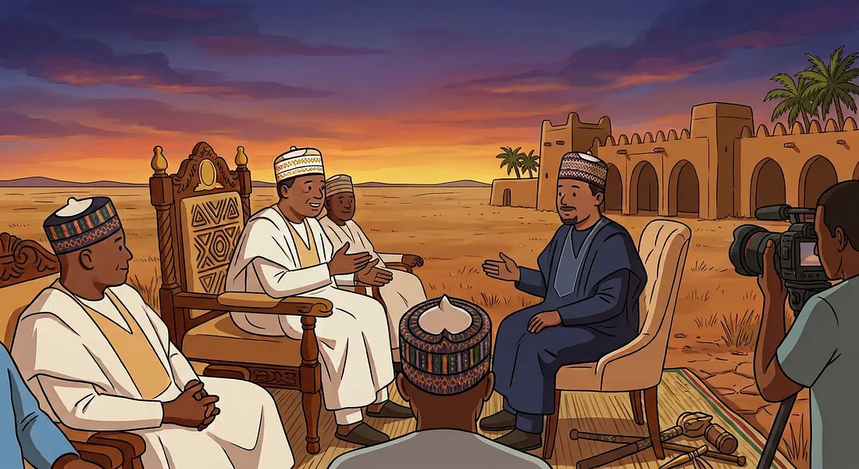
In the current discuss, the North as I see it, is primarily, not a place. By the North, I refer to a small group of persons that constitute the Northern Nigeria power elite. I am talking about the political arm of the Sultanate and the Emirates, that infamous Mafia that took residence in the City of Crocodiles. I am talking about the proverbial Hegemonic Fulani Oligarchy which has self-organized and has successfully consolidated its position by intermittently — and conveniently so — stoking the embers of ethno-religious sentiments in all places under its self-acclaimed jurisdiction.
This Mafia is a ruthless organization of strict observance. Within its ranks, power, wealth, positions and privileges are transmitted seamlessly from parents to children. This transmission of acquired taste and characteristics is carried out in a fashion that mimics the very essence and character of the type of organisations that emerged out of the old feudal societies of Italy. It is this similarity that prompted the title of the book The Kaduna Mafia edited by Dr. Bala Takaya and Prof. Sunny Tyoden. This Mafia-like organization is built like any modern military. It has all the features of a modern military, from its structure to its very purpose, namely: conquest.
Violence: A Means to an End
For the purpose of conquest, the proverbial oligarchy will stop at nothing. In fact, these people have arrogated unto themselves the prerogative of violence, as a means to an end. For them, violence is the means that takes them to their desired “end”, namely: religious homogeneity and socio-cultural and political dominance. The “means” is an array of long-term tactics and maneuvers deployed in both covert and overt religious and socio-economic war operations, with well trained and sophisticated individuals deployed in both categories.

Overtly, they have in their ranks the common man who has been radicalised. This man is fated to perform his duty through the instrument of religious extremism or in other words, terrorism. He is Boko Haram or ISWAP or a Bandit or more appropriately, the Fulani Herdsman. This radicalised man can also perform his duty through the mob that will, without hesitation, maim and kill anyone who has merely been accused of blasphemy. Essentially, the job of this man is violence and curiously, standing right next to him is the covert operator who has the duty of justifying the violence by postulating ‘respect for everyone’s religion’ despite the obvious contradiction, in principle.
Covertly, they have the politicians, military men, business tycoons, bureaucrats, intellectuals and technocrats occupying powerful and sensitive government offices at all levels. In fact, as far as the Mafia is concerned, the politicians, technocrats, bureaucrats and intellectuals within their ranks must derive their political claim or legitimacy from the Emirate. You must either belong to the ruling class or be closely affiliated to it. Since the beginning of the Second Republic, military leadership, the bureaucracy and academia, pertaining to the north has been dominated by members of the emirate class and their close associates.
The Hausa-Fulani Strategy
An important strategy that the Mafia has employed to its advantage on many fronts is the Hausa-Fulani phenomenon. In the political realm, this Hausa-Fulani nomenclature is perhaps the most important cog in the Fulani propaganda machine. It is by the instrument of this simple strategy that the mafia has consolidated political power in the region and by extension, the entire country. Simply put, it is because of this man-made phenomenon that they enjoy whatever advantages numerical strength bestows on any individual or group of persons in the political space.

But what is it, really?
In my opinion, it is a farce that has been used over time to keep Hausas and other tribes in the north and middle-belt region under control in political matters.
The term “Hausa” only comes to play when numbers are needed to convince other players on the national stage that the North is not to be trifled with, that the North must be granted their wishes. The fact however remains that once their demands are acceded to, the oligarchs will always ensure that those who benefit from the arrangement, those who become governors or ministers, those whose children get jobs in NNPC or CBN and those who get juicy government contracts are all members of the ruling class or at least, affiliates. The true Hausas and other northern tribes, irrespective of their religious persuasion usually do not benefit, except in exceptional situations where such benefit is part of a broader mafia strategy of continued control in the future.
At this juncture, I dare to postulate that in the realm, this Hausa-Fulani strategy is gradually losing its political and ethno-religious grip and thanks, in no small measure to the activities of bandits, herdsmen and other extremist groups. For oligarchs, the insecurity has had the unintended consequence of causing a reawakening amongst the northern tribes, especially in the Hausa communities.
This claim is highly demonstrable in the escalating cultural and political friction within Kwara State. The deep-seated resentment of the indigenous Yoruba population against the hegemony of the Ilorin Emirate and by extension, the Sulu-Gambari dynasty, has burst into the mainstream. This friction was vividly illustrated by the strong backlash from Yoruba nationalists following the attempted suppression of traditional Yoruba Isese festivals in Ilorin which even culminated in legal challenges against the Emir. By forcing an uncompromising Islamic-Northern identity over a historical Yoruba culture/tradition, the emirate has inadvertently reawakened a historical memory of Afonja’s betrayal, pushing local populations to openly interrogate the legitimacy of an imported feudal rule over their ancestral heritage.
Another important example is the case of the Hausa Native Advancement and Development Initiative’s petition at the International Criminal Court (ICC). By approaching the Office of the Prosecutor to seek redress against the relentless atrocities, mass displacements, and land-grabbing committed by armed Fulani militias across the Hausa heartlands, these communities are using the instrument of international law to formally divorce the identity of the Hausa victim from that of the Fulani aggressor. This move suggests that the traditional emirate structure and its political affiliates are no longer viewed by ordinary Hausas as protectors, but rather as custodians of a system that shields the perpetrators for the sole purpose of preserving a rotten political status quo.

“One North”: A Myth
I want to bring to the attention of the reader an important matter. This matter is the continued perpetuation of a myth. This myth is the erroneous assumption of “One North”. The refutation of this most obnoxious idea is in fact, not mine. It is older than independent Nigeria and I think it is important for people outside the north to know this. The north is not a single political entity. There is no such thing as “One North”.
Here is an illustration. When Ibrahim from Sokoto is in negotiations with Chinedu from Imo for political power, he mentions the north as his base. What Chinedu might not realize is that in the region, Ibrahim does not necessarily enjoy support from the people in Taraba, Plateau, Benue, Southern Kebbi, Southern Borno, Southern Kaduna, Southern Gombe, Southern Bauchi, most parts of Nasarawa State and most parts of Adamawa State. This is in addition to Kogi and Kwara states. Truth is, the Middle-Belt is not in bed with the oligarchy, at least, not anymore and no one should be left in doubt that the Middle-Belt is a real political and geographical entity. I will not go into the middle-belt bruhaha here as I have already done so elsewhere.
I assert that when-ever anybody advocates or drums support for the idea of “one North”, they do so only as a matter of convenience or to score cheap political points. The region is a bastion of discord and blurred lines of hatred and animosity where the situation is further accentuated by a level of ethno-religious violence that is threatening the very fabric of the Nigerian state. And like i said elsewhere, this violence and injustice must be dealt with urgently, as a matter of national interest.
Conclusion: The Unraveling of a Colonial Legacy
The contemporary socio-political landscape of Northern Nigeria cannot be understood without looking back on the fault lines deliberately drawn by/during British colonial rule. By institutionalizing a system that favored the emirate class and consolidated political power within the Fulani Oligarchy, the colonial administration indulged in a sort of political grandstanding that planted the seeds of an enduring inequality that relegated non-Fulani or non-emirate populations to second-class status on their own ancestral lands. For decades, this self-perpetuating phenomenon has successfully maintained its grip on power through a sophisticated mix of covert institutional dominance and the overt deployment of ethno-religious sentiments. By hiding behind the farce of the “Hausa-Fulani” monolith and leveraging the convenient myth of “One North,” this ruling elite has consistently weaponized numerical strength at the national bargaining table, while ensuring the dividends of power remain strictly within their own feudal lineage.
However, the architecture of this dominance is facing an unprecedented crisis of legitimacy. The very instruments of violence and insecurity — once stoked or tolerated to maintain ethno-religious and political hegemony — have backfired, triggering a profound reawakening among the historically subjugated Hausa communities and Middle-Belt minorities.
As the facade of “One North” continues to crack under the weight of its own contradictions, Nigeria finds herself at a critical juncture. The survival and progress of this nation depend not on sustaining a historical aberration, but destroying feudal networks, recognizing the true multi-ethnic reality of the region and replacing a pseudo-legacy of conquest with a system of genuine equity and shared prosperity.
Solomon is a Lecturer, Writer and Political Advocate; National Secretary of I-Vote Movement. PSJ Youth Ambassador. MCSN MPIN
Stay ahead with the latest updates!
Join The Podium Media on WhatsApp for real-time news alerts, breaking stories, and exclusive content delivered straight to your phone. Don’t miss a headline — subscribe now!
Chat with Us on WhatsApp