




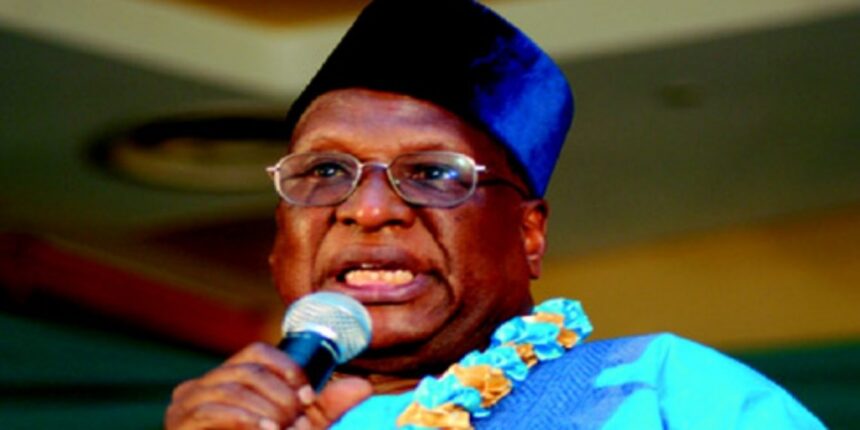
Family, friends accompanying body to Yola for burial
Veteran politician, businessman and former National Chairman of the Peoples Democratic Party, PDP, Alhaji Bamanga Mahmud Tukur has died in Abuja. He was 90.
Family sources confirmed to that the elder statesman died in Abuja on Saturday shortly after breakfast, capping a remarkable public life that spanned more than five decades across the civil service, boardroom and party politics.
His body, sources said, has been prepared for transportation to Yola, the Adamawa State capital, where he will be buried according to Islamic rites. At the time of this report, family members and associates were being notified, and a formal announcement was expected from the family.

His passing comes just days before his 91st birthday. Born on 15 September 1935 in present-day Adamawa State, Tukur had marked his 90th birthday last year amid glowing tributes to a life of service.
Tributes were already trickling on Saturday from political associates, business leaders and admirers across Nigeria and beyond, mourning a man variously described as an institutional memory of Nigerian politics and one of Africa’s most tireless champions of private enterprise.
A Consulate Politician and Business Colossus
Tukur’s career reads like a chronicle of modern Nigeria itself — from the post-civil war civil service, through the turbulent Second Republic, the military interregnum, to the return of democracy in 1999.
An alumunus of Ahmadu Bello University, Zaria, and the University of Pittsburgh in the United States, where he earned a master’s degree, Tukur first rose to national prominence in the mid-1970s as General Manager and Chief Executive of the Nigerian Ports Authority, a post he held from 1975 to 1982.
It was a stormy inheritance: the NPA was then drowning in congestion from the notorious cement importation glut of the Gowon era. Tukur’s tenure is credited with the construction of the Calabar Port, the Tin Can Island Port and the third wharf extension at the Lagos Port Complex in Apapa — projects that permanently reshaped Nigeria’s maritime landscape. He remained Honorary Life President of the West and Central Africa Ports Management Association long after leaving office.
In 1983, he crossed into politics and was elected civilian Governor of the old Gongola State — the vast territory that today comprises Adamawa and Taraba States. His tenure lasted barely three months before the Buhari coup of December 1983 terminated the Second Republic.
He returned to the front ranks under General Sani Abacha, serving on the Federal Executive Council as Minister of Industries between 1993 and 1995, where he left his imprint on the country’s industrial policy.
In 1992, he had made an unsuccessful run for the presidential ticket of the National Republican Convention, lobbying alongside rivals of Adamu Ciroma for the cancellation of a primary they alleged was rigged in the party leadership’s favour — an early demonstration of the stubborn streak that would define his later party career.
His most bruising political battle came late in life. Elected National Chairman of the PDP in March 2012 with the backing of President Goodluck Jonathan, Tukur’s tenure coincided with the party’s deepest crisis. In August 2013, seven governors, 22 senators and 57 members of the House of Representatives — led by former Vice-President Atiku Abubakar — staged a walkout and proclaimed a “New PDP” in open revolt against his chairmanship. Tukur initially vowed that only a party convention could remove him, but he finally resigned on 15 January 2014, reportedly under pressure even from his own son. He remained a member of the PDP Board of Trustees.
If politics made him a household name in Nigeria, business made him a figure of consequence on the continent. After leaving the Gongola Government House, Tukur plunged into full-scale entrepreneurship as founder and chairman of BHI Holdings, the DADDO Group of companies.
His signature achievement was the founding of the African Business Roundtable, ABR, the continent-wide association of African business leaders, of which he served as Executive President and later Life Patron.
Long before the African Continental Free Trade Area, AfCFTA, became reality, Tukur was preaching regional integration, trade facilitation and private sector-led growth through the ABR platform — work that associates credit with helping lay the conceptual foundation for AfCFTA.

In March 2002, he was elected Chairman of the NEPAD Business Group, taking the cause of African development to global stages. He served on the UNIDO International Business Advisory Council, the Ghana Investors Advisory Council, the OECD Africa Investment Advisory Board, and chaired the advisory boards of Africa Investor Ltd and African Investment Advisory.
Tukur held the national honours of Commander of the Order of the Niger from Nigeria and Commander of the Order of the Mono from Togo, in recognition of his contribution to business in Africa. Benue State University, Makurdi, awarded him an honorary Doctorate of Laws, and he was a Fellow of the Nigerian Institute of Transport Technology, Zaria.
He held the traditional titles of Tafidan Adamawa and Wakilin Ganye in his home state, and was widely respected in Adamawa as an elder and kingmaker.
He is survived by his wife, Hajiya Fatima Tukur, and a large family, including his son, Hon. Awwal Tukur. He was predeceased by another son, Mohammed Bamanga Tukur, who died earlier this year.

Burial arrangements in Yola are expected to be announced by the family in line with Islamic tradition, which calls for prompt interment.
Crediblenewsng.com
Stay ahead with the latest updates!
Join The Podium Media on WhatsApp for real-time news alerts, breaking stories, and exclusive content delivered straight to your phone. Don’t miss a headline — subscribe now!
Chat with Us on WhatsApp