

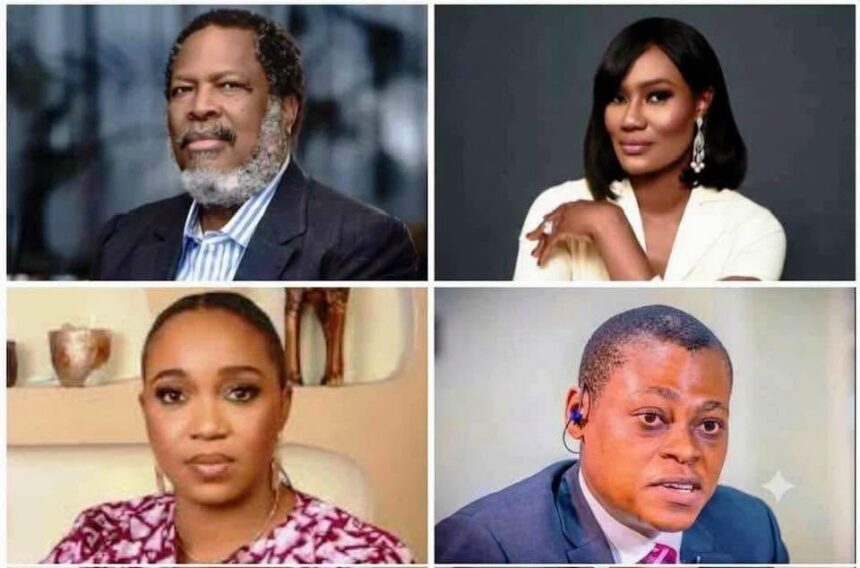
I often marvel at the theatrics and melodrama that have now become the hallmark of the Arise Media Group; especially on the Flagship TV program: The Morning Show (where the crew, but Dr Abati, have now ascribed to themselves the permanent role of the “only” upright watchdogs over Nigeria and Nigerians. A keen and discerning audience may not have failed to notice the genuflections to Nduka Obaigbena and anything about him by Rufai Oseni, Ayo Mairo and Ojy Okpe. Yet, there is a scandal that will never go away, hanging like an albatross on the neck of “The Duke” (as he is fondly called on set)
The scandal is one story Arise Media Group may have been forbidden from Spotlighting. Many may be wondering what this is all about! I will try to put it in perspective:
While ordinary terror victims were left to rebuild alone, national security accounts quietly bankrolled a N670 million payout to a media titan Named Nduka “The Duke” Obaigbena

Here is the story.
In April 2012, terrorists struck the Kaduna and Abuja premises of THISDAY and the tragedy was mourned as a devastating blow to free expression. Four lives were lost, infrastructure lay in ruins, and the nation grieved alongside the press. It was unfortunate. Yet, the true scandal lay not in the immediate smoke and debris, but in the quiet transaction that unfolded inside the corridors of state power nearly three years later.
Between late 2014 and early 2015—as Nigeria barreled toward a high-stakes general election, the Office of the National Security Adviser under Col. Sambo Dasuki (rtd) quietly released N670 million to THISDAY publisher and then-president of the Newspaper Proprietors’ Association of Nigeria, Nduka Obaigbena. Ostensibly, N550 million of the money was earmarked as terror compensation for the 2012 bombing, accompanied by N120 million meant for newspaper publishers affected by military circulation blockades.
The three-year latency of this pay-out raised immediate red flags, to wit, why did a supposedly urgent restitution slumber through 36 months of peacetime, only to awaken in the frantic, cash-heavy twilight of an election campaign?
The moral dissonance was stark. Across Kaduna, Kano, Maiduguri, Jos and several other cities and villages across Nigeria, millions of ordinary Nigerians buried loved ones, lost ancestral homes, and saw entire livelihoods incinerated by Boko Haram and other criminal terror gangs. To those citizens, the state maintained a rigid orthodoxy: government could not set a precedent by compensating private victims of terrorism. Yet, an elite exception was carved out for a well-connected publisher, financed directly from defense accounts; funds which were intended for front-line arms purchase, intelligence operations and military logistics to fight the very cause of the terror attacks!
The mechanics were equally telling. Rather than moving through transparent bureaucratic channels, the funds were funneled into a company named General Hydrocarbons Limited – an energy firm owned by Obaigbena with no defense or media mandates. When anti-graft investigations exposed the arrangement, the ethical fallout split the media industry.
Principles triumphed over patronage as outlets like The Sun returned their allocations; daily Independent and New Telegraph dissociated themselves from the disbursement; Nigeria Tribune and People’s Daily denied taking any money. The Punch severed ties with the proprietors’ association, and Obaigbena eventually entered a refund agreement with the EFCC, which allegedly saw him returning about three hundred and fifty million Naira to the national treasury.
The episode laid bare a troubling framework where media power oscillates between covert patronage and weaponized opposition. It became suggestive that in the circles of some of Nigerian press, when state resources flow smoothly through off-the-books channels, editorial alignment follows, and when constituted authority cuts the tap, the apparatus pivots seamlessly to aggressive moralizing and hostility.
See where I am heading with our moral “watchdogs”; our self-professed barometer of conscience?
For an institution meant to serve as an unyielding watchdog, this historical record remains a sobering reminder of the line between public accountability and private enterprise. I am throwing a public challenge to Rufai Oseni (leading the voracious pack at dishing out innuendos) and his crew on The Morning Show, to spotlight the N670 million matter involving their paymaster and to thoroughly condemn The Duke Obaigbena or they should stop being sanctimonious and accept that they are nothing but hatchet men and women available as tools in the hands of their pay master…
In my next note, I will be highlighting the Emefiele angle to the anti-government sentiments that seemingly shapes the editorial policy of Arise Media Group as dictated by The Duke.
Please stay tuned
- Danjuma Musa wrote in from Kaduna
Stay ahead with the latest updates!
Join The Podium Media on WhatsApp for real-time news alerts, breaking stories, and exclusive content delivered straight to your phone. Don’t miss a headline — subscribe now!
Chat with Us on WhatsApp