



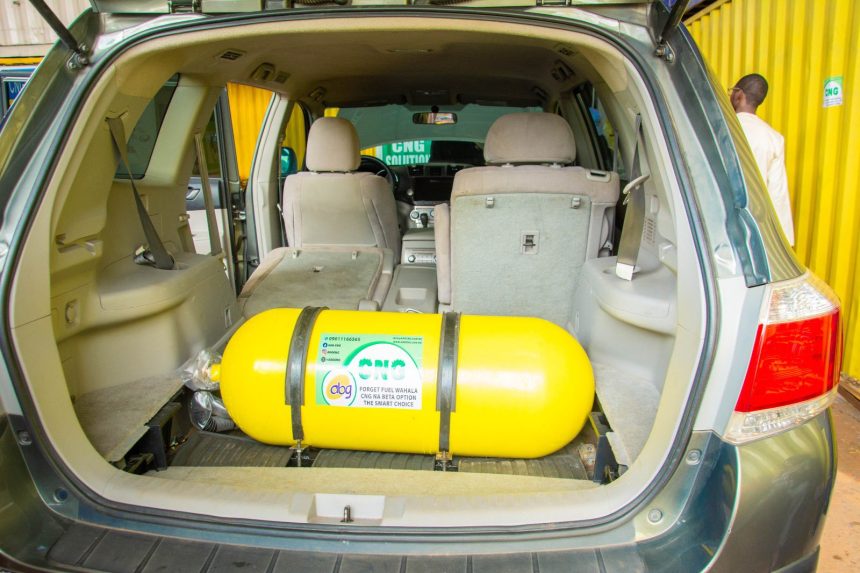
Three years after the federal government began pushing for the use of compressed natural gas (CNG)-powered vehicles in Nigeria, following the surge in the price of premium motor spirit (PMS), also known as petrol, many car dealers have not keyed into the initiative.
While buses and tricycles are being converted to CNG engines, cars are still mostly running on petrol.
During a market survey by TheCable, the publication learnt that in 2025, auto dealers invested billions of naira in importing cars into Nigeria; petrol-powered cars accounted for the majority of the investment, while only one private vehicle with a dual engine — consisting of CNG and petrol — was brought in.

‘NO DEMAND FOR CNG-POWERED CARS’

Femi Oladipupo, the manager of LongVille Auto, an automobile dealer, tested the waters by investing in a CNG-petrol-powered car, but his fingers got burnt.
“We sold like 15 petrol cars, and that single one (CNG car) was on the ground,” Oladipupo told TheCable.
The investor, with 26 years of experience in the auto-dealing market, said the CNG vehicle remained in his car lot for about a year without demand, and he eventually had to start using it.
“There was a vehicle we brought in (2025). A Toyota Corolla. It was CNG and petrol together. That car was here for over a year,” he said.
Following the company’s inability to sell one CNG-powered car in one year, Oladipupo said he has no intention to buy such vehicles for sale.
To avoid Oladipupo’s situation, Gbenga Ashaolu, founder of God’s Help Autos International Limited, focused his “over N1 billion investment” in car importation last year on petrol-powered cars.
“I don’t sell CNG vehicles,” he said.
Ashaolu said he is a businessman whose operation is determined by customers’ demand, as the company does not buy cars for itself, adding that “we’ve been hearing about it (CNG), but nobody has asked, and I can’t buy what people are not interested in”.
Morenike Adefehinti, the manager of Atlantic Biscoe, shared Ashaolu’s assertion, saying the first person to ask about CNG-powered vehicles in the company’s car lot was this reporter.
“You are the first person to approach me for a CNG car, and you are not even approaching me because you want to buy; it is because you are doing your findings. Do you get? This year, nobody has entered this car lot for a CNG car, so tell me why we should order a CNG car,” she added.
The manager explained that Atlantic Biscoe would not risk buying CNG-powered vehicles without demand because if her company fails to sell the car on time, it might incur losses, as Nigerians do not buy cars that stay too long in an automobile lot.
“I have a Sequoia there. It’s 05, and it has been there for like five to six years. Somebody came to ask for the price, and I told the person, and he said, ‘Let me see the paper.’ He saw the paper, and he said, ‘This car came in like five years ago; una go don dey use am for Nigeria.‘”

“Do you see the mentality? I can also think like that. And he’s not wrong to think like that.”
Expanding on the risk, the manager said the company can stock up a petrol-powered car for four to five years in the car lot, and when a customer buys it, all Atlantic Biscoe has to do is service the vehicle, and it starts.
“But gas, do we know what it has to go through, because we’ve not operated it before? We don’t know maybe if it’s sitting in one position for like six months, will it stand up, just like the fuel one will stand up? So when we look at that, do you want to go through that stress?” she asked.
Due to the uncertainty, Adefehinti said the company, which buys cars like Tundra and Tacoma from auctions that do not have CNG-powered vehicles, would only expand its fleet to include vehicles with gas engines based on the volume of demand.

“Let three people come and say, ‘We are looking for a CNG car.’ Then we can think, ‘Okay, let’s use one as a test, and maybe we can start bringing them”, but nobody has asked,” she added.
‘CNG CARS TOO PRICEY TO SELL’

Oladipupo said the cost of the CNG-petrol powered vehicle he placed on sale outstrips that of petrol-powered cars as a result of the fuel efficiency.
“Because of the fuel efficiency, that made the price higher than the normal petrol (car). Now, people like a situation whereby they will just say, ‘Okay, this one is N12 million, this one is N10 million or N10.5 million. So why wouldn’t I go for the one of N10 million or N10.5 million?’” he added.
Adefehinti also cited the cost of CNG cars as one of the reasons her automobile company has not commenced sales, adding that she is not a fan of converting petrol-powered cars to CNG due to the risk of errors during the conversion.
“Apart from the auction, when we bring it here, changing it to CNG is a lot of processes that even demand more money. Because we are still bringing in (petrol cars) and we are selling, and people are still complaining (about the price),” she said.

“Now, imagine we change it to CNG; we have to add the money we use in converting it. It (price) goes higher again. And I don’t think I ever will, even if I’m the owner of this car lot, think of changing any car I bring here to CNG.”
Speaking further on the cost involved, Adefehinti said it is not that “we do not want to change it to CNG. When Camry or Corolla was still N1.5 million, if they changed it, they would sell it — you can’t use N500,000 to do everything (conversion) – for N2 million or N2.1 million”.
“But now that even the smallest Corolla is going for N9 million to N11 million, and you want to convert it to CNG, you have to add your money, and you have to add your profit. Do you think people will not complain? So, on our own part? We do not see the reason to change a fuel (petrol) car to CNG because it’s a lot of trouble,” she added.
WHY NIGERIANS ARE NOT DEMANDING CNG-POWERED CARS
Oladipupo said the lack of demand for CNG-powered cars is due to it being an innovation in Nigeria, and people are just understanding it.
“It will take a long time to change people’s perspective on what they are used to doing,” he said.
“We as dealers sell to end users; now, we are investing our capital at first. We bring in cars, and this is the vehicle Nigerians are very aware of. So, suddenly, you want to invest your capital — the one you are investing in petrol cars — you want to shift it to another system entirely.
“It’s like you don’t really know what will come out of it, and for you now to put in your capital there, you know, as a businessman, you need to have some thinking about it; wouldn’t this tie down my capital?
“That’s why we don’t want a situation whereby we just invest our capital in CNG and, at the end of the day, have no patronage. The thing would just be there; nobody would come to buy, and the money would run out. That’s just the reason why we don’t invest in CNG. We believe in the traditional way of doing business.”
He said when people know more about CNG and are used to it, his company will start investing in it.
Oladipupo also blamed fear of gas explosion for the lack of patronage, saying that “most Nigerians are still having fear about the gas stuff because of the danger (explosion). They say, ‘Well, let’s just stay with petrol’”.
“That is what is dragging down the CNG business,” he added.
Adefehinti also said people are avoiding CNG-powered cars, not because they are not good, but due to some individuals’ experiences.
“Maybe for the first time you’re hearing an experience about CNG, you are hearing the worst of it. It is just Nigerian mentality: once I hear your experience, I won’t go there,” the manager added.

Classism is also one of the challenges affecting demand, according to Paul Oduyomi, the founder of Pobil Autos, who said Nigerians might be ignoring the CNG-powered cars to avoid being seen as a poor person for buying a car that uses cheaper fuel.
“People will say I don’t have money; that’s why I’m using CNG; class problem with Nigeria; we can have that too. ‘Ah, it’s CNG you are using, I’m using petrol. How much do they sell petrol that you cannot afford it, and you are turning your cars (or) buying CNG cars?’” Oduyomi said.
“So, it can also discourage people.”
GOVERNMENT NEEDS TO IMPROVE AWARENESS
Qudus Adeshina, the marketing officer of DM 101, said the government needs to increase awareness of CNG among Nigerians and auto dealers.
Adeshina said his company, which spent “over N1 billion” on car importation last year, pushes for petrol-powered cars because of its awareness.
“What I notice is that, because we know more about petrol cars, that’s why we are pushing it. Most people believe that it’s only the danfos (commercial buses) that need CNG,” he said.
Ashaolu echoed Adeshina’s advice, saying the awareness about CNG is still low among car users, and “by the time people begin to demand CNG, it’s easier for us to also put our investment in it. But for now, the awareness is really low”.
For Adefehinti, the only way the government can encourage auto dealers to include CNG-powered cars in their automobile lot is if the government wants to give out the cars and plans to buy them from the dealers.
Stay ahead with the latest updates!
Join The Podium Media on WhatsApp for real-time news alerts, breaking stories, and exclusive content delivered straight to your phone. Don’t miss a headline — subscribe now!
Chat with Us on WhatsApp