



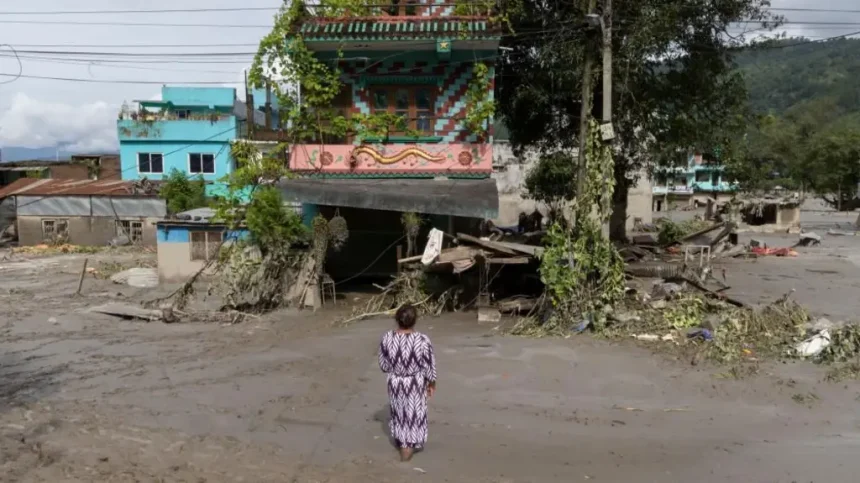
Rescuers in Nepal and Tibet are racing to search for survivors after Wednesday’s flash flood destroyed homes, swamped roads and swept away bridges
More than 900 people are missing and at least 389 have died in Nepal
The US Geological Survey says “glacial collapse and debris flow” triggered the deluge – and there are risks of more floods

A lake of rising water has formed at a site along the China-Nepal border – prompting fears it could burst its banks, reports Laura Bicker in Beijing
In Tibet, at least 558 people are missing, with three confirmed dead, but it’s not clear if these figures overlap with Nepal’s
On both sides of the border, hundreds of foreigners are missing – Nepal says that includes 178 tourists from India, 65 Americans, and 33 from the UK. Dozens of army and police personnel are also missing
Two sisters are desperately waiting for news of their parents, who travelled from Texas to Tibet on a pilgrimage: “We just love them a lot and want them to come home,” they tell the BBC
A man in Sussex tells us he thinks his wife, mum, uncle and brother may have died in Nepal
Edited by Elaine Okyere, Craig Hoyle and Tinshui Yeung, with reporting from BBC Nepali, Azadeh Moshiri in Kathmandu, and Laura Bicker in Beijing
What’s the importance of Gyirong, the largest China-Nepal land border crossing?published at 19:00
Gyirong is the largest land border crossing between China and Nepal, and Nepal’s single biggest trading link with Tibet.
Trade has surged in recent years – in 2024 alone, $632m (£466m) worth of goods crossed the port, roughly 30% of total China-Nepal trade that year.
It’s also a flagship Belt and Road project, branded as China’s gateway to South Asia, and the main route for foreign tourists and pilgrims heading to Mount Kailash.
Gyirong sits in a region prone to natural disasters and has suffered damage in the past.
An earthquake in 2015 destroyed Tibet’s other main crossing, Zhangmu, prompting China to develop Gyirong as its replacement. It reopened as an international port in 2017 and later became Tibet’s first Border Economic Cooperation Zone.
Then, in July 2025, flash flooding – likely caused by a glacial lake outburst – washed out Gyirong’s bridge. The port fully reopened on New Year’s Day this year.
That same road and infrastructure has now failed again.

Chinese President Xi Jinping has once more called for stronger monitoring and early-warning systems, echoing near-identical instructions issued after the 2025 flood – a sign that whatever measures followed last time weren’t enough to withstand a repeat event just over a year later.
Enormous boulders swept along Trishuli River, videos showpublished at 18:40
By Benedict Garman, Sherie Ryder and Charlotte Green
Shocking footage shared on social media shows two enormous boulders being swept down the Trishuli River in Nepal, demonstrating the sheer power of the surging floodwater.
A video confirmed by BBC Verify shows a huge rock being pushed slowly past houses in a flooded valley, about 35 miles (56km) from where the flood began.

The second verified clip, filmed about 3 miles further downstream, features a second boulder being violently rolled by waves in the muddy water.
While there has been speculation on social media that the boulders are glacier debris, remnants of the original landslide which appears to have triggered the flash floods, we have not been able to confirm this.
But we have established they are two distinct rocks rather than the same one filmed at different places by checking other footage and satellite imagery – both of which show that the first boulder came to a halt in the river before reaching the location of the second video.
Almost 40 hours since deadly flash flood at Nepal-Tibet border – a timelinepublished at 18:26
On Wednesday morning, a huge surge of mud and water swept down from the Nepal-Tibet border, leaving destruction in its path. Since then, the number of dead and missing has climbed, while rescue and recovery efforts have been under way.
This is how the last 40 hours have played out:
Wednesday

08:37 local time in Nepal (02:52 GMT): A magnitude 5.2 seismic event occurs near the Nepal-Tibet border. This was initially thought to be an earthquake, but the US Geological Survey (USGS) has since said it was a glacial collapse.
The USGS says the flow of debris from the collapse led to “subsequent catastrophic impacts downstream”.
Moments later: A wall of water and other material crashes downstream, taking buildings, roads and vehicles in its wake.
14:45: Authorities say 384 tourists are missing, including 291 foreign nationals. Nepalese authorities later confirm that 33 Britons are among those missing.
By 17:00: Nepalese police tells the BBC that at least 17 people have been killed.
22:45: The Nepalese prime minister’s office says search and rescue operations will continue throughout the night, with civilian and military personnel mobilised.
Thursday
By 08:00 local time (00:00 GMT) in Tibet: China says three people were killed on the Tibetan side, while 558 others are missing.
Shortly after 07:15 (01:30 GMT) in Nepal: Nepalese police say they have recovered 162 bodies so far. This figure has continued to rise throughout the day – and currently stands at 389.
Mid-morning: The Dalai Lama, the spiritual leader who lives in exile from Tibet, says he is praying “for all those who have lost their lives”.
14:00 in Nepal: An update from authorities puts the number of missing people at more than 900, including more than 500 foreign nationals.
Approximately 90 US nationals affected by floods, no deaths confirmedpublished at 17:57
The BBC understands that as of 08:00 ET (13:00 BST) the US government is aware of approximately 90 US nationals who may be affected by the floods.
The government is not aware of the deaths of any US citizens, but three US citizens have been safely rescued in Nepal.
The US State Department is providing $500,000 in emergency relief funds and has deployed a disaster response adviser to the region to support recovery efforts.
Deadly floods bring traffic to a standstill in Nepalpublished at 17:46
We can bring you some images from a major motorway in Kathmandu, Nepal, which has been halted by the floods.
Vehicles are stranded and congestion is building as the roads remain closed.
Number of rescued and injured in Nepal reaches 466 – policepublished at 17:27
The most recent update from Nepal police says that the number of injured and rescued people in the country now stands at 466, and it breaks it down by district.
We’re getting different figures from various agencies in Nepal. Earlier, we heard from the country’s prime minister that at least 573 people have been rescued today.
Information on impact of flood on Tibet ‘carefully controlled’published at 17:20
Rescue efforts in China are being led by the People’s Liberation Army, but state media said they face multiple challenges.The Air Force did manage to use a brief weather window to fly a drone over the area to try to find survivors and assess how safe it was for rescue teams to enter.
The border town of Gyirong is the main crossing for people and traffic heading between Nepal and China. Video footage appears to show a crushing wall of water crashing through buildings and washing away trucks and cars.
Thousands of pilgrims were making a journey along this route from Nepal towards a sacred mountain in Tibet. This is also one of the most controlled and politically sensitive regions of China.
Access to Tibet is restricted for foreigners. All the information we receive is from Chinese state media which is also carefully controlled.
Death toll rises to 389 in Nepal, say policepublished at 17:08BREAKING
The number of people killed in Nepal by flash flooding has risen to 389, according to Nepal police.
This is an update from the previous death toll of 359 given by authorities a few hours ago.
At least 573 people rescued today, says Nepal’s PMpublished at 16:51
We’ve heard again from Nepal’s Prime Minister Balendra Shah, who has been visiting areas affected by the recent floods.
He says over 13,000 security personnel from the Nepali army, armed police force and national police have been mobilised to engage in search operations – with 69 flights rescuing 573 people across the day.
Temporary relief camps have been set up and free treatment is being provided to injured citizens, he adds.
Shah says the government’s focus is on saving lives, searching for those who are missing, and providing relief to those affected.
‘No one has any answers,’ says daughter of missing US citizenspublished at 16:37
Ramesh Sharma, 65, and Neelam Sharma, 64, two US citizens of Indian descent, were travelling to Mount Kailash on a pilgrimage when the disaster struck.
Their daughter, Radhika Sharma, has not heard from them since the floods.
“They’re very religious,” Sharma tells the BBC. “So this is something that was very important to them.”
“The last we know is they were at the border… about an hour before the floods,” she says. “And we are hoping that they made it to the Tibet side.”
Sharma has spoken with the US Embassy in Beijing, who told her they are trying to locate US citizens in Tibet. She also tried to reach the US Embassy in Nepal to no avail. “No one has any answers,” she says.
“We’re just trying to piece together the story ourselves, to be honest,” she adds.
More than 17,000 children need urgent humanitarian assistance – Unicefpublished at 16:24
The flash floods in Nepal have left more than 17,000 children in need of urgent humanitarian assistance, according to children’s charity Unicef.
Its representative to Nepal, Alice Akunga, says children in the affected areas “saw their lives being literally washed away”, while “too many lost their lives and loved ones”.
“Children who have survived the floods now face heightened risks of disease, malnutrition, violence and exploitation,” she adds.
Akunga says Unicef is offering support on the ground, but “urgently” needs more resources “to reach every child in need”.
The charity is appealing for $17.2m USD (£12.6m) to sustain its early response “until the full extent of needs are assessed”, warning its services to children and women will be “severely constrained” without funding.
Army training centre becomes rescue hub in Nepalpublished at 16:15
As search and rescue efforts continue following the floods and landslides in Nepal, Maithali Barrack, an army training centre in Nuwakot district, has become a key base for emergency operations.
Helicopters are airlifting survivors from affected areas, while rescue teams work to reach communities cut off by the disaster.
Here are some of today’s pictures:
Chinese Communist Party calls on members to help maintain stability in Tibetpublished at 15:47
The Communist Party in Chinese-controlled Tibet is calling on grassroots members to help maintain stability in the region in the wake of the mudslide.
The party is wary of any anger or instability in a fragile region, which has a history of resistance to Beijing’s rule.
They are urging members to help in disaster relief efforts in their area and provide emotional guidance or psychological support to affected residents – especially those who have lost loved ones.
The emergency notice by the Organisation Department also offers incentives saying those who perform badly or are found guilty of dereliction of duty will be held accountable.
Missing tour group sent video nine minutes before floods hitpublished at 15:36
The last video from a tour group was sent just nine minutes before the floods hit, says the owner of a travel company.
Roshan Pandey, of Fishtail Tours and Travels, says he’s heard nothing from the group of 20 tourists since then.
Two Americans, one Briton and 17 Malaysians, all bound for Mount Kailash, along with seven Nepali staff guiding them are missing.
They were near Timur, a Nepali border town close to the Tibet crossing, where they had stopped to wait for a small landslide, which are common in the region, to clear.
The group had just sent a video showing it was under control, and that they were about to cross into Tibet.
“Not a single piece of brick is visible in that area, everything is under mud,” Pandey said.
Officials warn of possible blockage and secondary flood risk from Bhote Koshi riverpublished at 15:22
As we reported earlier, officials in Nepal are warning of a possible secondary flood risk near the Bhote Koshi river.
The National Disaster Risk Reduction and Management Authority says satellite information from China suggests the river has been “blocked” and that a “lake” has formed near the site of yesterday’s flash flood.
In a social media post, it says the information suggests “the lake is in the process of rising and there is a risk of bursting”.
It warns residents and rescuers in the lower bank area to “exercise special caution” and stay in safe places away from the river banks.
Why is it so hard to know what is happening in Tibet?published at 15:12
Tibet, which China annexed in the 1950s, is one of the most strictly controlled regions in the country.
It has long demanded greater autonomy and is heavily monitored because Beijing fears any signs of instability such as protests.
That is why orders are now coming personally from the top leader Xi Jinping, and Premier Li Qiang is on site today. It is rare for him to make a visit so soon after a major disaster.
To get into Tibet requires a special visa and it is difficult, if not impossible, for foreign media to gain entry. Trying to contact people there is just as hard.
This makes it very difficult for us to know what is happening and we are relying heavily on reports from Chinese state media.
Pilgrims making their way from Nepal through Tibet to the sacred mountain of Mount Kailash need four separate permits, which includes special permission from the Chinese military.
The Chinese foreign ministry has said 260 of the 558 people missing are tourists or pilgrims. We don’t know how many of the remaining are Tibetans, and how many are Chinese people who have moved there to run businesses or work on infrastructure projects.
‘We hope he is alive’ – family awaits news on missing Indian manpublished at 14:59
We are continuing to hear from families in India waiting for news of relatives caught up in the deadly flash floods.
Among them is the family of Ranajit Kumar Howladar, 63, who is part of a group of 30 tourists and two tour assistants from West Bengal who have been unreachable since 25 August.
Howladar was travelling to Kailash Mansarovar in Tibet, a major pilgrimage site sacred to Hindus and several other faiths.
His wife Gayatri tells BBC Hindi she last spoke to him on Tuesday night. “We just hope he is alive,” she says.
Their daughter Sunanda, who has been seeking information from police and the tour operator, says the agency told her two women from the group had been rescued, but could not provide information about the others.
Howladar, a retired railway employee, had waited until retirement to make what his wife described as a “dream” pilgrimage.
How did the floods spread, and which areas are most affected?published at 14:44
As we’ve been reporting, the US Geological Survey has said flash floods were sparked by a glacial collapse in the mountainous area close to the Nepal-Tibet border.
This resulted in seismic activity and caused “catastrophic” impacts downstream of the Trishuli river, as floodwaters spread into several regions in Nepal.
The Rasuwa district is the closest to the origin of the floods, while the neighbouring Nuwakot district has also been severely impacted.
In its latest update, Nepal police says of the 359 bodies recovered so far, 17 were recovered from Rasuwa and 28 in Nuwakot.
It added that 132 bodies have been recovered in Chitwan, which is where the Trishuli runs its course and flows into the Seti Gandaki river.
King Charles and Queen Camilla ‘heartbroken’ over Nepal flash floodspublished at 14:25
King Charles III says he and the Queen are “heartbroken” and send their “most profound sympathy” to those affected by the “devastating” flash floods in Nepal.
“Many in the United Kingdom have strong, deep and personal ties to this part of the world,” the British monarch says in a written message.
“We send our most profound sympathy to all those who have so tragically lost their loved ones and we feel deeply for the many families awaiting anxiously the news of friends and relations.”
The King also pays tribute to “the police and Armed Forces personnel who lost their lives while carrying out their courageous duty in the service of others”.
He adds that “as always, the United Kingdom stands ready to help support those in need”.
Families gather at airport in hope of informationpublished at 14:12
Here at Kathmandu’s domestic airport, we’re seeing military support arriving – all part of the effort to find the hundreds who are missing right now.
Families are gathering, waiting for any information they can find.
We spoke to one woman who was in contact with her husband at 08:30 local time (02:45 GMT) yesterday but hasn’t heard from him since. She’s desperate for information.
“My husband had taken the car to pick up a guest,” she says, adding that she has come today because she heard that the injured are being brought here after being rescued.
Source: BBC
Stay ahead with the latest updates!
Join The Podium Media on WhatsApp for real-time news alerts, breaking stories, and exclusive content delivered straight to your phone. Don’t miss a headline — subscribe now!
Chat with Us on WhatsApp