



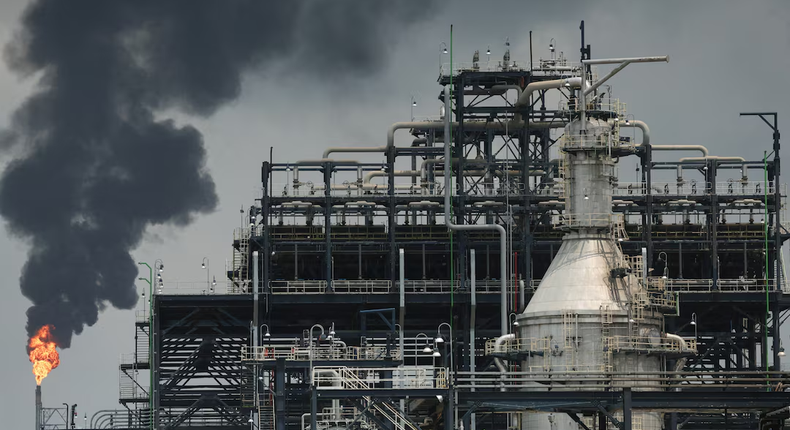
Nigeria’s domestic crude supply system is coming under renewed scrutiny after Dangote Refinery said oil routed through international oil companies and third parties is raising its feedstock costs, with industry estimates putting the additional burden at as much as $4 per barrel.
The complaint exposes a deeper problem in Nigeria’s effort to supply its growing domestic refining industry, crude may be produced locally and formally offered to refiners, but the route through which some barrels are sold can make them more expensive than alternative supplies available on the international market.
Dangote Petroleum Refinery has previously said that intermediaries can add between $3 and $4 per barrel to crude acquisition costs. The Nigerian government is now considering changes to its crude allocation and pricing system to improve direct access for domestic refiners.

The refinery raised similar concerns in a Tuesday statement by Devakumar Edwin, Group Vice President, Oil & Gas and Fertiliser at Dangote Industries Limited, responding to recent figures from the Nigerian Upstream Petroleum Regulatory Commission.
Edwin said a substantial share of crude allocated to the refinery under Nigeria’s Domestic Crude Supply Obligation has had to be obtained through international oil companies and third parties rather than directly from upstream producers.
That arrangement, he said, introduces additional premiums and transaction costs that can push the price of Nigerian crude above internationally recognised benchmarks.
In some instances, according to Edwin, domestically sourced crude has consequently become less competitive than barrels available on the international market.
The economics are significant for Dangote, whose Lagos refinery has capacity to process 650,000 barrels per day.
At full capacity, a $3 premium across 650,000 barrels would theoretically represent nearly $2 million in additional daily crude acquisition costs, while a $4 premium would push that figure to about $2.6 million. Actual costs would depend on how much crude is bought through intermediaries and the refinery’s utilisation rate.
The dispute comes as Nigeria tries to reduce its historical dependence on imported petroleum products by supplying its expanding domestic refining industry with locally produced crude.
Nigeria is considering changes to its domestic crude allocation and pricing framework as local refiners push for more direct access to competitively priced feedstock. BI Africa
Dangote pushes back against NUPRC figures
The latest statement follows NUPRC data previously reported by Business Insider Africa showing that Nigeria’s domestic crude supply performance improved sharply during the second quarter of 2026.
The regulator said producers supplied 53.7 million barrels of crude oil and condensate to local refiners between April and June, representing 97.4% performance against allocated volumes.
NUPRC also said Dangote Refinery accepted 52.6 million barrels from approximately 68.1 million barrels offered by producers during the quarter, suggesting that roughly 15.5 million barrels offered to the refinery were not taken up.
Dangote is now challenging the interpretation of those figures.

Edwin said the key issue is not simply how much crude is recorded as having been offered under the Domestic Crude Supply Obligation, but how much is genuinely available for purchase on commercially viable terms.
The refinery said it remains willing to purchase Nigerian crude provided sufficient volumes are available at competitive market prices.
That distinction is important because an offer recorded under the domestic supply framework does not necessarily mean a transaction will take place if the refinery considers the price commercially unattractive.
Dangote said it has encountered instances in which Nigerian crude was offered significantly above prevailing market benchmarks.

Higher feedstock costs ultimately flow through the refining chain and can increase the cost of petroleum products sold into the domestic market, Edwin said.
Nigeria considers changes to crude sales
The disagreement is emerging as Nigerian authorities consider reforms aimed at removing some of the costs associated with getting locally produced crude into domestic refineries.
Reuters reported that proposals being evaluated include allowing producers connected to international oil companies to supply nearby refineries more directly and providing discounts for refiners that lift crude directly from production facilities.
Such discounts could reflect savings on freight and handling costs that are embedded in international benchmark-linked crude prices even when Nigerian oil is sold to a refinery within the country.
The proposals suggest Nigeria’s domestic crude debate is shifting.

For much of the period following Dangote Refinery’s commissioning, the central question was whether domestic producers were supplying enough crude to local refinineries.
That pressure helped produce the Domestic Crude Supply Obligation and the government-backed naira-for-crude arrangement intended to guarantee feedstock for local refining while reducing pressure on foreign exchange.
Compliance has subsequently improved. NUPRC says producer compliance with domestic crude supply obligations rose above 90% in the second quarter, from below 43% in the preceding quarter.
Nigeria’s crude production has also recovered. NUPRC said the country produced an average 1.56 million barrels of crude per day in June, excluding condensates, its highest level since April 2020.
Stay ahead with the latest updates!
Join The Podium Media on WhatsApp for real-time news alerts, breaking stories, and exclusive content delivered straight to your phone. Don’t miss a headline — subscribe now!
Chat with Us on WhatsApp