


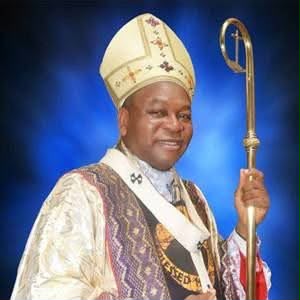
Every society relies on a few voices whose moral authority transcends politics. They steady the public conscience, calm the national pulse, and remind leaders of the higher call to justice and compassion. Cardinal John Onaiyekan once occupied that space. But his intervention since 2022, in the build‑up to the 2023 presidential election, revealed a troubling shift: the altar had become a political megaphone.
A Brief Look at an Illustrious Career
At 82, John Cardinal Onaiyekan remains one of the defining voices of Nigeria’s Catholic community. His rise from parish priest to Archbishop of Abuja and eventually to the College of Cardinals placed him among the most respected Christian voices on the continent. For decades, he was celebrated for his scholarship, his interfaith diplomacy, and his advocacy for peace. His elevation to Cardinal was the pinnacle of a life devoted to service.

But alongside this illustrious journey were moments when his public interventions blurred the line between spiritual guidance and political activism. Those moments, however, pale in comparison to the overt political posture he adopted from 2023 onwards.
Crossing the Line
After a recent visit to President Bola Tinubu by the Catholic Bishops’ Conference of Nigeria (CBCN), Cardinal Onaiyekan made comments that crossed a line he had previously respected.
He claimed that President Tinubu and his aides “were not looking very happy” during their closed‑door meeting. He also outlandishly claimed that the President was not aware of the suffering of the people.
Yet video footage released by the Presidency showed a calm, confident President explaining the dire economic situation he inherited and the steps already taken to stabilise the economy.
One thing became instantly clear. Onaiyekan did not go into that meeting with the sincerity of a missionary seeking the good of the land. He went with a vengeance to ridicule and condemn. He went with a hidden agenda camouflaged as speaking truth to power. He went for a monologue, not a dialogue. He was irritated and dismissive. Only his voice mattered. Only his voice was superior.
If he had carried a spiritual message from the throne of grace, divine humility would have manifested. Instead, he attempted to use his exalted office to impose a personal view on the country’s leader. For reasons best known only to him, he forgot the part of Scripture that says no leader rises without God’s knowledge.
The Politics of 2023 and the Partisan Turn
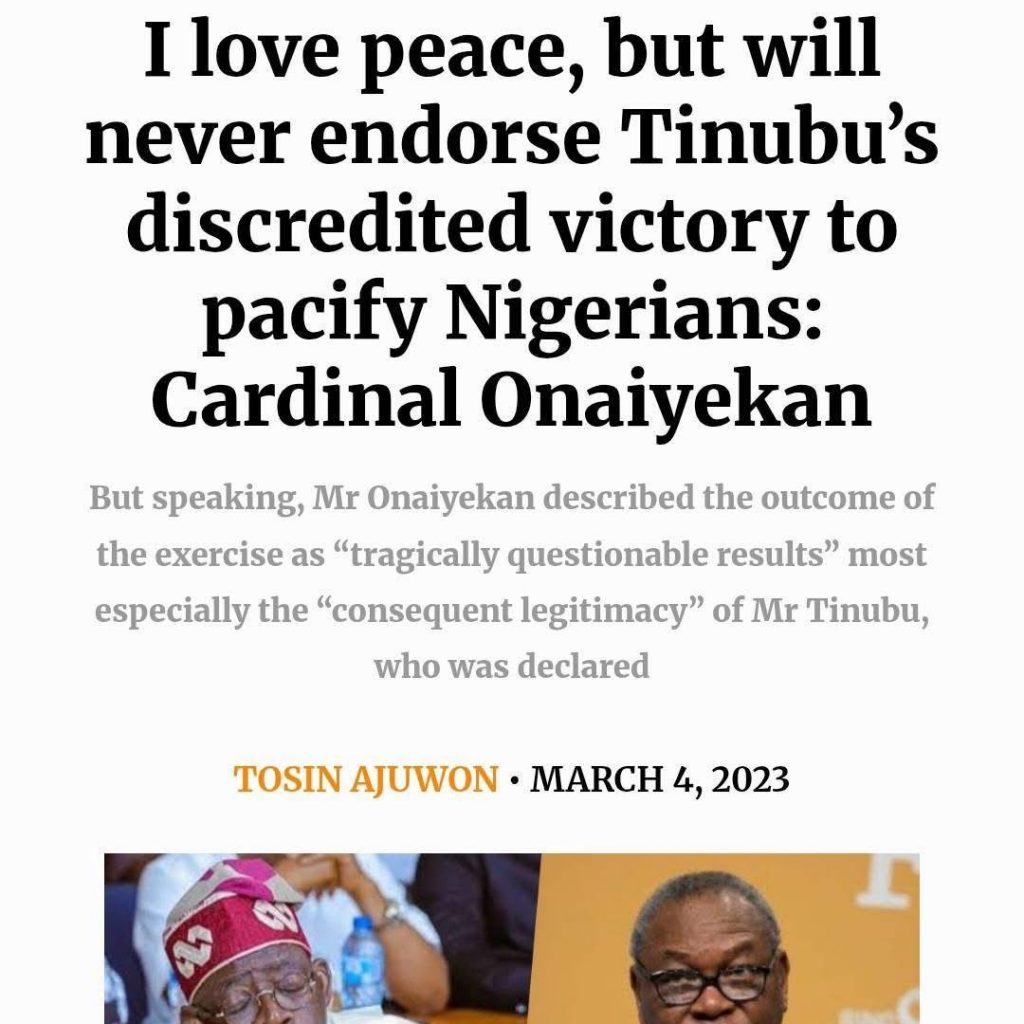
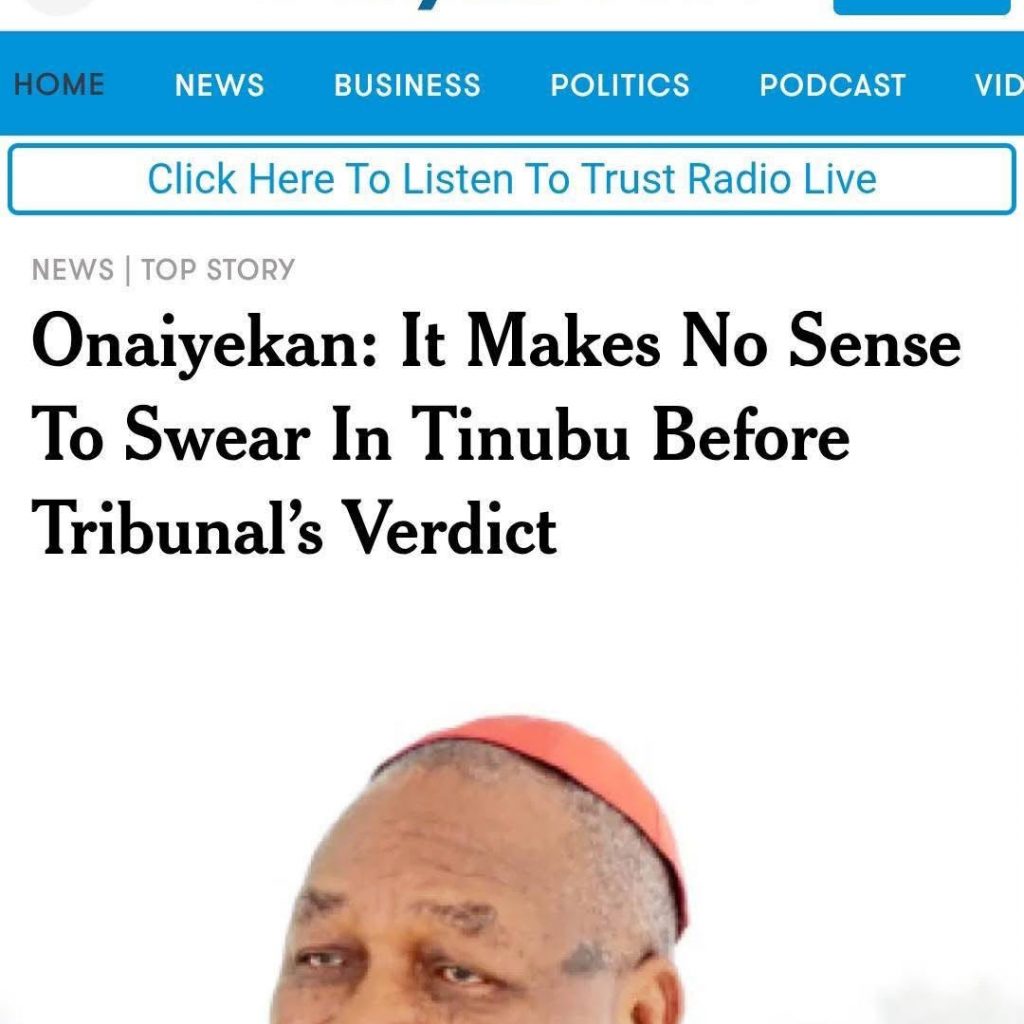
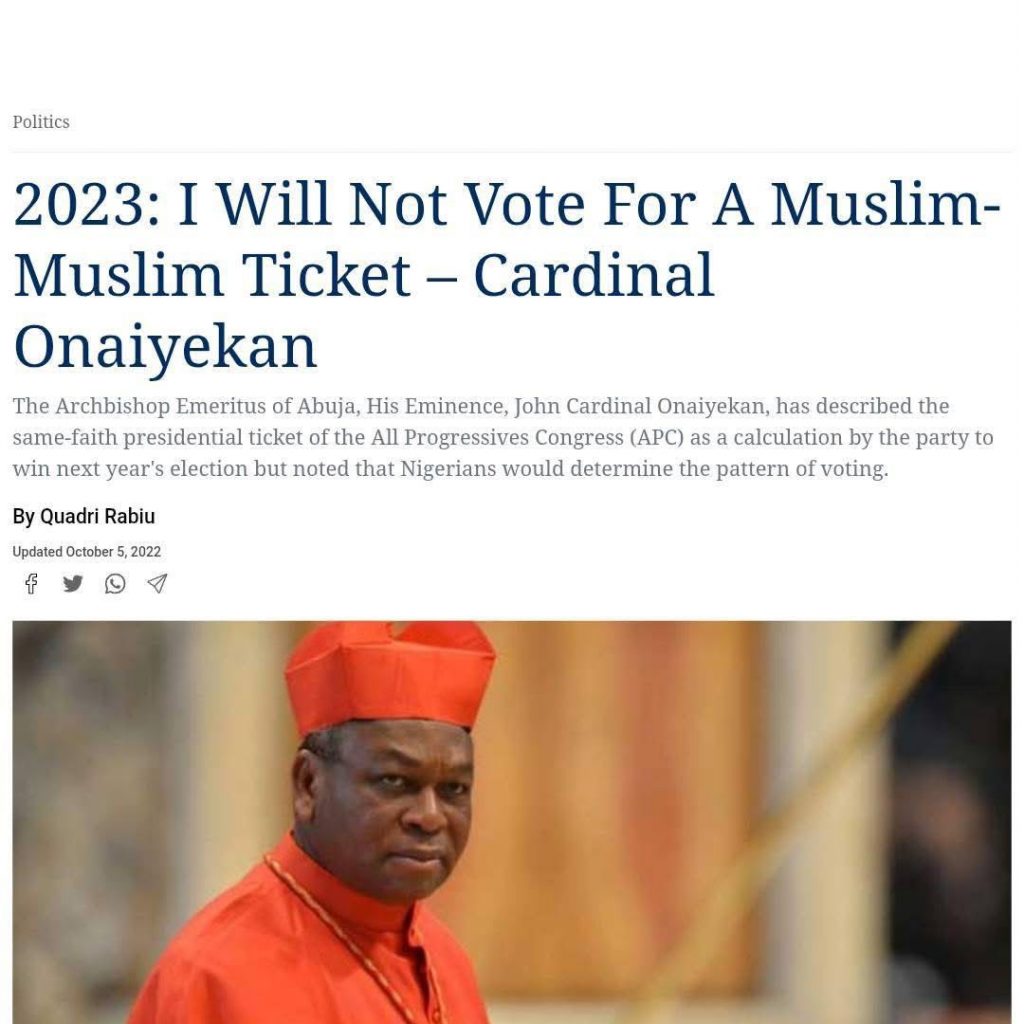
Prior to and following the 2023 presidential election, Onaiyekan’s rhetoric became unmistakably partisan. He condemned the Muslim‑Muslim ticket. He argued that Tinubu should not be sworn in while tribunal cases were ongoing. He declared Tinubu’s victory “discredited.” Presidency aides accused him of turning Catholic platforms into political bases.
The pattern was clear. His interventions were not pastoral. They were political.
The Economic Reality He Ignored
There was no way Onaiyekan could claim ignorance of Nigeria’s economic collapse before Tinubu took office. Charles Soludo said Tinubu inherited a dead economy. Every credible economic review validated that verdict.
The previous administration’s printing of over ₦30 trillion through CBN Ways and Means overdrafts triggered a catastrophic money multiplier effect across our financial system. In macroeconomic terms, that unbacked ₦30 trillion did not act in isolation; as it filtered through commercial banks, it effectively tripled its systemic footprint, unleashing a ₦90 trillion inflationary shockwave of excess liquidity that fundamentally devalued the naira and contributed to crushing the purchasing power of ordinary citizens.

To halt the damage, President Tinubu took the only responsible path available: he securitised the unbacked Ways and Means overdraft and structured its liquidation. By converting the toxic, inflation‑fuelled overdraft into long‑term tradable instruments, he removed its destabilising pressure from the monetary system, restored transparency to the CBN’s balance sheet, and created a predictable repayment pathway that no longer suffocates the budget. This single intervention cleaned up one of the most dangerous financial distortions in Nigeria’s recent history and prevented the liquidity shock from mutating into a full sovereign crisis.
Tinubu met a system where debt servicing consumed almost 100 percent of revenue. Twenty‑seven states were borrowing to pay salaries. Nigeria was borrowing to pay fuel subsidy. The economy had ground to a halt.
Was Onaiyekan expecting an instant revival? Did he imagine that a system in ruins would pick up at full steam without repairs, restructuring, and gradual restoration? Was he not aware that Singapore’s reforms took about eight years before their impact became visible? Did he not recognise that Western economies endured painful adjustments before prosperity returned?
25 Reforms in One Breath

Within three years, the Tinubu administration introduced reforms across every major domain of governance: FX unification, monetary tightening, external reserve rebuild, consumer credit architecture, oil‑revenue transparency, fuel subsidy removal, fiscal deficit reduction, four‑law tax reform package, progressive tax reliefs, electricity decentralisation, port modernisation, nationwide infrastructure expansion, aviation and border security upgrades, food‑security emergency, ward‑level agricultural mapping, constitutional State Police bill, judicially enforced LGA autonomy, NYSC overhaul, foreign‑policy doctrine, minimum wage increase, NELFUND student loans, conditional grants, ward‑level empowerment programmes, and the mining and minerals value‑addition revolution. In the Oil & Gas Sector, he Stripped NNPCL of automatic revenue retention pools while deploying aggressive tax incentives and streamlined contracting cycles to attract global investments. In the health sector, he boosted indigenous manufacturing of medical supplies through targeted tax waivers while modernising infrastructure and scaling up funding for primary healthcare networks. At the last count, according to the Presidency, over 3,000 primary health care centres have been rehabilitated.
This is the broadest reform canvas since 1999.
The Five Reforms That Change the Conversation
From this wide canvas, five reforms stand out as decisive, independently verified, and impossible to ignore.
- Monetary Tightening and FX Reform
The Central Bank collapsed multiple FX windows, floated the naira, cleared billions in FX backlogs, and mopped up excess liquidity. Former CBN Governor Sanusi Lamido Sanusi, one of Nigeria’s most credible monetary voices, confirmed that the economy is now growing faster than the population for the first time in years.
Net external reserves grew from just over $3 billion in May 2023 to over $40 billion today. This is a 17‑year high. It is the clearest evidence that the economy is stabilising.

- The Four‑Law Tax Reform Package
Nigeria now has the most comprehensive tax overhaul since independence. The Nigeria Tax Act, Tax Administration Act, Revenue Service Act, and Joint Revenue Board Act became fully operational nationwide in January 2026. The system is harmonised, modern, and fair. Low‑income earners and small businesses are exempt from multiple taxes. This is structural reform, not rhetoric.
- Constitutional State Police Bill
For the first time since 1999, Nigeria is on the verge of establishing State Police. Both chambers of the National Assembly have passed the bill. This is the most consequential security reform in a generation. It addresses a structural gap that every administration since 1999 failed to resolve.
- Judicially Enforced LGA Autonomy
The Supreme Court’s judgment granting direct federal disbursement to all 774 LGAs has transformed governance overnight. Local governments now receive their funds directly. The impact is immediate. Lagos Local Governments have become the poster examples of what is possible. Across the country, LGAs are delivering high‑impact projects, reviving abandoned infrastructure, and restoring grassroots governance.
- Fuel Subsidy Removal and Fiscal Reset
Ending the petrol subsidy was painful but necessary. It freed billions for states and LGAs. It ended decades of fiscal distortion. It stabilised the budget. It created room for investment. Without this correction, Nigeria would have collapsed under the weight of debt and subsidy obligations.
The Mining Revolution
Beyond these five, a quiet revolution is unfolding in mining. Forest guards have been deployed. Illegal mining is being dismantled. Tinubu has issued a matching order: no raw mineral leaves Nigeria without value addition. That is why Nigeria now has eight lithium processing plants, up from zero in May 2023. This is industrialisation in real time.
Human Capital and Infrastructure
Over 1.5 million students have benefited from NELFUND. For the first time, young Nigerians from modest backgrounds can attend university without the fear of dropping out due to unpaid fees. Parents who once struggled to raise school fees now have relief. Students who once faced uncertainty now receive upkeep allowances that allow them to focus on learning.
Since Nigeria’s return to democracy in 1999, public universities have been shut down cumulatively for over 1,700 days due to Academic Staff Union of Universities (ASUU) strikes. This is roughly five calendar years. Under Tinubu, only nine days in over three years. That is the stability the country has long needed.
Infrastructure is also undergoing a transformation. Massive road construction is underway nationwide. I saw a night picture of the Lagos–Benin expressway with concrete pavement and well‑lit lanes, and it was stunning. It was a reminder that infrastructure is not theory. It is lived experience.
States have undergone their biggest transformation in decades. From a situation where they could not pay salaries, they are now delivering infrastructure, reviving abandoned projects, and launching new ones. The difference is visible. The momentum is real.
What Would Have Happened Without the Reforms
Without these reforms, Nigeria would have faced hyperinflation above 70 percent, a sovereign default, permanent fuel queues, salary arrears across states, and a full currency collapse. The naira could have crashed beyond ₦3,000 to the dollar, a trajectory already visible in parallel markets before the reforms halted the slide. Mass industrial shutdowns would have followed, plunging the country into a full economic depression. Nigeria would have entered a crisis comparable to Lebanon or Sri Lanka.
The Altar Is Not a Weapon
This piece is not intended to persuade Onaiyekan to prioritise his pastoral calling over partisanship. It is to let the world know that his intervention is not altruistic. It is clear his aim is to give his candidate an undue advantage. It is a failed mission. It is dead on arrival.
This piece is to encourage the President and his team that well‑intentioned Nigerians see the hard work he has invested in nation building. It is to remind the President that they need to accelerate the process they already started to ensure that the vast majority of Nigerians begin to feel the impact of the reforms.
We have seen through the pain. Let the people feel the momentum of the gain.
Nigeria
reforms
catholic
Tinubu
Onaiyekan
Stay ahead with the latest updates!
Join The Podium Media on WhatsApp for real-time news alerts, breaking stories, and exclusive content delivered straight to your phone. Don’t miss a headline — subscribe now!
Chat with Us on WhatsApp