


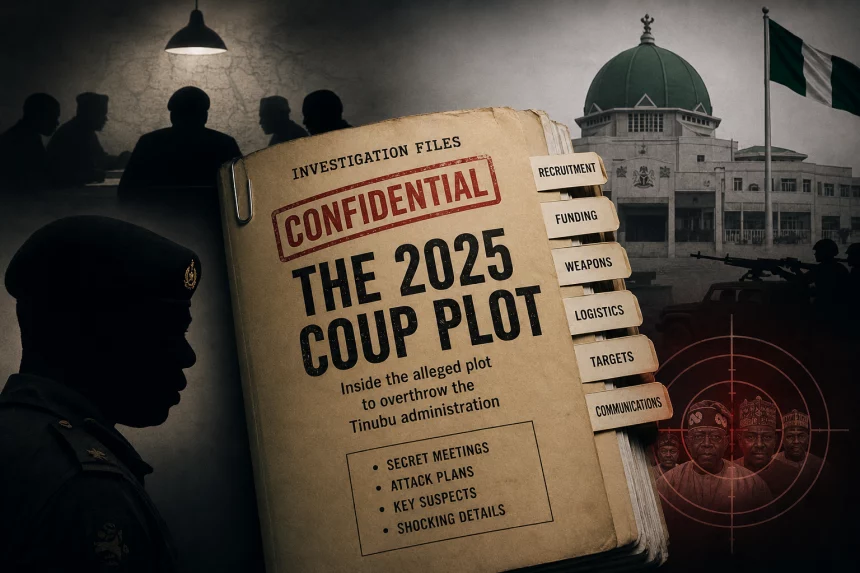
This report, the first part of a PREMIUM TIMES series of untold stories about last year’s alleged attempt to topple President Tinubu’s administration, paints a fuller picture of the alleged conspirators’ preparations toward the D-Day and H-Hour and the transition plan that would follow.
Fresh details of the operational blueprint allegedly developed by military officers accused of plotting to overthrow President Bola Tinubu’s administration last year have emerged. These include how they assigned targets to individual operatives, adopted coded language, filtered dates for the planned strike, and mapped out logistics for the operation. The new details also include the alleged conspirators’ transition plan.
Confidential documents running into over 7,400 pages, containing statements made by several suspects to investigators, bank records, secret notes, documentary evidence of the alleged conspirators’ secret conversations, and other exhibits assembled by investigators.
These documents showed that the alleged conspiracy centred on capturing strategic military installations, securing broadcast facilities, mobilising troops and neutralising senior military leadership.

Previous reporting by PREMIUM TIMES revealed that the alleged plot was coordinated principally by Mohammed Ma’aji, a Nigerian Army colonel, alongside a retired colonel M.M. Adamu, Shamsuddeen Bappah, a lieutenant-colonel and Abdulkarim Ibrahim, a major.
The trio of these officers—except Mr Adamu, whom military authorities said remains at large—gave separate, corroborating statements about the operational plan for the alleged plot. The conspirators used coded words and phrases to communicate during meetings or when talking about the plot.
For instance, while they referred to themselves as farmers, they codenamed the entire movement as farming. Other agricultural-related words were used: Fertilisers as logistics, harvest as the execution day, digital farming as the operation and technical partners as clerics approached for prayers.
They also used “H-hour” to mean execution time and “D-Day” as the day of execution.
This report paints a fuller picture of the alleged plotters’ preparations for D-Day and H-Hour, and what they intended to do thereafter.
The Coup ‘H-Hour’, ‘D-Day’
Mr Ibrahim told investigators that they proposed launching the operation between 1 a.m. and 2 a.m., describing the timing as consistent with previous military takeovers.
He said although no final date was agreed, three possible dates repeatedly featured during planning: 27 September 2025, 1 October 2025 (the Independence Day) and 4 October 2025. The other officers, including Mr Ma’aji, corroborated some of these dates.
One of the suspects, Ilyasu Jamilu, a major, told investigators that while 27 September, 1 October and a later date were discussed, the conspirators never settled on a final date because preparations had not been completed.
However, Mr Ibrahim said the alleged leader of the plot told them that the final D-Day depended largely on the availability of troops, weapons and other logistics.
“Col Ma’aji mentioned that the availability of troops and equipment would determine which of the dates would be D-Day,” he stated.

Alleged coup operational assignments
According to the documents, each participant was assigned a strategic task.
Mr Usman was tasked with leading the operation at the Presidential Aso Villa, the seat of Nigeria’s presidency, after conducting reconnaissance of the complex with the assistance of insiders, including a police officer, Ahmed Ibrahim.
The prosecution has shared more details about the planned attack on the Presidential Villa in the ongoing trial regarding the alleged coup at the Federal High Court in Abuja.

A video exhibit played by the prosecution during a proceeding in May showed one of the six defendants connected to the alleged coup, Zekeri Umoru, telling interrogators that the coup planners considered switching off the electricity supply to the Presidential Villa, Abuja, at the zero hour of the planned strike.
But Mr Umoru, a Julius Berger Nigeria Plc employee in the Maintenance Department at the Presidential Villa, said he warned that such a sudden power outage would trigger investigations and the detention of workers on duty.
He said the alleged coup leaders planned to recruit between 18 and 19 persons, including soldiers, State Security Service (SSS) operatives and Julius Berger staff members working within the Villa.
Mr Bappah was assigned to seize and hold 102 Battalion, Zuma, Niger State, while Mr Ibrahim was initially assigned to secure the Armed Forces Headquarters complex before his role was changed to Radio House in Abuja, where he was expected to deliver the takeover speech.


A Nigerian Air Force squadron leader, S.B. Adamu, was assigned to seize Air House; Muhammad Jiddah, a major, was tasked with taking control of the residence of the then Chief of Army Staff (COAS), Olufemi Oluyede, while Daniel Yusuf, also a major, was assigned to the residence of the then-Chief of Defence Staff (CDS), Christopher Musa, now the defence minister.
The documents also show that Akinwale Yusuf, a captain who was in Lagos, was expected to seize a divisional headquarters there, while Mr Adamu, the fugitive retired colonel, would coordinate activities from the gate of Niger Barracks in Abuja.
Mr Ibrahim told investigators that although Mr Bappah was initially expected to make the nationwide broadcast announcing the takeover, that responsibility was later transferred to him.
Airports, among priority targets
Based on the documents reviewed for this report, airports formed a critical part of the alleged plan.
According to Mr Ibrahim, the conspirators concluded that the operation could not succeed if aircraft were allowed to continue landing and taking off.
He said the plan was to deploy squadron leader Noel Zuzu’s gun truck onto the runway to halt flight operations in Abuja during the takeover.

Also, Sunday Felix, a lieutenant, stated that he had been tasked with surveying the airport in Lagos, gathering operational information and disrupting flight activities on “D-Day” with the assistance of an engineer.
“I knew the airport’s security arrangements due to my role in traffic control during visits of VIPs,” Felix reportedly told investigators.
Troops, weapon mobilisations and logistics
The records indicate that the alleged conspirators intended to draw manpower and equipment from several military formations.
In his statement, Mr Ma’aji told investigators that Mr Usman would source resources from 45 Special Forces Battalion, Bida; Ponfa Dangnap, a lieutenant colonel, would mobilise troops and equipment from 134 Battalion in the North-east, while Mr Ibrahim was expected to generate resources from 198 Battalion, also in the North-east.
Mr Ma’aji also claimed that both Abulrahman Hayatu, a lieutenant-colonel and Mr Dangnap assured him they had sufficient troops, vehicles, ammunition and weapons, although no execution date had yet been communicated to them.
Mr Ibrahim also told investigators he had been informed that Mr Dangnap would deploy four gun trucks, while Mr Hayatu would bring two gun trucks and accompanying soldiers for the operation.
According to another suspect, Bayawo Abdullahi, he was assigned responsibility for mobilising personnel from a naval unit under his command. He told investigators he had about 14 troops under him and access to three operational Hilux vehicles.
Arrests, not assassinations?
One of the more revealing aspects of Mr Ibrahim’s statement concerns the treatment of senior military officers after the takeover.
He told investigators he cautioned Mr Ma’aji against any bloodshed, arguing that history had shown successful coups generally relied on securing the cooperation of senior officers rather than eliminating them. Mr Hayatu also opposed killing anyone.
According to Mr Ibrahim, the coup leader responded that the service chiefs and other designated targets would be arrested.
However, that account differs from the statement of another accused officer, A.D. Dauda, a major who earlier told investigators that Mr Ma’aji had said the former CDS would have to be arrested or killed to prevent him from interfering with the operation. Mr Dauda said it was that conversation that convinced him to distance himself from the alleged conspiracy.
Mr Umoru, the Julius Berger staff member attached to the Presidential Villa shared his own perspective about the planned raid on the Villa in his videoed interrogation session played back in court. From his account, the level of force the alleged coup plotters planned to deploy was dependent on how much Villa insiders’ cooperation they could secure.
After warning Mr Ma’aji that a sudden power outage at the presidential villa would trigger investigations and the detention of workers on duty, he said the alleged coup leader concluded that he might enter the Villa with force if the insiders failed to cooperate.
(Mr Umoru and his co-defendants are contesting the admissibility of the video exhibits and their extra-judicial statements in court, citing the circumstances under which they were collected.)
The transition plan
Mr Ibrahim told investigators that Colonel Ma’aji intended to assume office as Head of Government if the operation succeeded.
According to him, Mr Ma’aji planned to move into the Presidential Villa after Mr Usman must have secured access to the premises.
He further claimed Mr Ma’aji intended to announce a new set of service chiefs during his inaugural address, although he said no names had been disclosed to members of the group.
He also stated that some participants were promised appointments in a post-takeover administration.
Mr Ibrahim said members were asked what positions they wanted if the operation succeeded. While Mr Jamilu said he requested to serve as an aide-de-camp (ADC) Mr Felix told investigators he was promised a ministerial appointment. Mr Bappah requested that he be made the chairman of the Economic and Financial Crime Commission (EFCC).

The coup allegation is a subject of ongoing criminal proceedings at both the General Court Martial convened by the military authorities and the Federal High Court in Abuja, where former retired military officers and other civilians are facing 13 counts of treason, terrorism, failure to disclose information, and money laundering over the alleged failed coup.
While little is known about the proceedings of the General Court Martial being held in camera, a lot has been reported by journalists covering the Federal High Court trial. The six men before the Federal High Court have challenged the admissibility of their statements, alleging, among others, that the circumstances of the collection of the exhibits breached safeguards under the Administration of Criminal Justice Act (ACJA). The prosecution has maintained that all of its pretrial activities were properly done, urging the court to throw out the defendants’ objection. But the court has yet to rule.
Source: PremiumTimes
Stay ahead with the latest updates!
Join The Podium Media on WhatsApp for real-time news alerts, breaking stories, and exclusive content delivered straight to your phone. Don’t miss a headline — subscribe now!
Chat with Us on WhatsApp