


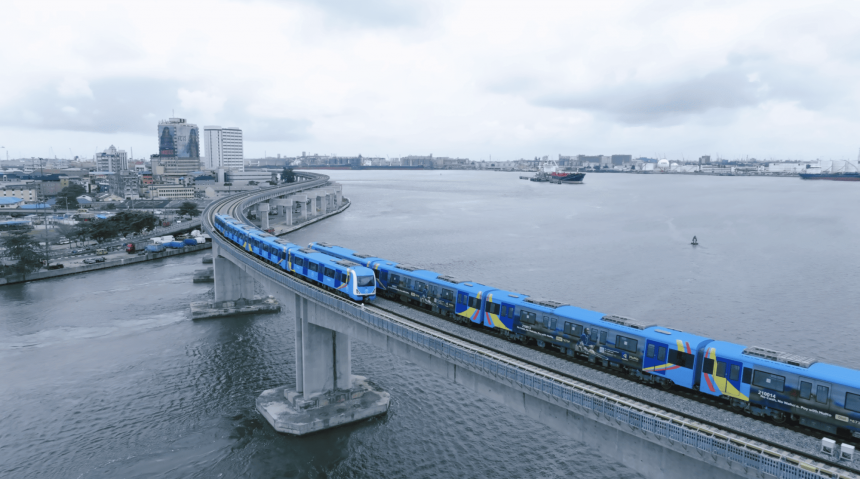
The Lagos Rail Mass Transit (LRMT) Blue Line has transported more than 8 million passengers in over 1,000 days of operation, while Phase II of the project has reached a major construction milestone with the successful installation of its first precast T-beam.
The Lagos Rail Mass Transit (LRMT) Blue Line has transported more than 8 million passengers in over 1,000 days of operation, while Phase II of the project has reached a major construction milestone with the successful installation of its first precast T-beam.
The update was disclosed in a post published on Thursday by China Civil Engineering Construction Corporation (CCECC) Nigeria through one of the company’s officials, John Zhao, on X.

CCECC is the technical partner responsible for delivering the Lagos Blue Line.
The company constructed the first phase of the rail corridor, currently operates the line, and is executing the ongoing Phase II extension from Mile 2 to Okokomaiko.
What they are saying
According to CCECC, the Blue Line has safely transported more than 8 million passengers since commercial operations commenced over 1,000 days ago.
The company also stated that Phase II has achieved another engineering milestone with the successful installation of its first precast T-beam.
- “The Lagos Rail Mass Transit-Blue Line, built and operated by CCECC Nigeria, has safely served over 8 million passengers in more than 1,000 days of operation. Meanwhile, Phase II has reached a new milestone with the successful erection of its first precast T-beam.”
A precast T-beam is a reinforced concrete structural component commonly used to support elevated railway bridges. Manufactured off-site and lifted into position during construction, the beams form part of the bridge deck that will eventually carry the railway tracks.
The installation of the first T-beam marks the beginning of the rail line’s superstructure, signalling that the project has progressed beyond piling, foundation and pier construction into one of the most visible stages of the elevated railway works.
Get up to speed
The Lagos Blue Line is a 27-kilometre standard-gauge electric rail project being developed by the Lagos State Government through the Lagos Metropolitan Area Transport Authority (LAMATA) as part of the Lagos Rail Mass Transit (LRMT) network.
- Its first phase, a 13-kilometre corridor stretching from Marina to Mile 2, commenced commercial operations in September 2023 after years of construction.
- The line has since become a key component of Lagos’ efforts to reduce traffic congestion by providing an alternative mass transit system for commuters travelling along the corridor.
- Phase II is a 14-kilometre extension from Mile 2 to Okokomaiko and is expected to significantly expand the Blue Line’s coverage across the Lagos-Badagry corridor.
- The extension will include six stations located at Festac, Alakija, Trade Fair, Volkswagen, LASU and Okokomaiko.
- The project will also feature a 400,000-square-metre depot at Okokomaiko to serve as the central hub for train maintenance and operations.
As part of the construction, the existing Mazamaza Bridge will be replaced after structural assessments found it unsuitable for rail operations, while new bridges will also be built at Satellite and LASU to support the extension.
What you should know
The Blue Line forms part of the Lagos State Strategic Transport Master Plan, which has been expanded from six rail lines to 11 rail lines and one monorail as the state seeks to build an integrated urban rail network.
- Currently, only the first phases of the Blue and Red Lines are operational, while work continues on their respective extensions.
- The Lagos State Government is also exploring plans to extend the Red Line into Ogun State to strengthen regional connectivity.
- In June, the Nigerian Railway Corporation (NRC) granted LAMATA a 15-year rail operating licence covering the Blue Line, Red Line and future rail corridors developed during the licence period.
Earlier this month, LAMATA and CCECC signed an agreement to establish a Railway Training Centre aimed at developing indigenous technical expertise for railway operations, maintenance and management as Lagos expands what is expected to become one of Africa’s largest urban rail networks.
The operating licence means new rail lines completed within the licence period will only require final safety and operational inspections before commencing passenger services, while the planned training centre is expected to strengthen the local workforce needed to support the state’s expanding urban rail network.
Stay ahead with the latest updates!
Join The Podium Media on WhatsApp for real-time news alerts, breaking stories, and exclusive content delivered straight to your phone. Don’t miss a headline — subscribe now!
Chat with Us on WhatsApp