



There is a prayer point many Nigerian politicians have conspicuously omitted from their devotionals: Lord, may I never invest in a political associate who will turn coat and spend the rest of his days trying to dismantle everything I built.
Asiwaju Bola Ahmed Tinubu, now President of the Federal Republic of Nigeria, clearly never said that prayer before he threw his considerable weight behind Kayode Fayemi’s political ascent.
Their bond was forged in the crucible of exile. When the annulment of Chief MKO Abiola’s June 12, 1993 presidential mandate ignited a resistance movement, Tinubu and Fayemi were among those who refused to look away. Tinubu provided the funding; Fayemi and other foot soldiers implemented the strategies. It was the kind of shared sacrifice that creates bonds men carry to their graves, or so one would think.

Tinubu, ever a man who rewards institutional loyalty, did not forget. He favoured Fayemi above most political associates when choices had to be made. That calculus showed clearly in Fayemi’s emergence as Ekiti State Governor and in the pivotal role Fayemi would later play in the formation of the All Progressives Congress. Without Tinubu’s compass pointing in his direction at critical junctures, Fayemi’s trajectory would have looked very different.
When Gratitude Expires
On his return for a second term as Ekiti Governor, something shifted. Fayemi, it seemed, had concluded that he was now his own man, a self-made political colossus who could chase the same presidential ambition his benefactor was actively pursuing. He eventually stepped back and endorsed Tinubu at the 2022 APC presidential primary, but only after testing the waters himself. In that limited sense, he managed to outperform Professor Yemi Osinbajo, another man whose entire political career was essentially gift-wrapped by Tinubu’s influence and goodwill.
Osinbajo ran the presidential race to a dismal third-place finish and, by no credible account, ever formally supported the man who had made him Vice President. History records no such gesture. But that is a story for another day.
The Prodigal Who Never Quite Repented
But the ingratitude did not begin in 2023. It has a longer, more instructive history.
When Fayemi first became Ekiti Governor in 2010, after a bruising three-year legal battle to recover his mandate, few paused to ask who had bankrolled the original 2007 campaign or who had quietly picked up the legal fees through every exhausting round of litigation. The answer to both questions was the same man: Tinubu. Yet for the better part of his first term, Fayemi systematically decoupled himself from the man also popularly called Jagaban, conducting his governorship as though he had arrived at the table entirely on his own merits.
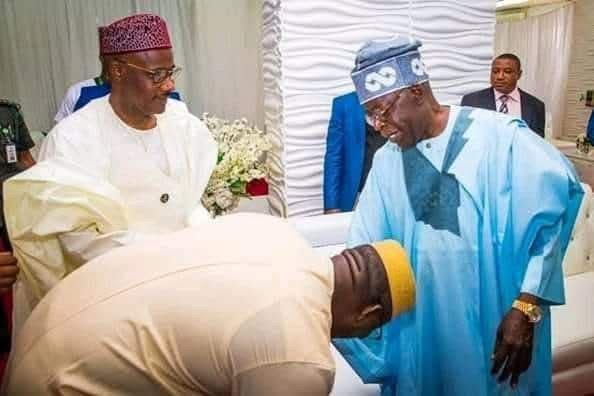
The universe, however, has a sense of timing. In June 2014, Ayodele Fayose of the PDP handed Fayemi one of the most crushing electoral defeats ever suffered by a sitting Nigerian governor, losing all sixteen of Ekiti’s local government councils to a man staging his own political resurrection. It was a humiliation of seismic proportions. Completely knocked down by the vicissitudes of political fortune, Fayemi did what pride had previously prevented. He went back to Bourdillon. Insiders who witnessed what transpired confirmed that Fayemi performed the dobale, the full Yoruba prostration of submission, before Asiwaju later in 2014, seeking forgiveness for years of deliberate political distance.
Tinubu, large-hearted to a fault, forgave him. In his characteristic let-bygones-be-bygones manner, he drafted Fayemi as Chairman of the 2014 APC Convention Committee, the very platform that produced Muhammadu Buhari as the party’s presidential candidate. It was a gesture of rehabilitation extended to a repentant prodigal.
What Tinubu perhaps did not anticipate was how quickly the prodigal would revert to type. A credible source who directly witnessed events at that convention told me that Fayemi wasted no time cozying up to Buhari the moment he emerged, almost immediately lobbying to be named running mate, a move transparently designed to exploit the contrived opposition to a Muslim/Muslim ticket, the principal target of which was eliminating Tinubu from vice-presidential consideration. Several media outlets documented the fierce lobbying through December 2014.
The intrigue ran deeper still. There were credible speculations that Fayemi was among those who commissioned British scholar Professor John Paden to write a book chronicling how Buhari became the first opposition candidate to defeat a sitting Nigerian president. The book was strategically crafted. It systematically downplayed Tinubu’s otherwise pivotal role in delivering that historic victory, while simultaneously claiming that Buhari personally chose Yemi Osinbajo as running mate, adding pointedly that he did so “despite significant pressure from Bola Tinubu, who wanted the vice-presidential position for himself.”
There was a school of thought that the architecture of the narrative was to project Fayemi, then Solid Minerals Minister, as the emerging intellectual and political leader of the Yoruba under a Buhari presidency, with Tinubu written out of the story he had largely authored. It is important to note that there is no published report directly linking Fayemi to Professor Paden. Until such a report emerges, his role in that enterprise remains a speculation, even though the signals that existed placed it firmly within the range of possibilities.
To Osinbajo’s enduring credit, in that rare instance, he publicly contradicted the book’s account of his emergence as Vice President and confirmed that it was Asiwaju who nominated him for the second highest office in the land.

A man who had prostrated for forgiveness in 2014 was, by 2015, linked to the groundwork for his benefactor’s political erasure. If that is not the textbook definition of a recurring pattern, it is difficult to know what else to call it.
The Steady Stream of Sour Grapes
Since Tinubu assumed the presidency, it has been a steady stream of sour grapes. If Fayemi is not granting pointed interviews criticising the APC, he is reportedly strategising with former Rivers State Governor Rotimi Amaechi on how to dismantle the administration. The irony would be almost poetic if it were not so predictable.
What makes the saga particularly revealing is Fayemi’s spectacular display of lily-liveredness. When Amaechi publicly alleged in 2025 that both men were the architects of a coalition designed to remove a Yoruba man from power, Fayemi’s rebuttal was so breathtaking in its evasion that it must have left Amaechi staring at the wall in disbelief. The man who allegedly co-designed the blueprint suddenly could not locate his own fingerprints on it.

The Saint from Mars
In a recent interview with broadcaster Edmund Obilo, Fayemi lamented what he described as the death of intellectualism in the APC. He mourned the collapse of internal democracy. He condemned the consensus arrangement as a polished synonym for imposition. He spoke with the serene conviction of a man who had never once imposed anything on anyone. Fayemi spoke like a saint from Mars.
For those who lived through his tenure as Ekiti State Governor, the cognitive dissonance was almost physically painful. His administration operated less like a democracy and more like a well-run fiefdom. Candidate lists for elective offices were drawn from the Governor’s office with the quiet efficiency of a procurement exercise. Loyal party men and women who had spent their own resources, sacrificed weekends and sleep, and earned genuine grassroots support in their constituencies were discarded. They were not reassigned, not compensated, not even properly explained to. Simply discarded, like pieces of rag that had outlived their usefulness.
Allow me to share a direct account.
A friend of mine, a lawyer employed in the telecoms sector, decided to contest a House of Assembly seat in his constituency. For months, he made the Lagos-to-Ekiti journey almost every other week, hosting communities, listening to their concerns, representing them in legal matters free of charge, and earning the kind of organic political capital that cannot be manufactured. By the time the primary season approached, the constituency was unambiguously behind him. He had done the work.
Then the list came.

His name was not on it. He was quietly advised, in his best interest, to shelve his ambitions. No explanation. No compensation. No acknowledgement of the months he had invested. My friend was not an isolated case; he was merely one of many who discovered that in Fayemi’s Ekiti, democracy was a performance staged for external consumption.
What the Harvest Looks Like
Today, the same Kayode Fayemi has positioned himself as a champion of credible primaries and internal party democracy ahead of 2027. The irony does not merely sting; it burns.
Whatever political misfortune Fayemi may be experiencing now in his own dealings with the APC establishment cannot possibly measure up to the futures he quietly mortgaged for others. There is no credible evidence that everything Amaechi alleged is accurate. But between my friend’s direct experience and what has been extensively documented in the Nigerian press, Fayemi is simply not the most convincing advocate for democratic principles this country has ever produced.
In life, you reap what you sow. Sometimes the harvest arrives slowly, and you forget you ever planted those seeds.
But the earth remembers. And karma, as it turns out, arrived sooner than anyone envisaged.
Tinubu
Fayemi
Nigeria
Lagos
APC
Stay ahead with the latest updates!
Join The Podium Media on WhatsApp for real-time news alerts, breaking stories, and exclusive content delivered straight to your phone. Don’t miss a headline — subscribe now!
Chat with Us on WhatsApp