



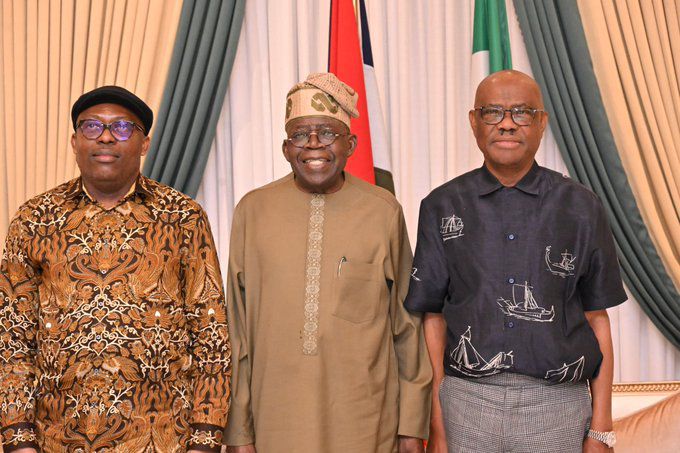
In the merciless arithmetic of Nigerian power politics, loyalty is the only currency that never devalues. As the country hurtles toward the 2027 general elections, the political battlefield of Rivers State crackles once more with dangerous electricity. At its centre stands a triangle that would have given Machiavelli pause: President Bola Ahmed Tinubu; Nyesom Wike, Federal Capital Territory Minister; and Siminalayi Fubara, the sitting governor of Rivers state.
The question setting political circles ablaze is deceptively simple: heading into 2027, how useful is Fubara to Tinubu? Examined through the cold, unforgiving lens of power politics, the answer is unambiguous.
The Making and Breaking of a Protégé

Before Nyesom Wike handpicked him, Siminalayi Fubara was a political unknown—a competent, quiet technocrat rising through the civil service to become accountant-general. Completing his second term as governor in 2023, Wike needed a successor he could trust—and control. He did not merely endorse Fubara; he engineered his entire political existence.
But what godfathers often forget is that you cannot hand a man power without also giving him the instinct to use it.
The peace lasted barely four months. By October 2023, a bitter feud erupted over the control of the state’s political machinery. In the chaotic months that followed, we saw the bombing of the House of Assembly complex, the defection of 27 pro-Wike lawmakers to the APC, and even a temporary, federally declared state of emergency. Although Fubara was reinstated, he remains institutionally weakened, staring down the barrel of 2027.
The Ghost of Amaechi
To understand Fubara’s utility to Tinubu, one must ask: has a sitting Rivers state governor ever survived going against a more powerful federal adversary backed by Abuja?
The answer arrived a decade ago. In 2015, Rotimi Amaechi was arguably the most powerful governor in Nigeria, serving as chairman of the governors’ forum and boasting deep state resources. He defected to the APC and went all out for Muhammadu Buhari.
Against him stood Nyesom Wike—then merely a junior minister of state for education, without gubernatorial immunity. Armed with federal backing and a consolidated local network, Wike delivered an absolute electoral massacre: 1,029,102 votes to the APC candidate’s 124,896. An 87% obliteration.
If Wike, as a junior minister in 2015, could reduce a sitting governor’s structure to rubble, the arithmetic of what a fully empowered Wike can do as a senior cabinet member in 2027 is clear. Fubara should study that history. More importantly, Tinubu already has.
The Jagaban’s Calculation
President Bola Ahmed Tinubu did not build a political empire by making emotional decisions. He is a political chess master who identifies allies, rewards loyalty, and cuts loose those whose utility has expired.
When observers argue that Tinubu “needs Fubara” simply because a sitting governor can mobilise state resources, they are counting assets without looking at liabilities. A governor whose assembly is split, whose local elections have been contested, and whose party structure is in shambles is not an asset. He is a liability wearing an asset’s clothing.
In 2015, Amaechi went all out for Buhari, yet Rivers state still voted overwhelmingly for Goodluck Jonathan. If a deeply entrenched Amaechi could not deliver the state, what can an embattled Fubara deliver? Considerably less than nothing—especially if backing him means alienating the godfather who actually commands the grassroots.
Wike brings organisational muscle, a cross-party coalition, and something money cannot buy: proven loyalty at a moment when loyalty cost him dearly. In 2023, Wike risked his entire political career, crossed his party, and absorbed the fury of his colleagues to back Tinubu. In politics, debts flow upward, and Tinubu owes Wike a moral and political debt.

The Ultimate Political Sin
Fubara has recently been seen at APC screening exercises in Abuja, attempting to thread the impossible needle of seeking re-election under the very party Wike heavily influences. But the political mathematics is resolving itself in real time.
To choose Fubara over Wike would be to reward betrayal with protection. It would signal to every ally across Nigeria that loyalty carries no guaranteed return. No leader can afford to send that message.
Fubara received everything from his godfather, and when the bill came, he refused to pay. There is no political sin greater than betrayal. Dante placed betrayers in the lowest circle of hell; Julius Caesar’s last words were directed at a betraying friend. In Nigerian politics, where the memory of grudges outlasts the memory of favours, betrayal is never forgotten.

The useful man is not always the man with the title. The useful man is the one who, when the river runs dry, finds water.
Nyesom Wike has always found water.
Babatunde Lasisi is a socio-political analyst based in Abuja. He can be contacted via blasisi554@gmail.com
Stay ahead with the latest updates!
Join The Podium Media on WhatsApp for real-time news alerts, breaking stories, and exclusive content delivered straight to your phone. Don’t miss a headline — subscribe now!
Chat with Us on WhatsApp