



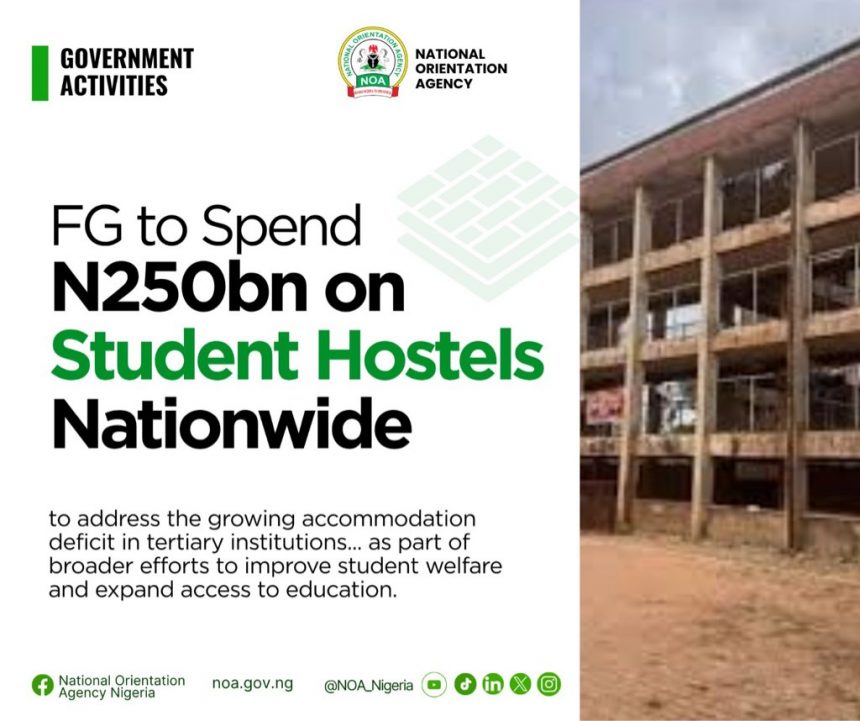
The Federal Government has unveiled plans to commit approximately ₦250 billion toward the construction and expansion of student hostel facilities across tertiary institutions in Nigeria in 2026, in what officials describe as a major intervention aimed at improving student welfare and strengthening the country’s higher education system.
The ambitious programme, which is expected to become the largest single-year investment in student accommodation in Nigeria’s history, will focus on tackling the persistent shortage of hostel spaces in universities, polytechnics, and other higher institutions across the country.
Under the initiative, thousands of additional bed spaces are expected to be created through a combination of direct government-funded projects and Public-Private Partnership (PPP) arrangements designed to attract private sector participation in educational infrastructure development.

Minister of Education, Maruf Olatunji Alausa, disclosed details of the initiative while outlining the Federal Government’s broader strategy for improving the learning environment in tertiary institutions.
According to the minister, the intervention is intended to significantly reduce overcrowding in student hostels, improve living conditions on campuses, and support the government’s efforts to increase access to quality tertiary education.
He explained that poor accommodation facilities had remained one of the major challenges confronting students in Nigerian tertiary institutions for decades, leading to congestion, rising rents in surrounding communities, insecurity, and increased pressure on existing infrastructure.
Alausa stated that the government was determined to reverse the trend by making deliberate investments in modern hostel facilities capable of accommodating growing student populations.
A breakdown of the proposed spending indicates that about ₦100 billion will be allocated for the construction of new 500-bed hostel facilities in approximately 50 universities across the country.
Each of the projects is estimated to cost around ₦2 billion and is expected to provide modern accommodation equipped with improved sanitation systems, water supply, electricity, and other essential facilities aimed at enhancing student comfort and academic productivity.
The minister explained that the selection of beneficiary institutions would be guided by factors such as student population, existing hostel deficits, institutional needs, and regional spread.
In addition to the direct government-funded projects, another major component of the programme will involve collaboration with private investors under Public-Private Partnership arrangements.
Under the PPP model, 24 large-scale hostel projects are expected to be developed across selected institutions nationwide.
Each of the PPP projects is projected to deliver between 1,200 and 1,500 bed spaces per institution, substantially increasing accommodation capacity in beneficiary schools.
According to the proposed arrangement, the Federal Government will contribute ₦1 billion to each project, while private sector partners are expected to inject approximately ₦3 billion each into the development process.
Officials said the partnership model is intended to accelerate infrastructure delivery while reducing the financial burden on government.
The intervention is expected to be funded largely through the Tertiary Education Trust Fund, commonly known as TETFund, which has over the years financed several educational infrastructure projects in public tertiary institutions.

Government officials said the initiative would not only focus on constructing new hostels but would also support the renovation, rehabilitation, and expansion of existing accommodation facilities already in use across campuses.
The Federal Government believes the programme will contribute significantly toward creating a more conducive learning environment for students while reducing the accommodation pressures that often force many undergraduates to seek expensive and sometimes unsafe housing outside school premises.
For many students in Nigeria, hostel shortages have become a major concern, particularly in federal universities where rising student admissions have not been matched with corresponding expansion in accommodation infrastructure.
In several institutions, available hostel spaces are often insufficient, forcing multiple students to occupy rooms designed for fewer persons.

The situation has also contributed to the rapid growth of off-campus settlements around universities, where students frequently face high rent costs, transportation challenges, insecurity, and poor living conditions.
Education stakeholders have repeatedly called for increased investment in hostel infrastructure, warning that inadequate accommodation negatively affects students’ academic performance, wellbeing, and overall campus experience.
Analysts say the new investment plan could help ease some of these longstanding challenges if properly implemented.
The government also expects the initiative to stimulate economic activities through job creation during the construction phase and through ongoing maintenance and facility management services after completion.
Construction companies, building material suppliers, artisans, and service providers are expected to benefit from the large-scale infrastructure programme.
The PPP component is also seen as an attempt to encourage greater private sector participation in Nigeria’s education sector, particularly in areas where public funding alone may not be sufficient to meet growing infrastructure demands.

Officials noted that involving private investors could improve efficiency, speed up delivery timelines, and introduce better maintenance culture in hostel management.
The Education Ministry further stated that the programme aligns with the broader agenda of the administration of President Bola Ahmed Tinubu to reposition the education sector and improve conditions for students and academic institutions nationwide.
The government maintained that improving student accommodation forms part of wider reforms targeted at enhancing the quality, accessibility, and competitiveness of Nigeria’s tertiary education system.
Observers say the success of the programme will depend heavily on transparent implementation, effective monitoring, and timely release of funds to ensure that projects are completed according to specifications.
There are also expectations that the government will put in place mechanisms to ensure affordability of the new hostel facilities for students once completed.
If successfully executed, the ₦250 billion intervention is expected to mark a significant milestone in Nigeria’s educational infrastructure development and could substantially improve campus living conditions for thousands of students across the country.
Stay ahead with the latest updates!
Join The Podium Media on WhatsApp for real-time news alerts, breaking stories, and exclusive content delivered straight to your phone. Don’t miss a headline — subscribe now!
Chat with Us on WhatsApp