


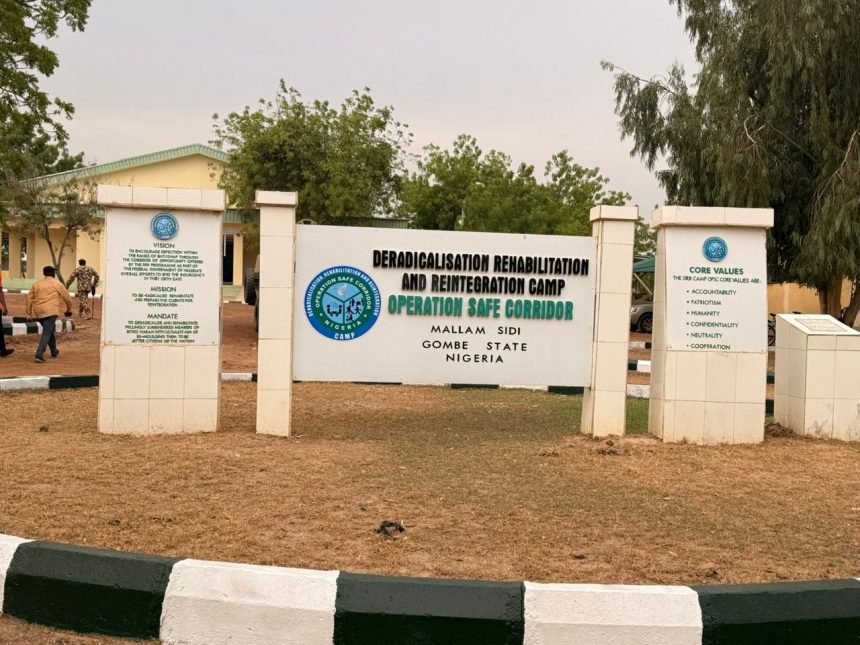
On Wednesday, April 22, the federal government graduated 744 former combatants and victims of violent extremism who completed the mandatory six-month deradicalisation, rehabilitation and reintegration (DRR) programme at the camp in Mallam Sidi, Gombe state.
The participants — referred to as “clients” — were drawn from five geopolitical zones in Nigeria, as well as others from neighbouring West African countries and the Sahel.
As with previous batches, news of their graduation and planned reintegration into society was met with scepticism and unease, with many Nigerians questioning the process and its implications for public safety.

But who exactly are these individuals — and how did they get here?

THE LONG SHADOW OF INSURGENCY
In the dusty towns and mountainous landscape of northern Nigeria, the scars of an insurgency that began more than a decade ago remain etched into everyday life — abandoned homes, fractured families, and communities still learning how to live with loss.
What started in 2009 as a fringe Islamist movement rejecting Western education and Nigeria’s secular state has since evolved into one of Africa’s deadliest conflicts. The group, Jama’atu Ahlis Sunna Lidda’awati wal-Jihad — better known as Boko Haram, a loosely translated Hausa phrase meaning “Western education is forbidden”— first took root in Borno state before spreading rapidly across the region and later spilling into parts of the north-west and neighbouring countries in the Lake Chad Basin. Under its late leader Abubakar Shekau, the insurgency grew in both scale and brutality, marked by bombings, mass abductions, and relentless attacks on civilians, schools, and security forces.
The conflict has killed thousands and displaced millions, leaving behind a complex security crisis that has strained Nigeria’s military and humanitarian systems. For many analysts, the lesson is clear: guns alone cannot end an ideology. There was an indisputable need to blend both kinetic and non-kinetic efforts in counterinsurgency.
That realisation shaped a quieter, less visible front in Nigeria’s counterinsurgency efforts, one that seeks not to neutralise low-risk insurgents, but to change them.
In 2015, the federal government, through the ministry of defence headquarters (DHQ), began developing Operation Safe Corridor (OPSC), formally launching it in 2016 as a deradicalisation, rehabilitation, and reintegration (DRR) programme for low-risk individuals associated with violent extremist groups. Inside the programme, former fighters or associated persons are taken through months of reorientation, psychological counselling, and vocational training, as well as psychosocial support, aimed at preparing them for a return to civilian life.

But as Nigeria leans into this stick and carrot strategy, difficult questions linger: Can communities forgive those who once terrorised them? And can men trained for war truly return as citizens? These questions have built a web of misconceptions and narratives about the operational nuances of OPSC.
Yusuf Ali, OPSC coordinator, explained that the programme focuses on low-risk, unrelated victims of crime.
“It is anchored on the recognition that not all individuals affiliated with insurgent groups are ideologically indoctrinated combatants,” Ali told a media parley in April.
“Many are coerced, conscripted or influenced by socioeconomic vulnerabilities like poverty, displacement or loss of livelihood. Inclusion of unrelated victims of crimes, such as persons wrongly retained, abducted or psychologically affected by prolonged exposure to conflict, reflects OPSC humanitarian inclusion.”
INSIDE OPERATION SAFE CORRIDOR
OPSC operates as a multi-agency structure involving 17 ministries, departments and agencies, coordinated under the Office of the National Security Adviser and the Defence Headquarters.
International partners such as the EU, UNICEF, Foreign Commonwealth and Development Office (FCDO) and the International Organization for Migration (IOM) also support aspects of monitoring and technical assistance.

Within the camp, participants undergo a six-month programme combining psychosocial therapy, deradicalisation sessions led by approved clerics, education, physical training, and vocational skills acquisition.

Aliyu Gebi, a security consultant, describes it as “a school within a school” — designed to rebuild both thinking patterns and livelihoods.
At the top of the leadership ladder is the chief of defence staff (CDS), who doubles as chairman of the national steering committee (NSC). Other members of the NSC include the executive governors of Adamawa, Borno and Yobe states, chiefs of army, naval, and air staff, inspector-general of police, chief of defence intelligence, director-generals of DSS and NEMA, and the national coordinator, National Counter Terrorism Centre (NCTC).
Within Nigeria, its accountability partners include the Centre for Democracy and Development (CDD) and the Office for Strategic Preparedness and Resilience (OSPRE).
“OPSC is not a single entity and it is not purely military,” Ali explained.

HOW ENTRY INTO THE SYSTEM WORKS
“Clients do not surrender to OPSC”
Gebi explained that individuals do not enter OPSC directly.
“They are first received at forward operations bases closest to where they surrender or are arrested,” he said. From there, they are transferred to the Joint Investigation Centre (JIC) in Borno for profiling.
“So, it’s purely a military security intelligence operation,” Gebi said.
At this stage, case files are opened, background checks conducted, and community-level verification begins. The process determines whether individuals are prosecuted, further investigated, or channelled into non-kinetic interventions.
“After profiling comes categorisation,” Gebi explained.
“Those with cases to answer go through prosecution, while others move into different rehabilitation tracks depending on their assessed risk.”
He added that some individuals spend years in detention or investigation before final decisions are made, especially in cases where evidence is difficult to establish.

WHO MAKES IT TO OPSC?
Ali explained that the focus of the programme is to separate core perpetrators from peripheral actors in a conflict where levels of involvement vary widely.
He also noted that some participants include individuals affected by prolonged exposure to conflict, trauma, or wrongful association, all of whom require psychosocial support before reintegration.
Women and children, including those “born inside the bush”, are not processed through OPSC. According to officials, minors are handled separately by UNICEF and state authorities, while adult female participants are also managed outside the programme’s framework.
“Inclusion of unrelated victims of crimes such as persons wrongly retained, abducted or psychologically affected by prolonged exposure to conflict reflects OPSC humanitarian aspect,” Ali said.
“The humanitarian aspect of the conflict, when they surrender, there are some of them that have been traumatised or subjected to various forms of abuse, or are in drugs. There has to be a systematic way of providing psychosocial support in an organised way for them. These factors necessitated the establishment of the OPSC.


Individuals who have been cleared as low risk after undergoing a series of screenings by the judiciary and security agencies are then sent to undergo the six-month DRR at OPSC camp in Mallam Sidi, Gombe state.
Ali added that clients also include convicted associated persons who have served their sentences based on the criminal justice system.
“Before they are released to join the society, they have to pass through the DRR process,” he said.
Beyond social reintegration, the programme also attempts to create pathways to employment. Ali said OPSC partners with the National Directorate of Employment (NDE) to absorb participants with relevant qualifications, particularly those with skills in areas such as computer training.
After reintegration, participants are placed under structured monitoring by security agencies, including the police, with periodic feedback to OPSC.
“This allows us to respond quickly if there is any case of misbehaviour,” Ali said.
BALANCING JUSTICE WITH REINTEGRATION
On how the programme ensures a balance between justice and reintegration, Gebi noted that OPSC is not a substitute for justice nor does it amount to blanket forgiveness.
He explained that individuals profiled and categorised as having committed serious crimes, particularly offences that fall under crimes against humanity, the Rome Statute or other international laws, are not treated as mere “victims of circumstance”.
“There is no absolution for that. There is no amnesty,” he said, stressing that such acts remain punishable under both Nigerian and international law.
In such cases, the justice system takes precedence through specialised judicial mechanisms overseen by security and legal authorities. Only after conviction and completion of sentences may some individuals undergo rehabilitation processes before reintegration.
Even then, reintegration is not automatic. Clearance is determined on a case-by-case basis, depending on risk assessment and behavioural evaluation.

Also speaking with TheCable, SK Sati, a security consultant with OPSC, noted that the programme does not handle full reintegration independently. Instead, it prepares participants for return, while state governments take responsibility for their gradual re-entry into communities.
“Reintegration happens in phases,” Sati explained.
“We prepare them psychologically and socially in the camp, but the states handle their final return. They understand their communities better.”
He added that community acceptance remains a critical hurdle.
“Rehabilitation does not automatically mean acceptance. Many of them must prove themselves again,” he added
OPSC vs BORNO MODEL
Aliyu Abubakar was 22 when he emerged from years spent inside Sambisa forest, where he had been taken in 2011 by a cleric who was a friend of his late uncle.
Like many others, he said he was not a frontline fighter but a foot soldier, sent on errands within and outside the camp.
“In 2021, we heard the state governor on the radio asking us to embrace peace and come out, that we are all one,” he told TheCable. “That message calmed many of us.”
Abubakar said he went as far as recording the broadcast on his phone, a reminder that leaving was possible.
He eventually surrendered alongside other young men and was received by security forces before entering a deradicalisation and reintegration process under the Borno state government.
His journey reflects a broader pathway out of insurgency, one that sits alongside, and often intersects with, the federal OPSC programme, a relationship that is frequently misunderstood.
Gebi explained that while OPSC operates as a DRR programme, the Borno model operates a Disarmament, Demobilisation, Deradicalisation, Rehabilitation, Reconciliation and Reintegration (DDDRRR) framework, and processes significantly larger numbers of people exiting insurgent-held areas.
He noted that the two are not competing systems but complementary ones. Some individuals who pass through the Borno model are further assessed and required to undergo the OPSC process for formal certification.
“Operation Safe Corridor, being the only federal government-driven programme, is the only one that can withstand judicial scrutiny,” Gebi said
“State processes cannot give you a certificate recognised by law… only Operation Safe Corridor can do that.”
He added that OPSC also enables participants to be captured in national systems such as the National Identification Number (NIN), a step state programmes cannot independently complete.
This has led to increasing alignment between both models. According to Gebi, about 117 graduates of the Borno programme have so far transitioned into OPSC, with another 600 awaiting transfer.
“After they go through the Borno model, they are brought into Operation Safe Corridor to undergo its curriculum, acquire skills, and, if successful, graduate with a certificate,” he added.
He argued that the federal structure gives OPSC greater continuity and legal weight.
“The federal government does not have indigenes — it has citizens, governed by one constitution,” he said.
INSIDE THE OPSC CURRICULUM
OPSC runs a structured, multi-layered curriculum aimed at both deradicalisation and reintegration. Gebi described it as “almost like a school within a school”, combining psychosocial support, education and skills training.
A core element is psychosocial therapy, which helps participants address trauma, rebuild trust and overcome fear and low self-esteem.
This is paired with deradicalisation, where government-approved clerics engage participants to challenge extremist beliefs and dismantle the ideological conditioning behind them.
The programme also includes basic education, physical activities and vocational training. Participants choose skills based on their interests and what is viable in their home communities, with agriculture strongly encouraged.


Overall, the curriculum is designed to restore independent thinking and equip participants with the tools to reintegrate into society.
THE CHALLENGES
Sati told TheCable that Nigeria’s struggle against insurgency reflects a broader misunderstanding of how such conflicts end.
Commenting on the shortfalls of the programme and measures to address them, Saki noted that tracking thousands of reintegrated participants after they return to their communities has proven challenging.
“One of the weak links is the feedback mechanism. Monitoring over 3,000 individuals is not an easy task,” he said.
Also commenting on the challenges, Gebi identified funding as a major constraint to scaling OPSC, warning that reliance on external donors is increasingly unsustainable amid shifting global priorities. He argued that the programme requires consistent federal budgetary support to expand effectively.
He also pointed to the need for stronger institutionalisation. He explained that frequent staff rotations, particularly among military personnel, leads to a loss of institutional memory and continuity.
According to him, establishing more stable, long-term postings, alongside a dedicated civilian workforce including psychologists, doctors and counsellors, would strengthen programme delivery.
Another key gap, he said, is in strategic communication. While acknowledging the sensitivities of operating within an active conflict, Gebi stressed the need for greater transparency and public engagement to build trust and understanding. Clearer, more proactive communication could also encourage public support for the initiative.
More broadly, he called for regular public briefings to explain how the programme works and address misconceptions, particularly the belief that OPSC is an amnesty scheme.
Despite these challenges, Gebi noted that programmes like OPSC and the Borno model are often better appreciated internationally than at home, highlighting the need for more informed public discourse within Nigeria.
Stay ahead with the latest updates!
Join The Podium Media on WhatsApp for real-time news alerts, breaking stories, and exclusive content delivered straight to your phone. Don’t miss a headline — subscribe now!
Chat with Us on WhatsApp