



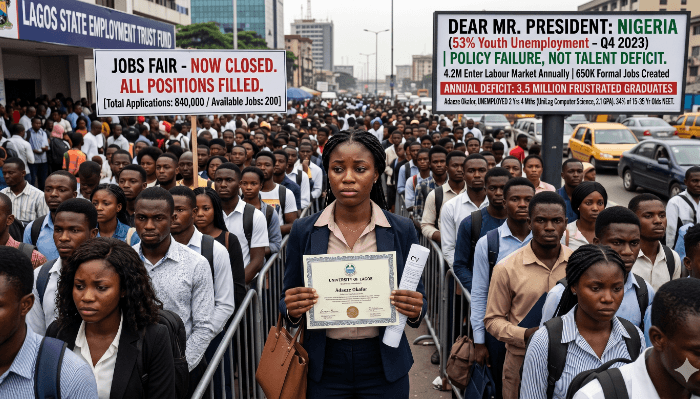
Mr. President, last September, a young woman named Adaeze Okafor queued for eleven hours at a Lagos job fair organised by the Lagos State Employment Trust Fund. She holds an upper second-class degree in Computer Science from the University of Lagos. She has been unemployed for two years and four months. By the time she reached the front of the queue, the 200 available positions had been filled. She went home. She did not make the news.
Adaeze is not an anomaly. She is the statistical norm. According to the National Bureau of Statistics, 53 percent of Nigerians between the ages of 18 and 35 are either unemployed or working in conditions that do not meet the basic threshold of productive employment. Every year, 4.2 million young Nigerians enter the labour market. Every year, the formal economy generates approximately 650,000 new jobs. That is a structural deficit of 3.5 million people annually — compounding, year on year, into a backlog of frustrated, educated, unemployable young citizens who have done everything they were told to do and found nothing waiting for them on the other side.
This is not a talent problem, Mr. President. It is a policy failure. And it has a solution.

THE PROBLEM, PRECISELY
Nigeria spends approximately 5.4 percent of its annual budget on education — producing graduates into an economy that cannot absorb them. The mismatch is not incidental. It is structural. Nigerian universities produce 2.1 million graduates annually in fields that the labour market has not demanded in meaningful volume for a decade. Meanwhile, the country faces acute shortages in software engineering, precision manufacturing, renewable energy installation, medical technology, and advanced logistics — fields that require vocational depth, not just academic credentials.
The Industrial Training Fund, established in 1971 to bridge exactly this gap, currently operates at less than 30 percent of its mandated coverage. The National Directorate of Employment — designed to provide skills-to-employment pipelines for WAEC and polytechnic leavers — has not produced a publicly audited placement report since 2019. The Government Enterprise and Empowerment Programme — N-Power — which enrolled over 500,000 graduates in its 2016 iteration — was redesigned, relaunched, restructured, and de-funded across four budget cycles without a single independent impact evaluation being conducted and published.
Nigeria has not failed to create youth employment programmes. It has created dozens of them. What it has never done is evaluate, consolidate, and enforce any of them.
WHY IT PERSISTS
Youth unemployment in Nigeria is politically visible but institutionally invisible. It generates speeches. It generates summits. It generates ministerial taskforces that produce reports that are not acted upon. What it does not generate is accountability. No minister has ever lost their portfolio over youth unemployment data. No agency has ever had its budget cut for failing to meet placement targets it publicly committed to. The NYSC — a programme that places 350,000 graduates annually into mandatory service — operates with no post-service employment tracking infrastructure. ‘Corpers’ finish. The state certifies their completion. The federal government has no data on where they go next.
There is also a private sector coordination failure that government has consistently refused to name directly. Nigeria’s largest employers — Dangote Group, MTN, NNPC subsidiaries, the major commercial banks — collectively employ fewer than 200,000 Nigerians. The SME sector, which globally drives 60 percent to 80 percent of employment in emerging markets, accounts for 84 percent of employment in Nigeria — but receives less than five percent of total commercial bank credit. You cannot solve a youth employment crisis without solving the SME financing crisis that sits underneath it. These problems are not parallel. One causes the other.
THE SOLUTION — THREE DIRECTIVES, NINETY (90) DAYS
Mr. President, the legal and institutional architecture to act already exists. The ITF Act, the NDE mandate, the SMEDAN Establishment Act, and the CBN’s existing policy frameworks provide sufficient statutory ground for everything that follows. What is needed is not new legislation. It is executive will, a mandate, and a deadline.
01 Consolidate all federal youth employment programmes under a single accountable Office of Youth Employment within the Vice President’s office
Nigeria currently runs at least fourteen (14) distinct federal youth employment interventions — across six ministries, with no shared database, no cross-programme eligibility, and no unified outcome tracking. Within 60 days, the President should direct the Office of the Vice President to produce a full audit of all federal youth employment programmes, their expenditures for the last four fiscal years, and their verified placement outcomes. Programmes that cannot demonstrate verified placements above 30 percent of enrolment should be defunded and consolidated into a single Nigerian Youth Employment Initiative with a unified digital registration portal, a biometric-verified placement tracking system, and a quarterly public dashboard — modelled on Kenya’s Ajira Digital Programme, which placed 600,000 young Kenyans in digital work within 36 months of launch.
Mandate an NYSC-linked post-service employment tracking system within 90 days
Every Nigerian who completes the NYSC programme represents a federal investment of approximately N180,000 in stipends, accommodation, and training. The country has no system to track the employment outcome of that investment. The NYSC Secretariat should be directed to implement a mandatory post-service employment declaration — digitally collected, linked to the NIN identity infrastructure, and publicly reported annually. Employers who hire NYSC completers should receive a verified hiring credit of N50,000 against PAYE obligations per hire for the first 24 months — a self-financing incentive modelled on South Africa’s YES4Youth programme. This single system would generate Nigeria’s first reliable labour market signal for graduate employment at scale, giving policymakers the data they currently cannot see.
Require all CBN-regulated commercial banks to allocate a minimum of 20% of SME lending to enterprises with verified youth ownership (18–35)

SMEs cannot hire young people if they cannot access growth capital. Nigeria’s commercial banking sector, under existing CBN sectoral allocation guidelines, already accepts directed credit obligations — the agricultural credit guarantee scheme and the Creative Industry Financing Initiative are precedents. A directive extending this logic to youth-led SMEs, with verification through the CAC and BVN infrastructure already in place, would inject a minimum of N450 billion in annual credit into the segment that actually drives employment. This is not a grant. It is a directed lending obligation on institutions that already operate within the CBN’s regulatory perimeter.
THE ASK
Mr. President, Adaeze Okafor is still waiting. So are the 3.5 million young Nigerians who entered the labour market last year and found nothing. And the 3.5 million who will arrive this year. And the year after that.
I am asking you to do three things before the end of this month. Direct the Vice President’s office to issue the programme audit and consolidation mandate, with a public dashboard commitment and a defunding clause for non-performing programmes. Direct the NYSC Secretariat to implement the post-service employment tracking system with the employer hiring credit attached. And issue a CBN circular directing minimum youth-SME lending allocations under the existing sectoral credit framework.

The total net fiscal cost of these three directives is approximately N4.2 billion annually — roughly equivalent to what the federal government currently spends on inter-ministerial youth employment summits that produce no measurable placements. The returns — in reduced security expenditure alone, as the correlation between youth unemployment and insurgency recruitment in Nigeria’s North-East and Niger Delta is extensively documented — would be measured in the tens of billions within three years.
The jobs do not need to come from government. They need to come from an economy that government has stopped strangling. You have the tools. You have the mandates. You have the institutions.
What 53 million young Nigerians need to know is whether you have the will.
A Nigerian who means well. Writing until someone listens.
Stay ahead with the latest updates!
Join The Podium Media on WhatsApp for real-time news alerts, breaking stories, and exclusive content delivered straight to your phone. Don’t miss a headline — subscribe now!
Chat with Us on WhatsApp