

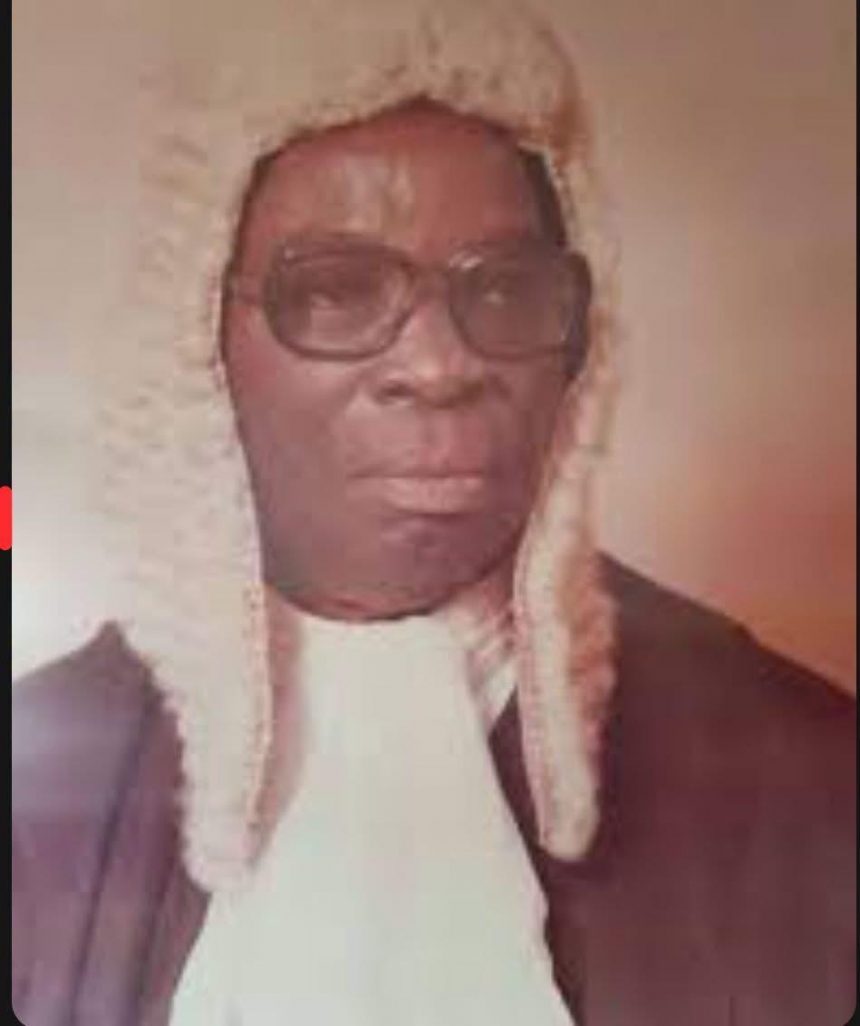
Born in May,1917 in Ilesha, Western Nigeria, few months after his father’s demise Babatunji Olowofoyeku grew up as the last born of an extended family in Ilesha, his mother enrolled him at the age of 5 at Otapete Methodist School and he was baptised there in the Methodist Church in 1924 and assumed the Christian name ‘Daniel’.
It was at the school he became a friend to his classmate, Tai Solarin, who was then known as Augustus Solarin. They both attended St. Andrew’s College, Oyo, from 1936 until 1942. Solarin later said that he was radically changed by Olowofoyeku’s final essay in which he observed that some of the colonialists were ignorant, and not well-prepared for the duties they were assigned, and therefore had no business running the lives of Nigerians. For this essay, he was punished for challenging the status quo, and suspended from college in his final academic year. However, he sat for and passed the final teacher’s examination as an external student a year later.
In protest against his perceived oppression by the colonial authorities, he dropped his middle name ‘Daniel’.

HE BECAME A TEACHER
Olowofoyeku taught at Oduduwa College from October 1942 until 1943 where his students included the revered Richard Akinjide, who was Attorney General of Nigeria. He taught till 1947 before he was appointed as Principal at Western Boys High School, Benin (January 1947 – December 1948).
HOW HE BECAME A LAWYER
In 1948, a case was instituted against him. Olowofoyeku, who was not a lawyer, researched and provided instructions to his defence attorney in court. Then, he won the case. That incident changed his career journey. He gained admission into the London School of Economics (LSE) to study law, left Nigeria in December 1949, passed the LLB (Bachelor of Laws) in June 1952 and passed the English Bar exams too. He became the first Ijesha man called to the English Bar.
He returned to Nigeria in 1952 and in September 1963, he was installed as Attorney General and Minister of Justice of the Western Region. He was also at the same time appointed a Queen’s Counsel (QC) by the British Government, as recognition of his official legal duties to the Commonwealth.
HIS DETENTION IN 1966
Due to internal political strife within the NCNC and under-representation of the West in the federal cabinet, Olowofoyeku and other Western Nigeria NCNC members in the legislature decided to align themselves with Ladoke Akintola’s newly formed Nigerian National Democratic Party (NNDP) in 1964 to form the United Progressive Grand Alliance (UPGA) with a faction of the Action Group. Olowofoyeku’s constituents in Ilesha were angry and viewed this move suspiciously and unfavourably. Consequently, his previously staunch support among them quickly vanished.
The political activities in the West heated up around December 1965. There was chaos in West and especially in Ilesha. Olowofoyeku escaped an assass!n’s bullet by a few inches during a campaign rally near Ilesha.
In the aftermath of the December 1965 elections, there was a bl00dy military c0up on 15 January 1966, establishing a National Military Government. Olowofoyeku was arrested and taken into custody by the Military Government on 30 January 1966 and detained for six months. He was first detained at Agodi in Ibadan and later transferred to Kirikiri in Lagos. He was allowed very limited family visitation rights throughout the period.
Olowofoyeku was released after the second counter c0up on 29 July 1966 that was carried out by soldiers of Northern Nigerian extraction who replaced the old military regime of Major-General Aguiyi-Ironsi. After being set free, Olowofoyeku vowed never to get involved in partisan politics again. Within weeks of his release in July 1966, he left Nigeria for Paris, France, to seek rest and refuge.
He returned in 1967 and moved to Lagos where he re-opened his law practice in Western House on Broad Street near the Lagos High Court. He continued to practise law for many years, during which time he was one of the first 20 to be appointed as a Senior Advocate of Nigeria (the equivalent of the Queen’s Counsel in the UK).
Despite being approached by Obafemi Awolowo in 1979 to come and join his new Unity Party of Nigeria (UPN), Olowofoyeku declined.
HIS DEMISE

On 26 March 2003, at the age of 85, Olowofoyeku passed away. His funeral, which lasted several days, was held partly in the High Court in Lagos, at his main residence in Victoria Island, and at his two homes in Ilesha.
Olowofoyeku was married, and had at least 17 children (13 sons and 4 daughters), who include international musician Toby Foyeh and actress Folake Olowofoyeku.
Sources: Wikipedia/ConnectNigeris
Stay ahead with the latest updates!
Join The Podium Media on WhatsApp for real-time news alerts, breaking stories, and exclusive content delivered straight to your phone. Don’t miss a headline — subscribe now!
Chat with Us on WhatsApp