



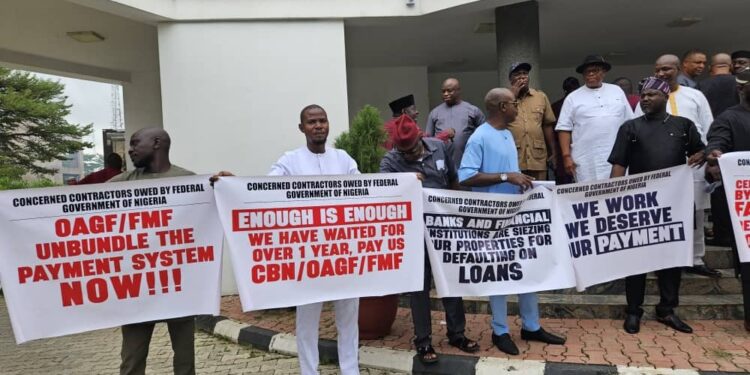
Nigeria’s mounting backlog of unpaid contractors is emerging as a hidden credit risk, with investors increasingly factoring it into the country’s fiscal outlook.
The development is based on claims by contractors and industry groups highlighting delayed payments tied to federal projects executed since 2024.
The situation demonstrates a growing concern that what appears as routine payment delays may reflect deeper liquidity challenges and off-balance-sheet obligations.

Contractors estimate that the Federal Government owes about N150 billion for verified projects, with only partial payments made so far despite commitments to clear a portion of the debt.
Beyond this, the All Indigenous Contractors Association of Nigeria (AICAN) suggest over N1 trillion in additional unverified claims, pointing to a broader accumulation of liabilities. Analysts say this trend effectively positions contractors as informal financiers of government spending, raising concerns about fiscal transparency and risk perception.
What they are saying
Stakeholders across the construction and financial sectors say persistent delays in contractor payments are no longer just operational issues but signals of broader fiscal strain. They argue that these arrears are increasingly being interpreted by investors as implicit debt obligations.
- “We’ve completed projects, submitted certificates, and waited months—sometimes over a year—for payment,” said an Abuja-based civil engineering contractor. “In the meantime, we’re servicing bank loans, paying staff, and absorbing inflation shocks. It’s not sustainable.”
- “When obligations are systematically delayed, they don’t disappear—they accumulate,” said Bamanga Abdul, a public finance expert. “Investors understand this. Even if it’s not explicit in official debt figures, they factor it into risk assessments.”
- “Cash flow mismatches are one of the earliest warning signs investors look for,” said Abudullahi Bindow, a senior economist at an Abuja-based investment firm, Sirdick Capital. “If revenues are insufficient or poorly timed relative to spending, something has to give—and in this case, it’s contractor payments.”
- “When payments are delayed indefinitely, the entire financial model breaks down. We’re effectively lending to the government at zero interest while paying double-digit rates to banks,” Omolayo Odunbaku, a project manager at a construction firm noted.
These views highlight a growing consensus that delayed contractor payments are being treated as indicators of fiscal stress rather than isolated administrative lapses.
More Insights
From a financial perspective, unpaid contractor obligations function similarly to short-term borrowing, allowing the government to benefit from completed projects while deferring cash payments. This creates what analysts describe as a “shadow debt system” that is not formally captured in public debt statistics.
- Contractors claim that about N150 billion is owed for verified projects, with only about N21 billion released so far, despite a 35% payment commitment.
- Industry estimates suggest more than N1 trillion in additional claims remain unverified, indicating a potentially larger liability pool.
- Delayed payments are linked to broader macroeconomic pressures, including volatile oil revenues, currency instability, and rising debt service costs.
- Investors are responding by demanding higher yields, shortening investment tenors, and applying higher risk premiums to Nigerian assets.
This dynamic suggests that beyond immediate liquidity challenges, the issue is reshaping how markets assess Nigeria’s creditworthiness and fiscal discipline.
FG’s responses
Recent policy responses indicate that authorities are aware of the risks posed by mounting arrears and are exploring measures to address them. However, analysts say structural reforms will be required to prevent recurrence.
Recently, following a meeting between the Minister of Finance, Mr. Wale Edun and AICAN’s executives in Abuja, the Federal Government agreed to pay 35% of N150 billion owed to indigenous contractors upfront, as part of efforts to resolve outstanding payment disputes.
- In December 2025, President Bola Tinubu established a multi-ministerial committee to address unpaid contractor obligations.
- In February 2026, the Senate urged a return to the previous system allowing MDAs to pay contractors directly.
- The government has acknowledged revenue constraints and is considering reforms such as improved revenue collection and digitized payment systems.
“There needs to be a shift from reactive to proactive fiscal management,” says Bola Joseph, an infrastructure finance consultant. “Otherwise, these arrears will persist—and the costs will keep rising.”
Ultimately, unpaid contractors are no longer just a domestic administrative issue but a key signal for investors assessing Nigeria’s fiscal health.
What you should know
Outstanding contractor debts have been a recurring issue in Nigeria’s public finance management, with similar budgetary provisions made in previous years.
- However, contractors often complain that budgetary allocations do not always translate into actual cash payments.
The Federal Government has earmarked N100 billion in the 2026 budget for the settlement of outstanding obligations owed to indigenous contractors across the country.
Stay ahead with the latest updates!
Join The Podium Media on WhatsApp for real-time news alerts, breaking stories, and exclusive content delivered straight to your phone. Don’t miss a headline — subscribe now!
Chat with Us on WhatsApp