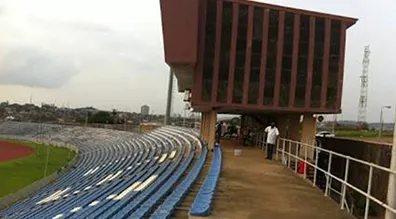
Sixty-eight years after the foundation was laid for what became the first modern stadium in West Africa, the historic Liberty Stadium, now known as Obafemi Awolowo Stadium, stands today as a symbol of Nigeria’s sporting heritage, though largely sustained by memories of its glorious past.
Wednesday, March 11, 2026, marks 68 years since the foundation-laying ceremony of the iconic arena conceived by the government of the former Western Region to commemorate the region’s attainment of self-government. The stadium was later renamed after the region’s premier, Obafemi Awolowo, whose administration championed the project.
Despite its historical significance, the once-celebrated sporting complex has suffered decades of neglect, particularly after its takeover by the Federal Government in 1976. Today, the arena that once earned the reputation as the “Pride of Africa” largely survives on memories of the landmark events it hosted.

The Nigerian national team last played at the stadium on July 9, 1983, defeating Togo 2–1 in a qualifying match for the 1984 Summer Olympics football tournament.
Liberty Stadium occupies about 40 acres of a 75-acre hillside site that rises gradually toward the northeast summit. Construction of the facility cost £521,050, with an additional £38,000 spent on land acquisition and £35,000 on building the approach road.
The idea for the stadium was conceived in 1957 by Gabriel Akin-Deko, then the Western Region’s Minister of Agriculture. The regional government subsequently established a planning committee comprising ministers and sports administrators, including J.O. Adigun, J.O. Oshuntokun, and J.O. Adebiyi, alongside athletics representatives Chief J.O. Ajiwunmi and J.B. Ojo.
The stadium was designed by chartered architect J.E.K. Harrison in collaboration with the Western Region Ministry of Works and Transport. Construction was carried out through direct labour by the ministry, with structural engineering support from Ove Arup and Partners and steel works executed by the Nigerian Steel Construction Company.
Officially opened on September 30, 1960—on the eve of Nigeria’s independence—the stadium quickly established itself as a major sporting venue. Its first international match came two days later when the Ghana national football team defeated Mali 5–1 in a semi-final match of the Kwame Nkrumah Cup on October 2, 1960. Ghana’s Aggrey Fynn scored after 15 minutes, becoming the first player to score in a full international match at the venue.
The stadium also hosted Nigeria’s first floodlit football match on October 11, 1960, when the Western Region team, Western Rovers, defeated Portuguese Guinea—now Guinea-Bissau—3–2.
Technologically advanced for its time, the stadium featured an underground drainage system designed to disperse heavy rain without flooding the pitch. The playing surface was meticulously maintained by Joseph Ogunyemi, the first Nigerian trained and appointed as stadium manager.
Before assuming the role in December 1959, Ogunyemi underwent 18 months of specialist training at major British sporting venues, including Wembley Stadium and White City Stadium, as well as the athletics ground of the University of London. He also attended technical courses in Paris and at the Olympic Stadium in Berlin.
However, his departure coincided with the gradual deterioration of the once-lush playing field, which became plagued by aridity, weed encroachment and neglect, symbolic of the wider decline of the historic facility.
Today, as Liberty Stadium marks another anniversary, it remains a monument to a visionary era in Nigerian sports infrastructure, one whose legacy still resonates even as the facility awaits meaningful revival.
Stay ahead with the latest updates!
Join The Podium Media on WhatsApp for real-time news alerts, breaking stories, and exclusive content delivered straight to your phone. Don’t miss a headline — subscribe now!
Chat with Us on WhatsApp