




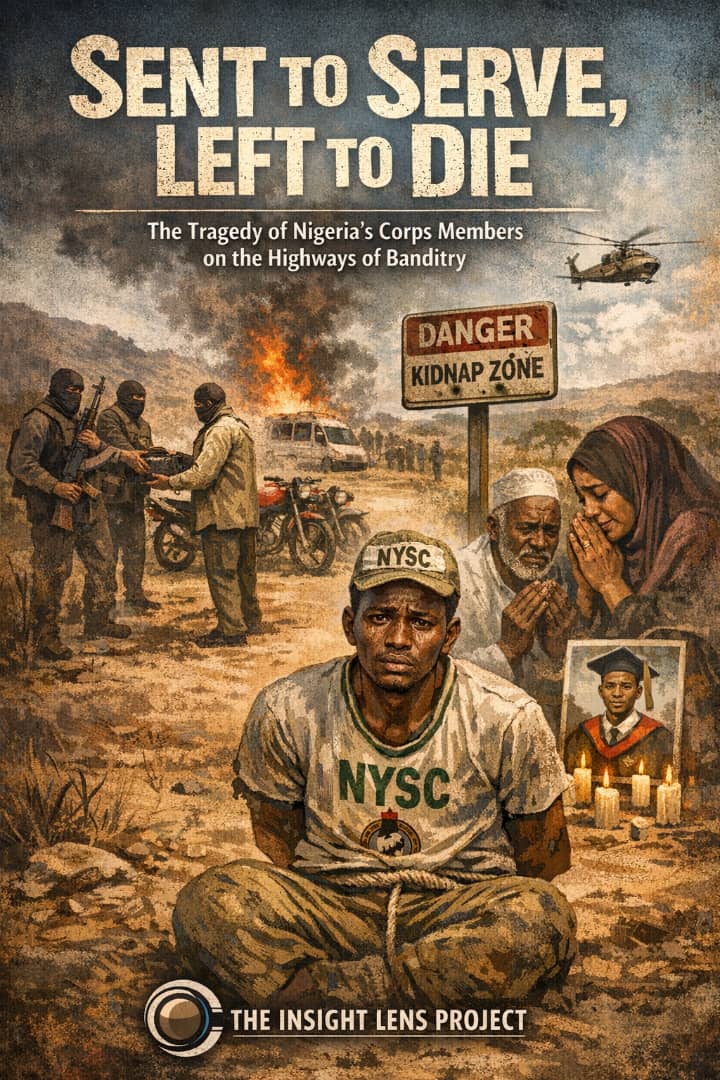
For decades, northern Nigeria has been caught in a relentless cycle of violence that has destroyed communities, emptied villages and claimed thousands of lives. Yet despite the scale of the crisis, the institutions meant to confront it have too often failed to rise to the challenge. Gatherings of northern political elites, from the Arewa Consultative Forum to the Northern Governors’ Forum frequently produce statements of concern but little in the way of meaningful protection for the people who live with the daily consequences of insecurity.
For ordinary citizens, the cost has been devastating. For young Nigerians in particular, the consequences can be fatal.
The National Youth Service Corps, once conceived as a noble instrument for national unity and development, now carries an increasingly troubling risk. Each year, thousands of young graduates leave their homes and travel across the country to serve in unfamiliar regions. Many undertake these journeys along roads that have effectively fallen under the control of armed gangs. They travel without escorts, without meaningful protection, and with little assurance that the state will intervene if something goes wrong.

The ordeal of Musa Usman Abba has come to illustrate this growing tragedy.
Abba, a graduate of Plant Science and Biotechnology from Federal University Gusau, was abducted in January 2026 while travelling toward Sokoto State to begin his national service posting. Like many families confronted by Nigeria’s vast kidnapping economy, his relatives were left with little choice but to negotiate with his captors.
They raised ten million naira, an enormous sum for a modest household and delivered it as ransom. It was not enough. The kidnappers demanded additional payments, including three motorcycles. Weeks passed in uncertainty. Hope slowly faded. By early March, with no word from the abductors, relatives gathered to perform funeral prayers in absentia.
Then, in a cruel twist, a video emerged on March 8.
Filmed outdoors in what appeared to be a barren rural landscape, Abba spoke directly to his family in Hausa. He greeted them calmly with “Assalamu alaikum” and repeated the words that have since echoed across social media: “Alhamdulillahi ina rai.” Praise be to God, I am alive.
The footage offered proof of life, but it also underscored the brutality of the system that had swallowed him. Frail and visibly distressed, Abba’s condition suggested the toll of weeks spent in captivity.
His story lays bare the structural failures surrounding the NYSC programme. Before deployment, graduates are required to sign indemnity forms that effectively absolve the government of responsibility should they be injured or killed while serving the country. When kidnappings occur, families are left to fend for themselves. There is no guaranteed life insurance, no military escort along known kidnapping corridors, and little accountability from the authorities responsible for the safety of those sent to serve.
In effect, families are pushed into negotiating directly with criminal networks, transforming the lives of their children into ransom transactions.
Civil society groups say the situation has become intolerable. Human rights advocates are now calling for urgent reforms, including military escorts for corps members travelling through high-risk regions, policies that allow graduates to serve closer to their homes, and government-funded life insurance covering kidnapping, injury and death. They also demand the removal of clauses that shift the burden of ransom payments to families.
One prominent advocate, Dr. Alice Oludimu, described the current system as “a meat grinder targeting Nigeria’s youth.”
“We cannot keep serving a nation that refuses to protect us,” she said. “Another ten million naira should not be paid for a corpse.”
Perhaps most troubling is the quiet that has followed. Despite the brutality of Abba’s abduction and the desperation of his family, national outrage has been uneven. Voices that often mobilise quickly around tragedies elsewhere have remained largely muted. The silence reflects a deeper societal fatigue, a troubling acceptance of violence as a permanent feature of life in parts of the country.
Yet Abba’s story refuses to fade quietly. It forces an uncomfortable question upon the nation.

If a country cannot protect the young people it compels to serve it, what exactly is it asking them to sacrifice?
Until decisive action is taken, Nigerian graduates will continue to travel along roads that have become highways of fear. Families will continue to gather money for ransoms they cannot afford. And the country will continue to watch its brightest hopes walk, unguarded, into danger.
©️ Adebamiwa Olugbenga Michael is a Lagos-based political economy and policy intelligence analyst and publisher of The Insight Lens Project, providing data-driven insights across Nigeria and West Africa using open-source data
Stay ahead with the latest updates!
Join The Podium Media on WhatsApp for real-time news alerts, breaking stories, and exclusive content delivered straight to your phone. Don’t miss a headline — subscribe now!
Chat with Us on WhatsApp