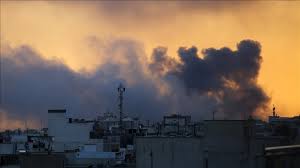




Iran has threatened to attack oil facilities in neighbouring countries after Israel struck at least five energy sites in and around Tehran, smothering the city in black smoke and escalating fears that the conflict will result in significant disruption to the world economy.
“If you can tolerate oil at more than $200 per barrel, continue this game,” said a spokesperson for Iran’s Revolutionary Guards (IRGC) on Sunday.
The US sought to calm markets as oil prices surge by pledging not to target Iran’s energy infrastructure.

However, fireballs and thick plumes of smoke rose over Tehran on Sunday after Israeli airstrikes hit four storage facilities. Iran’s oil distribution company said four employees were killed, as a dark haze hung over the city and the smell of burning oil lingered in the air. Explosions in the capital’s nearby city of Karaj reverberated across the region, and left the area under smoke.
A spokesperson for the IRGC said Iran would retaliate if the strikes on energy infrastructure continue. State media quoted the spokesperson accusing the US and Israel of targeting civilians and fuel facilities, saying Gulf states should press them to stop or “similar actions will be taken in the region”.
However, the US energy secretary, Chris Wright, suggested the strikes that hit Iranian oil facilities were carried out by Israel and that Washington would not target Iran’s energy infrastructure. Speaking to CNN, Wright claimed disruptions to petroleum and gas supplies would be brief, “a few weeks” at worst. Iran produces about 4% of global oil, much of it exported to China.

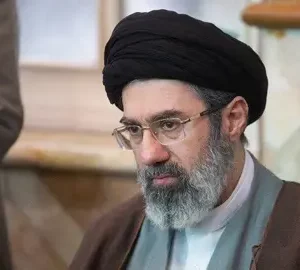
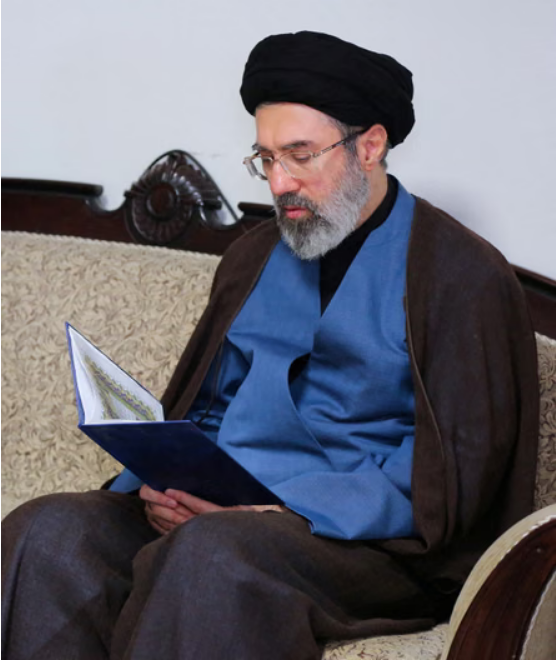
The tensions came as Mojtaba Khamenei, the second son of the late Iranian supreme leader Ayatollah Ali Khamenei, was chosen as his successor.
Members of the clerical body responsible for selecting Iran’s highest authority announced the decision on Sunday night, calling on Iranians to rally behind him and preserve national unity.
In a statement carried by state media, the assembly said Khamenei had been chosen through what it described as a “decisive vote”.
The body urged citizens across the country, “especially the elites and intellectuals of the seminaries and universities”, to pledge allegiance to the new leadership and safeguard unity at a critical moment for Iran.
The move could lead to a further escalation of the war after Donald Trump had already acknowledged that Mojtaba Khamenei was the most likely successor and made clear he considered such an outcome unacceptable.
Mojtaba Khamenei’s elevation marks the first time since the 1979 Islamic revolution that Iran’s supreme leadership has passed from father to son. It is a development likely to ignite debate within the country about the emergence of a dynastic system in a state founded explicitly to overthrow hereditary rule after the shah.
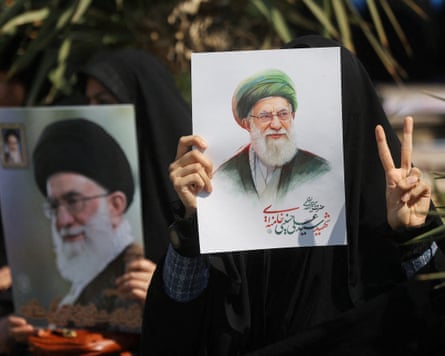
Trump said earlier on Sunday that Iran’s next supreme leader was “not going to last long” if Tehran did not get his approval first.
Earlier in the day, in a post on X in Farsi, the Israeli military said it would continue pursuing every successor of Ali Khamenei and it would pursue every person who sought to appoint a successor for him.
The clerical meeting to appoint a new leader happened as fighting between Israel and Iran intensified over the weekend. Iranian strikes have hit energy infrastructure across the Gulf and Israeli attacks have targeted oil storage and fuel facilities inside Iran.
A fresh wave of Iranian strikes hit the Gulf on Sunday, with Saudi Arabia, the United Arab Emirates, Qatar, Bahrain and Kuwait all reporting attacks. Saudi Arabia said it intercepted 15 drones, while strikes in Bahrain caused “material damage” to an important desalination plant. Two people were killed on Sunday and 12 others injured after a projectile fell on a residential location in Al-Kharj, a city in Saudi Arabia, the Saudi civil defence said.
On Sunday evening the US military said a US service member had died of injuries sustained during an Iranian attack on US troops in Saudi Arabia. It brings the US death toll from the war to seven.
According to reporting by the Washington Post, Fox News and other US media organisations, Russia has been providing Iran with intelligence that could help it target US military assets in the region. The Guardian is unable to confirm this.
The recent attacks on Gulf states appear to highlight a clash within Iran’s leadership, contradicting remarks made on Saturday by the president, Masoud Pezeshkian, who apologised to countries on the Arabian peninsula and suggested strikes against them would end, provided their airspace and US bases were not used against Iran.
According to analysts, Pezeshkian’s pledge not to strike Gulf states exposed rare public rifts within the ruling elite with Iran’s leadership showing signs of strain, as officials of the regime scrambled to explain and reinterpret the president’s words, which appeared to anger the country’s more conservative factions.
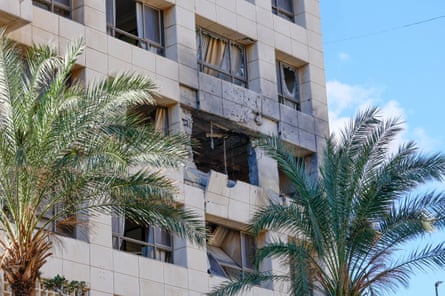
Nonetheless, the Iranian military continued striking the neighbouring countries.
Throughout the day, Iran launched intermittent barrages of ballistic missiles towards Tel Aviv and central Israel. At least one person was seriously injured after a residential building was hit, according to Magen David Adom, the country’s ambulance service. Most of the missiles were intercepted by Israeli air defences and caused no casualties.

Meanwhile, Israel’s war on several fronts continued, with the Israel Defense Forces launching intense strikes on Lebanon, where the Iran-backed armed group Hezbollah is based. The assault on Lebanon left four people dead in a hotel blast in Beirut and killed a further 12 in strikes on southern areas of the country. Israel said it was targeting “key commanders” in the Iranian military’s Quds Force.
Lebanon’s health ministry said at least 394 people had been killed in the conflict. The Norwegian Refugee Council said about 300,000 people had fled their homes.
Meanwhile, violence continued to surge in the occupied West Bank and Gaza. Three people were killed by Israeli settlers in the occupied West Bank on Sunday, bringing the number of Palestinians killed in recent days to six.
An Israeli airstrike killed at least two Palestinians in Gaza City on Sunday, local health officials said, the deadliest incident in the territory since Israel and the US launched their war against Iran a week ago.
The Israeli military did not immediately respond to a request for comment about Sunday’s strike.
Agence France-Presse contributed to this report
Source: The Guardian

Stay ahead with the latest updates!
Join The Podium Media on WhatsApp for real-time news alerts, breaking stories, and exclusive content delivered straight to your phone. Don’t miss a headline — subscribe now!
Chat with Us on WhatsApp