
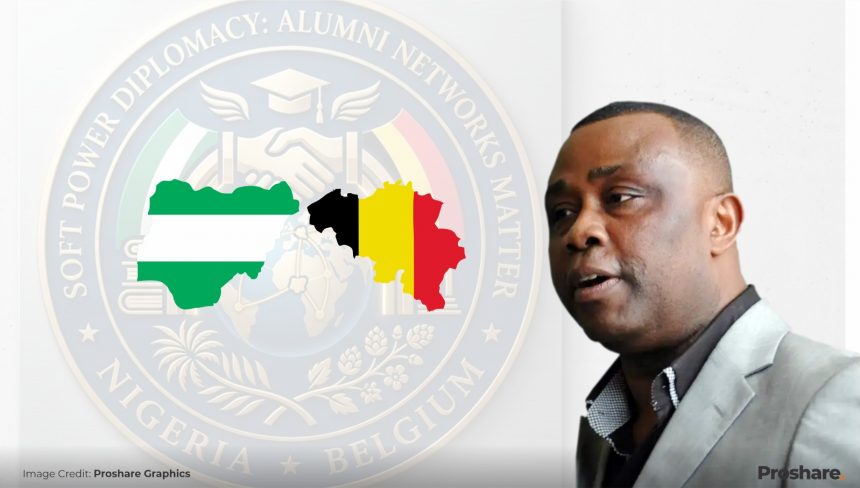
When His Excellency Pieter Leenknegt, Ambassador of the Kingdom of Belgium to Nigeria, convened Nigerian alumni of Belgian universities at his official residence in Abuja, it was more than a ceremonial reception. It was a masterclass in soft power diplomacy. It was deliberate, strategic, and future-oriented.
Made in Nigeria Goods
In an age where diplomacy is often reduced to high politics, it is easy to overlook the quiet but enduring power of human relationships. Yet history repeatedly shows that the most resilient bilateral partnerships are not built solely in ministries or boardrooms. They are built in lecture halls, laboratories, shared student apartments, Erasmus years, and alumni networks. The event quietly asserts that diplomacy can be much more than security pacts, trade negotiations, and geopolitical positioning.

This is soft power diplomacy in its purest form.
Education as Strategic Infrastructure
Belgium has long invested in educational exchange as a pillar of its international engagement. When Nigerian students study in Brussels, Leuven, Ghent, Antwerp or Liège, they do not merely acquire degrees. They absorb institutional culture, regulatory systems, governance models, research standards, and professional ethics. They build friendships. They internalise values. They form networks.
When they return to Nigeria or operate transnationally between both countries, they become bridges.
The Abuja alumni gathering recognised this reality. It transformed what might otherwise remain a dispersed community into a conscious network. A network that can be mobilised for innovation, research collaboration, trade facilitation, governance dialogue, and investment partnerships.
In diplomacy, networks are assets. Alumni are strategic capital.
From Cultural Diplomacy to Economic Diplomacy
Politics
In my recent book, Economic Diplomacy of the Diaspora, I argue that the diaspora and transnational communities are not passive beneficiaries of foreign policy. They are active instruments of it. They carry relational capital that governments alone cannot manufacture.
Educational alumni networks represent a particularly powerful category of diaspora capital because they combine three critical elements:
- Cultural fluency – the ability to interpret both Nigerian and Belgian contexts with credibility.
- Professional competence – often grounded in internationally competitive training.
- Relational trust – built through lived experience in both societies.
When mobilised, this triad becomes a catalyst for economic diplomacy.
A Belgian-educated Nigerian entrepreneur is more likely to navigate Belgian regulatory frameworks confidently. A Nigerian public official who studied in Belgium understands the operational logic of European institutions. A Belgian company considering entry into Nigeria benefits immensely from trusted alumni who can interpret local realities accurately.
This is where soft power matures into hard economic outcomes.

Why This Matters Now
The Nigeria–Belgium relationship is evolving, and more visibly so in the past three years. Trade volumes, investment conversations, and institutional exchanges are expanding. Belgium’s strategic ports and logistics expertise align with Nigeria’s maritime and energy ambitions. Belgian strengths in green technology, health systems, Research & Decelopment, and advanced manufacturing intersect with Nigeria’s development priorities.
Education
But the sustainability of these partnerships depends on trust.

Alumni networks foster precisely that: sustained, people-to-people trust that transcends political cycles. Governments change. Policy frameworks shift. Even Ambassadors get recalled back to headquarters or reassigned to another Mission. But alumni bonds when properly organised, endure for decades. For the alumni, like people say in Nigeria: no leave, no transfer.
By hosting this gathering, Ambassador Leenknegt signalled something important: that Belgium sees its educational relationship with Nigeria not as a historical footnote, but as a forward-looking strategic asset.
Diplomacy Beyond the Embassy Walls
Modern diplomacy is no longer confined to embassies issuing communiqués. It increasingly operates through ecosystems. These are universities, business associations, cultural institutions, diaspora platforms.
The alumni event in Abuja reflects a recognition that diplomatic capital resides in people. It acknowledges that the most persuasive ambassadors are often those who have lived between worlds.
In Economic Diplomacy of the Diaspora, I emphasise that nations which deliberately structure and mobilise their diaspora networks outperform those that treat diaspora engagement as symbolic outreach. Belgium’s alumni initiative demonstrates structural thinking: identify the network, convene it, formalise it, and align it with bilateral objectives.

Nigeria, too, can draw lessons from this model; strengthening its own engagement with foreign-educated Nigerians and harnessing that talent pool systematically for national development, where it does not yet exists.
Made in Nigeria Goods
A Personal Reflection on the Quiet Power of Educational Ties
A few years ago, during a summer visit to my hometown of Igbuzo in Delta State, I sat with my father, then in his mid-nineties. There was a gentle insistence in his voice about a request he had made to me several times before: that I should formally visit our traditional ruler with him.
We went.
After the initial courtesies, the Royal Father asked where in Europe I was based. “Belgium,” I replied.
“Where in Belgium?” he pressed.
I confess my reflex was dismissive. Of what importance could that detail be? What would he know of Belgian geography?
“Our home is in a place called Ostend,” I said casually.
He paused. Then his face lit up. Turning to his Queen, he exclaimed with unmistakable excitement: “Come and meet an Oostendenaar!”
What followed was an extraordinary afternoon. The Obuzor of Igbuzor, Obi (Professor) Louis Chelunor Nwoboshi, recounted his time in the 1960s as a doctoral researcher at Ghent University and a visiting scholar at University of Oxford. Every fortnight, he would take the ferry from Ostend to Ramsgate or Dover en route to Oxford. Ostend was not just a Belgian coastal town to him. It was a corridor of intellectual formation, friendship, and possibility.
Economics
In that moment, geography dissolved. Generations collapsed into shared experience. What I had casually mentioned as an address was, to him, a bridge to a formative chapter of his life.
An immediate bond was forged, one that endures to this day.
That encounter reminded me that educational exchange is never merely transactional. It imprints memory. It builds affinity. It shapes identity in ways that can resurface decades later in the most unexpected settings.
That is soft power at work.
The Long Game of Soft Power
Soft power rarely produces instant headlines. As my encounter in Igbuzo illustrated, its effects may lie dormant for decades, only to resurface as enduring affinity and trust.
The Royal Father’s excitement at hearing the name “Ostend” was not about geography. It was about memory, belonging, and intellectual formation. It was about a chapter of his life before I was even born, that Belgium had helped shape. It was a connection strong enough to transcend time, age, and distance.
That is precisely what Ambassador Leenknegt’s alumni initiative recognises.
Politics
When a diplomat convenes former students who once walked the campus corridors of Brussels, Leuven, Ghent, Antwerp, or Liège, he is not merely hosting a reception. He is activating stored goodwill. He is reconnecting formative experiences with present strategic interests. He is converting memory into diplomatic capital.
The Obuzor’s ferry rides from Ostend to Oxford in the 1960s were, in their own quiet way, acts of bridge-building. Today’s alumni network in Abuja represents a structured, intentional continuation of that same bridge.
Soft power, when properly cultivated, compounds across generations.
If diplomacy is ultimately about advancing national interest while preserving mutual dignity, then initiatives like this embody its highest form. They remind us that nations are not bound together only by treaties or trade statistics, but by shared classrooms, shared journeys, and shared stories.
Soft power diplomacy, indeed, in its glory.
About the AUTHOR
Collins NWEKEis an International Trade Consultant & Economic Diplomacy researcher. He was a former Green Councillor at Ostend City Council, Belgium, where he served three consecutive terms until December 2024. A first-generation migrant who transitioned from civil society activism into elected office, he writes frequently on democracy, governance, and Africa–Europe relations. He is the author of the forthcoming book ‘Economic Diplomacy of the Diaspora’. He is also a Distinguished Fellow of the International Association of Research Scholars and Administrators, serving on its Governing Council. A columnist for The Brussels Times, Proshare, and Global Affairs Analyst with a host of media houses, Collins writes from Brussels, Belgium. X: @collinsnweke E: admin@collinsnweke.eu W: www.collinsnweke.eu
Stay ahead with the latest updates!
Join The Podium Media on WhatsApp for real-time news alerts, breaking stories, and exclusive content delivered straight to your phone. Don’t miss a headline — subscribe now!
Chat with Us on WhatsApp