The good news for Liam Rosenior is that, by his own analysis, there are two easily identifiable problems stopping his Chelsea side from reaching their potential.
The bad news is that, again in his own words, they are “deep-lying” issues and are already proving costly.
“We’re losing points not based off our performances, but based off of set plays and discipline,” head coach Rosenior said after the 2-1 away defeat to Arsenal on Sunday. “I don’t want to be sat here saying how well we play every week without picking up the points. As a group, me as the leader as well, we have to take more accountability for some of the decision-making we’re having in terms of our discipline and in terms of the moments of the goals — not just today — the goals we conceded. Some of them are just not acceptable at this level.”

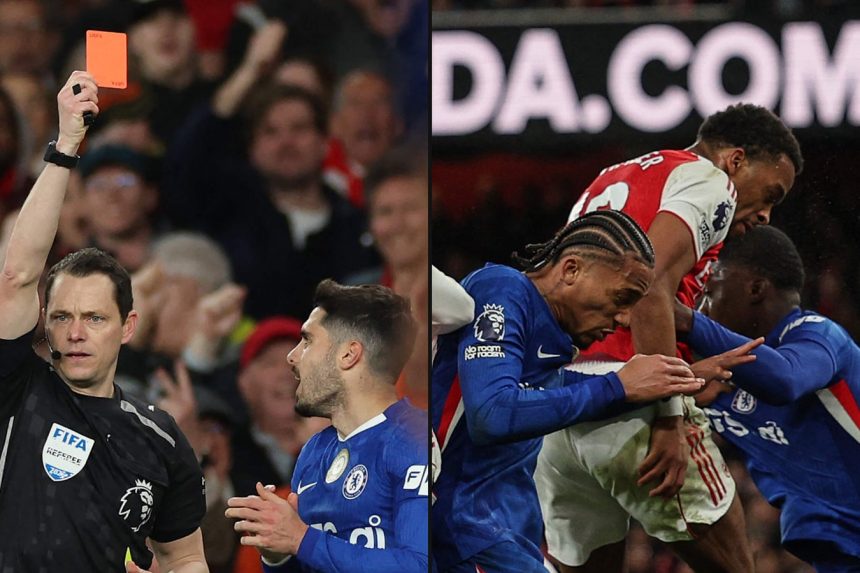
Of the nine goals Chelsea have conceded in their past six Premier League games, five have been from set pieces. They have received a red card in each of their last two matches, taking their tally for dismissals this season to seven in the league (the most in the division and three ahead of next-ranked Everton) and nine in all competitions.
“It’s not about the punishment. It’s about finding the reason why,” Rosenior said of Chelsea’s disciplinary record. “It’s a focus and a concentration thing.”
The same can be said of their set-piece problems.
Concentration lapses in marking and failing to keep their heads when opponents flood the box have cost them the past three goals conceded: Zian Flemming’s late equaliser from a corner for Burnley, William Saliba’s opener on Sunday and then Jurrien Timber’s winner.

Zian Flemming scoring from a stoppage-time corner for Burnley to deny Chelsea a winBen Whitley/PA Images via Getty Images
Look at those moments, along with any of the split-second choices by Marc Cucurella (against Fulham on January 7), Wesley Fofana and Pedro Neto that led to their respective red cards and this squad’s composure under pressure is showing cracks.
Explaining that is not as simple as pointing to their youth.
The sides that come closest to Chelsea’s record for sendings-off in the Premier League this season — Everton on four, Tottenham Hotspur, Wolverhampton Wanderers and West Ham United on three — have considerably higher average ages weighted by minutes played, ranging from 26 (Spurs) to 28 (Everton). But the three sides with the youngest average after Chelsea have only four red cards between them.
Other factors — including past experiences weighing on their minds, injuries and suspensions impacting the consistency of the defence, and their communication on the pitch — are all at play.
“When we perform under pressure, the reason why athletes at that level can do it better than others is that they’ve already gone through the process,” says Dr Tom Bates, a performance psychologist who has worked at Premier League clubs Brentford and Aston Villa. “They’ve already trained it inside-out. So they take what is essentially conscious and it becomes subconscious.”
Bates stresses the importance of training set pieces in depth, in conditions that replicate a match situation as closely as possible, to help players deal with the pressure they bring.
It is fair to assume that Chelsea spend considerable time working on set pieces: they recruited specialist set-piece coach Bernardo Cueva from Brentford ahead of last season, and Rosenior’s post-match comments, such as referring to a “marking assignment” that was not carried out correctly when Flemming was left free for his header at Stamford Bridge, make clear that they have detailed plans for such situations.
The question then becomes why those strategies are not being followed.

As Bates explains it, players’ decision-making is directly impacted by their emotional regulation, such as anxiety levels, in pressurised game situations like set pieces.
“The more in control of my emotions I am, or the less anxiety I experience, the broader my perceptual lens, which means I see more of what’s actually going on,” Bates says. “When under conditions of anxiety, my perceptual field narrows.
“It’s like a laser focus, or like tunnel vision. I miss key parts of what’s happening. So I might lose my man, I might not have noticed the cue of the decoy runner, (or) I didn’t hear my centre-back tell me something.”
The fact that Chelsea have been struggling in set-piece situations makes this something of a cycle.

“It’s what’s known as an anchor,” Bates says. “The emotion is so strong and so raw that those things just come flooding back: ‘Here we go again, it’s going to happen again’.”
So how can Chelsea recover their composure?
“It just needs a calm head out there to organise,” says Robert Huth, the former Germany international defender who won the Premier League with Chelsea in 2005 and 2006. “At the moment, they haven’t got that kind of leadership in the team to take hold of that situation.”
Huth was also a member of Leicester City’s Premier League-winning squad in 2015-16 and spent time at Stoke City under Tony Pulis, whose team were known for their set-piece prowess. He believes stronger leadership on the pitch can help Chelsea both with their organisation when defending dead-ball deliveries and with keeping their composure.
“Having a calm head on the pitch would really benefit the team,” Huth says. “When you lose your temper on the pitch and you get booked, you need someone just to have a chat with you.
“I’ve lost my head plenty of times, and I’ve had someone senior just go, ‘Rob, calm down. Don’t do this, don’t talk to the ref. Just go away’. It does really, really help. But at the moment, I look at the team, and I don’t think they have that senior player on the pitch that kind of oozes authority.”

Chelsea’s current captain Reece James is seen as having made important strides as a leader in recent times, but has returned to predominantly playing as a right-back under Rosenior since he succeeded Enzo Maresca in January — which Huth points out is less ideal for communication with team-mates than being more centrally positioned on the pitch.

Chelsea old boy Robert Huth suggested their current team need more leadership input on the pitchMike Hewitt/Getty Images
“The communication part of it is absolutely critical,” Bates says. “What would look like being ill-disciplined is actually two things: an inability to be able to regulate my emotions to make rational decisions, and a disconnect from the whole, so players break from the shared mental model and become individuals, and so it looks very disjointed and disconnected.”
Team selection issues won’t have helped Chelsea’s defensive solidity in the past few games, either. Injuries to James and Cucurella plus Fofana’s suspension after being sent off against Burnley have been disruptive.
“It definitely helps if you’ve got a settled back four,” Huth says. “When you’re not sure about who you’re playing with, you second-guess yourself. If they can get a back four together that can play continuously for a number of games, I think over the long-term and short term that will benefit Chelsea massively.”
Chelsea’s struggles to keep their cool in games threaten to undermine what had overall been a strong start under Rosenior.
“If we get to the bottom of those two main things, we can be a very, very good team and we can achieve all the things we want to achieve,” he said on Sunday.
Unfortunately, these problems are far simpler to identify than to solve.
Source: nytimes
Stay ahead with the latest updates!
Join The Podium Media on WhatsApp for real-time news alerts, breaking stories, and exclusive content delivered straight to your phone. Don’t miss a headline — subscribe now!
Chat with Us on WhatsApp