



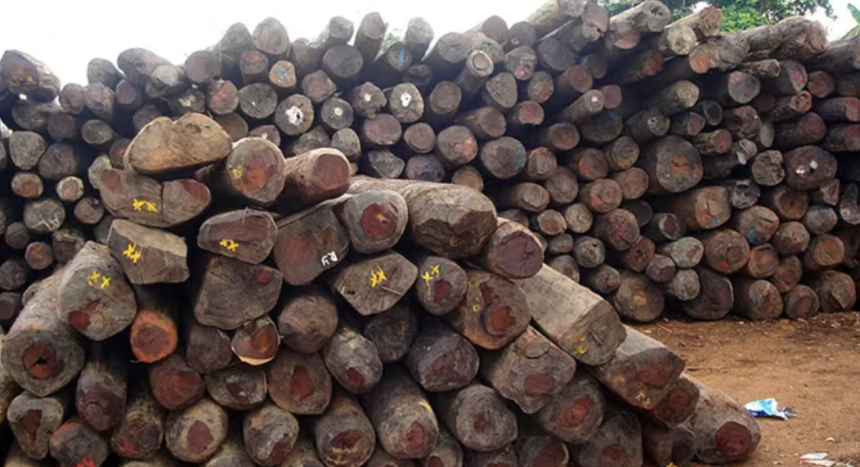
Between 2014 and 2018, Nigeria underwent a seismic shift in its forestry sector, transforming from a minor timber participant into the world’s largest exporter of African rosewood, known locally as Kosso. This surge was fueled by an insatiable demand in China for “Hongmu”, a high-end, Ming-style furniture with decorative finishes that symbolises status. At the peak of this boom in 2017, Nigeria accounted for approximately 58 percent of all West African rosewood exports to China.
According to the Environmental Investigation Agency (EIA), more than 1.4 million rosewood logs were laundered through Chinese ports, enough to fill an estimated 10,000 shipping containers. The scale of the trade was particularly intense between January 2014 and June 2017, when an average of over 40 containers of rosewood logs left Nigeria for China each day. That volume translates to roughly 5,600 logs daily, equivalent to about 2,800 trees harvested every 24 hours.
To “legalise” these logs, which were worth an estimated $300 million (over ₦100 billion), thousands of permits by the Convention on International Trade in Endangered Species (CITES) were allegedly signed retroactively by Nigerian officials, bypassing international conservation laws.

Kosso was listed under Appendix II and III of CITES in 2016, requiring that any international trade be subject to strict regulation and sustainability assessments to ensure the species’ survival in the wild. In November 2018, the convention suspended rosewood exports from Nigeria, citing concerns over widespread overharvesting and the ecological impact of unregulated trade.
While the ban officially halted legal exports, “wildcat” logging continues at an alarming pace across the country’s forests, from Oyo and Ogun to Taraba and Cross River states.
THE BIOLOGY OF VULNERABILITY
Kosso, scientifically known as Pterocarpus erinaceus, is not an ordinary forest tree. It is a dense, slow-growing hardwood native to West Africa’s savannah woodlands and forest margins. Its ecological value extends beyond its timber. Kosso, taking up to 120 years to mature, plays a structural role in forest composition, contributes to soil stability, carbon sequestration, and provides shade and habitat for birds, insects, and small mammals.
Rosemary Ubaekwe, a forest ecologist, said that unlike fast-growing plantation species, Kosso cannot regenerate quickly after large-scale extraction.
Ubaekwe said it requires specific forest conditions to thrive, including stable soil systems and the presence of mature, seed-bearing trees that enable natural regeneration. When these older trees are removed indiscriminately, she noted that the reproductive cycle is disrupted. Younger trees, even if present, cannot compensate for the ecological role of mature stands.
This biological reality means Kosso is not easily replaceable. Replanting efforts, where they exist, do not immediately restore ecological function. A harvested Kosso tree represents decades of growth lost in a single act of logging.
“Its regeneration depends on mature, seed-bearing trees and specific forest conditions; so selective logging poses a serious threat to population viability,” she said.
“Logging disrupts these ecological processes, affecting forest resilience, biodiversity loss, ecosystem services and the ability of forests to recover. Overexploitation of Kosso is a grave danger to the integrity and sustainability of forest ecosystems in Nigeria.”

The forest ecologist said that when loggers remove the largest trees, they remove the primary seed sources for future generations. Over time, forests lose the capacity to sustain themselves.
She explained that canopy cover is central to forest stability. When large hardwoods like Kosso are removed, the upper forest layer becomes thinner. This alters light penetration, temperature, and moisture retention within the forest interior.
“Forest fragmentation has a direct negative impact on the habitat suitability for birds, primates, and other forest-dependent organisms, including endangered species such as the African forest elephant, many of which require continuous canopy cover to forage, nest, and seek shelter,” she said.
“Logging activities increase human intrusion, hunting, and more exposure to increased deforestation. These disturbances over time reduce species richness, disturb ecological interactions and weaken the forest ecosystem resilience.”

THE ECONOMIC SPILLOVER: FORESTRY, AGRICULTURE, AND TOURISM
Ubaekwe told TheCable that the consequences extend beyond forest ecosystems into sectors that depend on forest health. The depletion of high-value hardwoods like Kosso distorts Nigeria’s forestry sector. She said illegal extraction prioritises short-term profit over regeneration, removing commercially valuable trees without ensuring replacement.
“Forests have slow but cumulative effects on adjacent agricultural systems,” she explained. “Loss of canopy cover and soil degradation can lower crop productivity in the long run.”
She noted that when mature trees are removed, soil erosion accelerates. Microclimate changes follow: temperatures rise, humidity drops, and water retention declines. These shifts compound over seasons, and farmers notice declining yields.

In regions where agriculture is already vulnerable to climate variability, the loss of nearby forests removes a critical buffer, threatening food security for communities that depend on small-scale farming.
“Degraded forests lose biodiversity and aesthetic value, directly reducing their tourism potential and threatening community livelihoods,” Ubaekwe noted.
She added that Nigeria’s forests hold potential for nature-based tourism that could generate revenue for local communities, but that potential evaporates when forests are stripped of their iconic species. Communities that could have benefited from eco-tourism income instead face a future where forests offer neither ecological services nor economic opportunities.
WHY THE TRADE PERSISTS
Nigeria is a CITES signatory, and domestic laws prohibit illegal logging. If the ecological and economic costs are clear, why does the Kosso trade continue despite international prohibitions?

“Rosewood is a high-value species with strong economic incentives behind it,” said Felix Ajogwu, a principal officer at the Department of Forestry, CITES, and Wildlife Management in the Federal Ministry of Environment.

“When you have a commodity that traffickers can easily sell at high margins, enforcement becomes extremely difficult.”
Ajogwu told TheCable that the regulatory framework exists on paper, but enforcement falters at multiple points in practice. From forest reserves where trees are felled, to checkpoints where shipments pass inspection, to ports where containers are loaded for export.
He added that the profit margins are substantial enough to absorb the cost of bribes and falsified documentation.
“From source to destination, there are capacity gaps at multiple points,” he said. “Weak interagency coordination and poor species identification make enforcement challenging.”
He said forest rangers lack resources to patrol vast landscapes, checkpoint officers may not have training to distinguish rosewood from other timber, and port inspectors face container volumes that exceed inspection capacity.
“There are cases of misclassification and falsification of documents,” Ajogwu explained. “A container of rosewood could be labelled as teak. If enforcement officers are not trained to identify the species correctly, the shipment will be allowed to pass through.”
The government official also noted that mislabeling is common: exporters declare shipments as non-restricted species and rely on the fact that most inspectors lack expertise to verify contents.
“As long as there is strong international demand, there will be actors willing to supply it,” he said. “Poverty also drives participation in illegal wildlife and timber trade.”
Ajogwu, who has worked on biodiversity conservation and CITES compliance, said addressing illegal logging without addressing the economic conditions that make it attractive is unlikely to succeed.
He said the high global demand for rosewood continues to create strong financial incentives along the supply chain. In forest-dependent communities facing limited livelihood options, logging offers immediate income where formal employment is scarce.
Ajogwu said trade networks also adapt to pressure as scrutiny increases. Consignments may be misdeclared, documentation manipulated, or routes redirected through alternative channels, noting that regulatory tightening does not automatically eliminate trade, but can push it into more opaque forms.
He argued that without strengthening compliance systems, improving inter-agency coordination, and addressing livelihood vulnerabilities, enforcement efforts will struggle to achieve durable results.
“When one species is restricted under CITES, exporters often shift to other valuable species not captured under the appendices. The trade adapts to regulation,” he said.
On her part, Ubaekwe said the persistence of the trade “highlights significant gaps in forest governance in Nigeria”, adding that although international regulations exist, “local enforcement remains poor, with limited resources and weak coordination.”
According to her, sustainable forest management requires strong policies, effective implementation, and community participation, elements that are “inconsistently applied”. The result is a system where short-term profit often outweighs long-term ecological planning.
WHAT IS AT STAKE AND THE POLICY RESPONSE
Ubaekwe warned that if current extraction rates continue, degradation will be gradual, cumulative, and increasingly difficult to reverse.
“Continued overexploitation could push Kosso populations to critically low levels, weakening overall forest resilience,” she said.
As the largest trees are removed, the age structure of Kosso populations becomes skewed toward younger, non-reproductive individuals. Within a decade, some forest populations could reach a tipping point where natural recovery becomes nearly impossible without intensive intervention.
She added that fragmentation will worsen. As logging opens new access routes and agricultural encroachment follows, continuous forest blocks will be reduced to isolated patches. Carbon sequestration capacity will decline, soil erosion will accelerate, and water cycles will be disrupted. The cumulative effect will be landscapes that are ecologically impoverished, economically unproductive, and increasingly vulnerable to climate shocks.
“Over the next decade, continued overexploitation will threaten both the integrity and the ability of Nigeria’s forests to recover, potentially creating degraded landscapes that will require intensive intervention to restore,” the forest ecologist explained.
In response to mounting concerns over forest depletion, the federal government has introduced policy measures aimed at tightening control over timber exports. In December 2025, President Bola Tinubu signed an executive order placing a ban on the export of all wood species and related forest products from Nigeria.
Unlike the 2018 CITES suspension, which targeted only rosewood, this new order covers all wood species, charcoal, and allied products. It defines forest resources broadly to include all trees and associated biodiversity within Nigerian forested areas.
The order also invalidated all existing licenses and permits previously issued by any federal or state agency for the extraction and export of wood.
The directive seeks to halt the rapid depletion of Nigeria’s forest cover, combat illegal logging, reverse “economic leakage”, and align with Nigeria’s climate change mitigation goals, including the country’s net-zero commitment.
This 2025 order is a dramatic policy U-turn, because in early 2023, the Nigerian government had lifted restrictions on the export of charcoal and certain processed woods to boost foreign exchange earnings. However, the resulting surge in illegal logging and environmental degradation, which reportedly cost the country billions in lost ecological value, led to this current total prohibition.
Beyond export controls, enforcement coordination has also been a focus. Ajogwu noted that a Wildlife Law Enforcement Task Force comprising 16 agencies was inaugurated in March 2023 to enhance inter-agency collaboration, intelligence sharing, and compliance with international obligations.
Mohammed Abdullahi, former minister of environment, said the purpose of the task force is to “provide coordinated, cooperative and centralised wildlife law enforcement support by facilitating national multi-agency information sharing, intelligence-led operations and collaborative compliance and enforcement actions”.
According to Ajogwu, coordinated enforcement frameworks are critical in addressing complex environmental crimes that cut across forestry, customs, security, and trade institutions.
He said while these measures signal institutional recognition of the problem, their long-term impact will depend on implementation capacity, monitoring mechanisms, and sustained coordination across agencies.
Stay ahead with the latest updates!
Join The Podium Media on WhatsApp for real-time news alerts, breaking stories, and exclusive content delivered straight to your phone. Don’t miss a headline — subscribe now!
Chat with Us on WhatsApp