
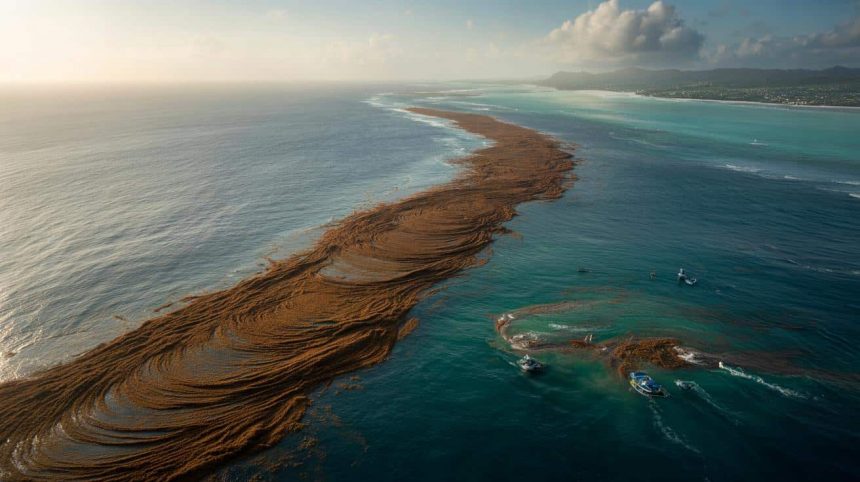
From the window of a small research plane, the Atlantic looks strangely dirty. Where you’d expect endless blue, a thick brown ribbon stretches from the Caribbean almost all the way to the coast of West Africa, like someone dragged a giant paintbrush across the ocean.
The pilot jokes that it’s “the world’s longest latte spill.” Nobody laughs for long.
Down below, that band of brown isn’t pollution in the usual sense.
It’s a vast trail of seaweed called sargassum, floating in dense mats, smothering beaches, choking marine life, and unsettling the rhythm of coastal towns that depend on clear water and tourists.

A stain that long doesn’t just appear.
It’s sending a message.
A continent-long brown ribbon on the ocean – and why it feels so wrong
The first time you see sargassum from above, it looks almost harmless.
Just drifting patches of caramel-colored seaweed, swirling lazily in turquoise water.
Then the scale hits you.
This “patch” is thousands of kilometers long, stretching like a shadow between the Atlantic and the African coastline, wide enough to track from space.
Satellite teams now call it the **Great Atlantic Sargassum Belt**, an unbroken brown smear that can span from the Gulf of Mexico to West Africa.
From the air, it feels like watching a slow-motion spill.
One nobody really knows how to stop.
On the ground, the story gets more personal.
In a small fishing village in Cabo Verde, people wake up to a smell that turns the stomach before breakfast has even started.
Overnight, the sea has pushed huge rafts of sargassum onto the shore.
The once-silver water is a muddy soup, clogged with tangled weed and trapped fish.
Boats can’t leave the harbor; propellers jam as soon as they try.
Tourists, who came for white sand and clear waves, take photos, pull a face, and quietly change their plans.
Hotels suddenly have to spend hours clearing shorelines with tractors and shovels.
Every new wave brings more brown.
Scientists say this belt isn’t totally new.
Sargassum has existed for thousands of years in a natural, relatively stable zone of the North Atlantic.
What’s different now is the size and behavior of the bloom.
Since around 2011, it has ballooned into something planetary, with floating islands thick enough to block light, disrupt oxygen levels, and scramble migration routes.
Warmer water, fertilizer runoff from rivers like the Amazon, and changing ocean currents are all feeding the growth.
A perfect recipe for *too much of a good thing*.
The brown ribbon has become a sort of oceanic mood ring.
And the mood isn’t calm.
How this giant seaweed belt quietly reshapes coasts, lives, and routines
Dealing with sargassum is oddly physical.
There’s nothing abstract about it when it piles up in front of your door.
On Mexico’s Caribbean shore, hotel workers roll out before sunrise with rakes, loaders, and wheelbarrows, trying to clear the beaches before the first sunburned guest appears.
Each new tide dumps fresh brown heaps that can weigh tons per kilometer of coast.

Some communities have started using floating barriers to keep the weed offshore and funnel it toward collection points.
Others compost it, or experiment with using it in bricks, biofuels, or animal feed.
It’s a daily battle between human schedules and ocean timing, and the ocean doesn’t care about check-in time.
We’ve all been there, that moment when you realize a “temporary problem” is becoming the new normal.
For coastal residents, that moment often comes with a whiff of rotten egg.
As sargassum decomposes, it releases hydrogen sulfide gas.
In small amounts, that’s just foul-smelling.
In heavy concentrations, it can irritate eyes, lungs, and trigger headaches, especially for kids and older people.
Families close windows even on hot nights.
Small businesses stress over cancellations every time a new satellite image warns of a big wave of weed arriving.
Let’s be honest: nobody really checks ocean forecasts every single day, until the day the beach stops looking like the brochure.
Some researchers try to keep the conversation grounded in hope.
They talk about adaptation, early warning tools, and potential economic uses for this unwanted biomass.
“Think of it as a climate-era resource falling out of the sky in the wrong place,” says a marine ecologist working between Senegal and Brazil. “We didn’t choose it, but we can choose how we respond.”
Beyond the lab, local leaders are quietly drawing up new playbooks:
- Build **rapid-cleanup teams** that can move in the hours after landfall.
- Set up community alerts when gas levels spike or big mats are approaching.
- Support fishermen with alternative gear or routes when traditional areas clog up.
- Invest in small-scale processing plants to turn collected sargassum into something useful.
- Share data across borders, because the brown belt ignores national lines.
The ribbon may be long, but the options are no longer just “watch and suffer.”
This brown ribbon is a warning line – and a mirror
Once you’ve seen the satellite image, it sticks in your mind.
A drawn-out brown streak across blue, connecting continents that already share so many invisible links.
It forces an uncomfortable question: what else is growing quietly, fed by our fertilizers, emissions, and habits, until it suddenly becomes visible from space?
Sargassum is dramatic because it smells and stains and shows up on holiday photos.
A lot of other shifts in the ocean don’t announce themselves that loudly.
The belt won’t just vanish next year.
Its size and route will wobble with currents, storms, and climate swings, but the underlying drivers are still on.
In a way, this is less about seaweed and more about a slow, honest conversation between coastlines and the changing planet that surrounds them.

The brown ribbon doesn’t shout.
It just stretches on, waiting to see what we decide to do next.
| Key point | Detail | Value for the reader |
|---|---|---|
| What the “brown ribbon” is | A vast belt of floating sargassum seaweed between the Atlantic and Africa | Gives context when you see dramatic photos or headlines about “algae invasions” |
| Why it’s growing so much | Warmer water, nutrient runoff from big rivers, shifting currents | Helps connect a visible problem on beaches with wider climate and land-use issues |
| How people respond | Beach cleanups, barriers, new uses for sargassum, early warning systems | Shows where solutions are emerging and how coastal communities are adapting |
FAQ:
- Question 1What exactly is sargassum, and is it toxic by itself?
- Answer 1Sargassum is a type of brown seaweed that floats naturally on the ocean surface. Fresh sargassum isn’t poisonous, but when large amounts pile up and rot, the gases released can irritate the eyes and respiratory system.
- Question 2Why has this giant brown belt become so visible in recent years?
- Answer 2Stronger blooms started showing up around 2011. Warmer waters, extra nutrients from river runoff, and changing Atlantic circulation all seem to boost growth and push the seaweed farther and wider across the ocean.
- Question 3Is the sargassum belt only a problem for tourists?
- Answer 3No. It affects fishermen, local businesses, coastal ecosystems, and even public health when decomposition gases build up. Tourism is just the most visible part of the story for people far away.
- Question 4Can this seaweed be used for something positive?
- Answer 4Yes, researchers and startups are testing ways to turn it into fertilizer, building materials, biofuels, and animal feed. The challenge is collecting and processing it safely without causing new pollution issues.
- Question 5Does the sargassum belt mean climate change is getting worse?
- Answer 5It’s one sign among many of a warming, more nutrient-rich ocean in some regions. The belt doesn’t “prove” everything by itself, but it lines up with broader trends scientists are tracking in the Atlantic.
Stay ahead with the latest updates!
Join The Podium Media on WhatsApp for real-time news alerts, breaking stories, and exclusive content delivered straight to your phone. Don’t miss a headline — subscribe now!
Chat with Us on WhatsApp