

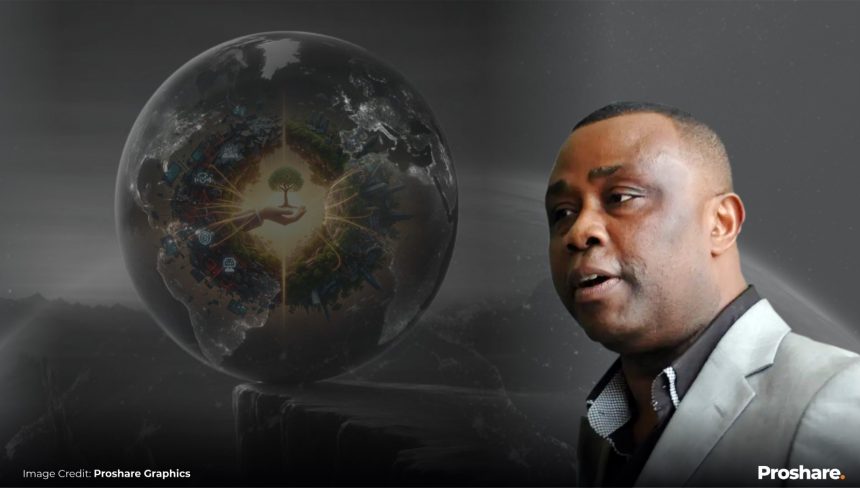
A strategic reading of global turbulence in the World Economic Forum’s Top Global Risks 2026 feels like another warning siren for the Global South. But Collins Nweke refuses the comfort of despair. Instead, he interrogates the risk map with strategic intent, recasting geopolitical tension, climate stress, technological disruption, and information disorder not as inevitabilities to endure, but as signals to read.
This essay makes a clear case: global risks are also market signals. For countries willing to act with foresight, discipline, and strategic non-alignment, today’s turbulence can unlock fresh opportunities in supply chains, energy transition, digital services, and post-conflict reconstruction. It is a call for agency over anxiety, and for repositioning the ‘Global South’ as a provider of solutions, not a passive casualty of global disorder.
The latest Global Risks outlook from the World Economic Forum paints a sobering picture of a world entering a period of elevated geopolitical tension, deepening geoeconomic confrontation, accelerating climate shocks, and intensifying information disorder.

At first glance, this appears like a catalogue of threats. But for the Global South, it can also be read as something else entirely: a forward-looking map of where global demand, capital flows, and strategic partnerships are shifting.
History teaches us that moments of systemic disruption rarely distribute costs and opportunities evenly. They punish countries that remain passive, but reward those that reposition early.
Viewing geoeconomic confrontation through the lens of collateral damage to the strategic bridge is imperative at this time in history for the Global South. Geoeconomic confrontation, topping the risk rankings, reflects a world in which trade, technology, finance, and industrial policy are now instruments of power.
For many developing economies, the danger is obvious: supply-chain fragmentation, sanctions spillovers, and forced alignment. Yet the opportunity is just as clear.
As companies diversify away from single-country dependence, new manufacturing, processing, and assembly hubs are needed. The ‘Global South’ can capture these flows by offering:
- Predictable regulatory environments
- Regional market access
- Competitive energy and labour costs
Rather than choosing sides, countries that master strategic non-alignment can become bridges between competing blocs. Neutrality, in this context, is not weakness; it is a commercial asset.
Armed Conflict and the Rise of the Peace Economy
State-based armed conflict remains a dominant risk, and conflict disproportionately harms developing regions. But post-conflict environments also generate large, sustained economic demand.
Reconstruction, housing, transport corridors, power systems, digital infrastructure, and humanitarian logistics together form what can be described as a ‘peace economy’.
Global South countries that invest in construction capacity, engineering services, and regional logistics platforms can position themselves not only as recipients of aid but as providers of reconstruction services across their regions.
Peace, in this framing, becomes both an industry and a moral imperative.
Climate Risk as Industrial Policy Trigger
Extreme weather and Earth systems stress are no longer distant environmental concerns. They are immediate economic variables.

Yet climate pressure is also redirecting trillions of dollars into:
- Renewable energy
- Battery and storage technologies
- Green hydrogen
- Climate-smart agriculture
- Adaptation infrastructure
For the Global South, the strategic shift must be from a climate vulnerability narrative to a climate solutions provider.
Countries that embed climate goals into industrial policy can simultaneously attract capital, build export capacity, and reduce long-term fiscal exposure.
Misinformation, Trust Deficits, and the Economics of Credibility

Misinformation and societal polarisation are often treated as political problems. Increasingly, they are economic ones. Investors price uncertainty. Tourists avoid instability. Skilled professionals emigrate from countries they no longer trust.
The opportunity lies in building credible institutions, transparent digital governance, and independent data ecosystems. Trust, once rebuilt, becomes a competitive advantage.
In a volatile world, credibility itself becomes a form of capital.
Technology Risks and the Possibility of Leapfrogging
Concerns about AI and cybersecurity reflect a fear of rapid technological change. For the Global South, however, technology remains one of the most powerful tools for leapfrogging. AI-enabled public services, digital health, smart agriculture, and online education platforms can dramatically expand access at relatively low marginal cost. The strategic error would be to remain mere consumers of imported technology. The opportunity is to become co-creators of context-specific digital solutions.
The Strategic Choice Before the Global South

The 2026 risk landscape signals a deeper truth: the era of automatic globalisation dividends is over. Returns will now accrue to countries that design a strategy, not those that simply open markets.
This means:
- Practising strategic non-alignment
- Building regional value chains
- Linking diplomacy to concrete economic outcomes
- Mobilising diaspora capital and expertise
- Measuring success in jobs, exports, and industrial depth
In the final analysis, Top Global Risks 2026 should not be read only as warnings. They should be read as signals of where the next phase of the world economy is being shaped. For the ‘Global South’, the choice is stark.
Remain positioned as the most exposed terrain of global turbulence or reposition as a platform for solutions in the energy transition, supply-chain diversification, digital services, and post-conflict reconstruction.
Those who read the world’s fears correctly will discover that inside today’s risks lie tomorrow’s markets.
Stay ahead with the latest updates!
Join The Podium Media on WhatsApp for real-time news alerts, breaking stories, and exclusive content delivered straight to your phone. Don’t miss a headline — subscribe now!
Chat with Us on WhatsApp